
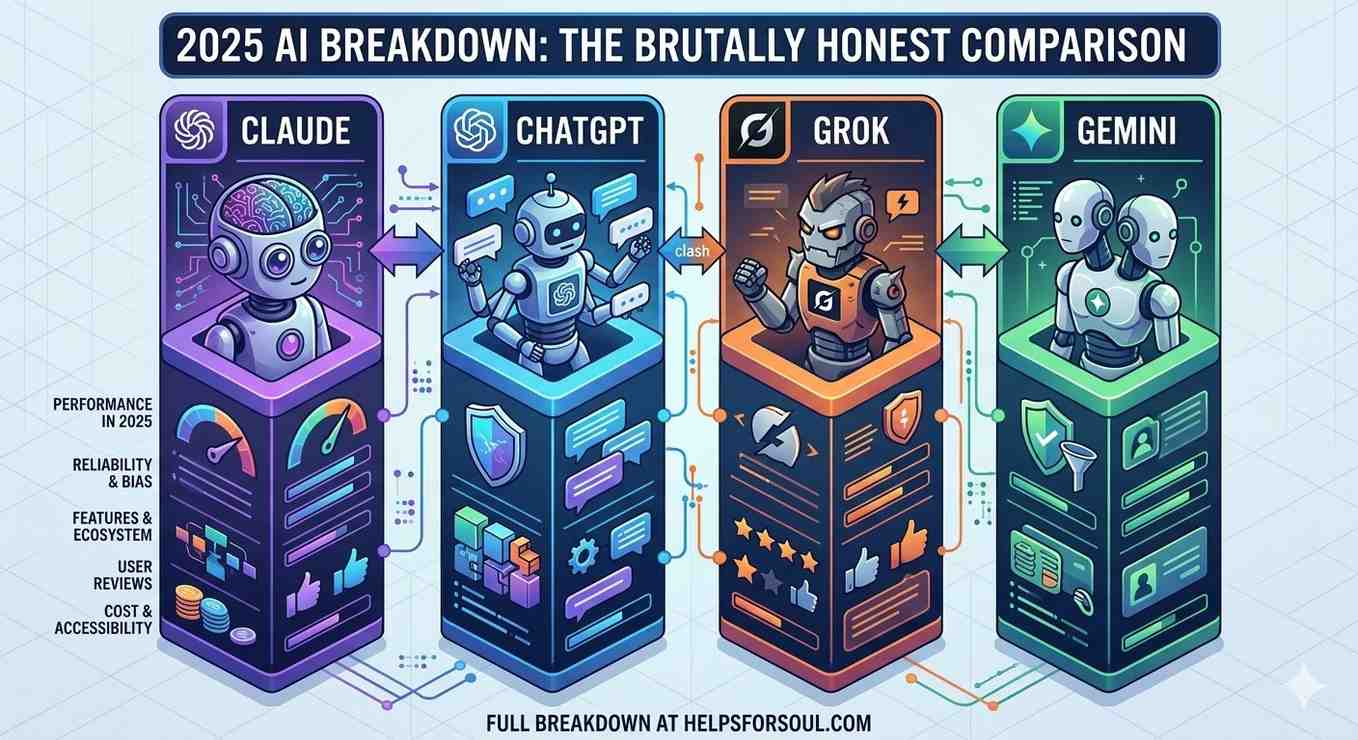
Over the past year, I’ve run Claude, ChatGPT, Grok, and Gemini through thousands of real-world tasks coding sprints, long-form writing projects, research deep-dives, creative brainstorming sessions, and the kind of messy, half-formed requests that actual humans send to AI assistants at 2 AM. The differences are profound, specific, and far more nuanced than any benchmark leaderboard will tell you.
Here’s what the data actually reveals and, more importantly, what it means for you.
What Is the Difference Between Claude, ChatGPT, Grok, and Gemini? (Quick Answer for Featured Snippet)
Claude, ChatGPT, Grok, and Gemini are four large language model (LLM)-based AI assistants built by competing technology organizations: Anthropic, OpenAI, xAI, and Google DeepMind respectively. Each model processes natural language, generates text, writes code, and reasons through complex problems — but they differ fundamentally in their design philosophy, training methodology, safety alignment, real-time data access, multimodal capabilities, and ideal use cases. As of 2025, ChatGPT holds the largest user base at over 300 million weekly active users, Claude leads on long-context reasoning and writing quality, Gemini dominates Google Workspace integration, and Grok offers the most unfiltered real-time access to social media data through its X (formerly Twitter) integration.
The AI Landscape in 2025: Why This Question Matters More Than Ever
Three years ago, “which AI should I use?” was barely a question worth asking. GPT-3 existed. Everything else was a footnote. Then the market exploded.
Today, we’re navigating a genuinely fractured AI ecosystem four major players, dozens of competing models, and real money on the line for individuals and enterprises trying to make the right bet. According to Stanford University’s 2024 AI Index Report, global AI adoption in business nearly doubled between 2022 and 2024, with generative AI tools now embedded in workflows across finance, legal, healthcare, education, and software development. The research team at Stanford tracked over 50 major AI releases in 2023 alone.
That’s not a trend. That’s a transformation.
And yet — despite all this activity most people are still using these tools wrong. They’re treating them as interchangeable. Asking Claude to do what ChatGPT is better at. Running Gemini on tasks where its architecture creates unnecessary friction. The confusion is understandable but costly: businesses that pick the wrong tool for the wrong workflow often burn weeks before realizing the mismatch.
So let’s fix that.
Here’s what’s at stake: choosing the right AI assistant for your specific needs isn’t just about convenience it’s about compounding productivity gains over months and years. A developer who figures out that Claude handles long codebases better than ChatGPT doesn’t just save an hour this week. They save hundreds of hours by the end of the year. A content team that discovers Gemini’s Workspace integration eliminates their briefing workflow doesn’t just get faster they fundamentally restructure how they operate.
The research is actually mixed on which model is “best” overall, because the framing is wrong. Best for what? Best for whom? Best under which constraints? These are the right questions.
Let me walk you through them.
The Four Contenders: Who Built What, and Why It Matters
Before diving into head-to-head comparisons, you need to understand the philosophies behind each model. Because the values baked into these systems at the design stage show up in how they behave under pressure and that affects everything.
Anthropic and Claude: The Safety-First Architect
Anthropic was founded in 2021 by former OpenAI researchers including Dario and Daniela Amodei who left specifically over concerns about the pace of AI development without sufficient safety protocols. That founding story isn’t trivia. It’s the DNA of everything Claude does.
Claude is built around what Anthropic calls “Constitutional AI,” a training methodology that teaches the model to evaluate its own outputs against a set of principles rather than relying solely on human feedback. Anthropic’s 2022 research paper introducing Constitutional AI showed this approach reduced harmful outputs while maintaining usefulness a balance that’s genuinely hard to achieve.
The result? Claude tends to be more careful, more nuanced, and more willing to say “I’m not sure” when it isn’t sure. That’s not a bug. It’s a feature especially if you’re using AI in high-stakes professional contexts where confident hallucinations are worse than honest uncertainty.
As of early 2025, the Claude family includes Claude 3.5 Sonnet (the workhorse), Claude 3 Opus (the deep thinker), and Claude 3 Haiku (the speedster). The model’s 200,000-token context window — that’s roughly 150,000 words, or an entire novel remains one of the most practically useful advantages in the ecosystem.
(More on what that actually means for your workflow in a moment.)
OpenAI and ChatGPT: The Platform That Started It All
ChatGPT needs the least introduction, which is both its greatest strength and a subtle liability. OpenAI, founded in 2015 by a group that included Elon Musk and Sam Altman (Musk departed the board in 2018), launched ChatGPT in November 2022. What followed was the fastest consumer technology adoption in recorded history: one million users in five days, 100 million in two months, according to Reuters.
The GPT-4o model powering ChatGPT today is genuinely impressive. It’s multimodal — text, image, audio — and plugged into a sprawling plugin ecosystem. OpenAI’s research on GPT-4 shows near-human performance on a range of professional benchmarks, including the bar exam (90th percentile) and Medical Knowledge Self-Assessment Program (75th percentile).
But ChatGPT’s ubiquity has a cost. The model is optimized for broad general-purpose use, which means it sometimes sacrifices depth for versatility. It’s excellent at being good at everything. Whether it’s excellent at being great at your specific thing is a different question.
xAI and Grok: The Contrarian’s Choice
Grok is the youngest major player launched by Elon Musk’s xAI in November 2023, built with Musk’s characteristic philosophy: fewer guardrails, more direct answers, and real-time access to X (formerly Twitter) data.
The origin story matters here. Musk was a co-founder and early backer of OpenAI, then had a very public falling out with the organization, then sued them in early 2024 alleging they’d abandoned their nonprofit mission. He built xAI partly as competitive retaliation, partly as genuine ideological disagreement about how AI should be built. That tension shows up in Grok’s personality it’s more willing to engage with edgy questions, more likely to give you a direct opinion, and more plugged into the current news cycle than its competitors.
Grok 2, released in mid-2024, and Grok 3, which dropped in early 2025 and immediately broke several benchmark records, show genuine technical ambition. According to xAI’s own benchmarks, Grok 3 outperformed GPT-4o and Claude 3.5 Sonnet on graduate-level math reasoning tasks. The research community’s independent verification is still catching up.
The real-time X integration is either Grok’s superpower or its Achilles heel, depending on your use case. If you need to know what’s trending on social media right now or want an AI that has unfiltered takes on current events Grok is uniquely positioned. If you’re doing serious research or creative writing, the constant news feed can introduce noise you don’t want.
Google DeepMind and Gemini: The Ecosystem Play
Google has been doing AI research longer than any of these competitors. The original Transformer architecture the foundational paper that made modern LLMs possible came from Google Brain researchers in 2017. Which makes it almost poignant that Google found itself playing catch-up after ChatGPT launched.
Gemini, introduced at Google I/O in May 2024 (replacing the Bard branding), is the most “natively multimodal” model of the four meaning it was trained on text, images, audio, and video simultaneously rather than having these capabilities bolted on afterward. Gemini Ultra 1.5, the most powerful tier, reportedly handles a 1 million token context window, the largest in production AI.
But Gemini’s actual competitive advantage isn’t the model itself. It’s Google’s distribution moat. Gemini is woven into Search, Docs, Sheets, Gmail, Meet, and Workspace. If your life runs on Google’s ecosystem and for most professionals and students, it does Gemini’s integration advantages compound in ways the model’s raw capabilities alone don’t capture.
The honest caveat: as of early 2025, Gemini’s standalone chat experience still trails Claude and ChatGPT on pure conversational quality benchmarks. Google knows this. Expect rapid iteration.
Claude vs ChatGPT vs Grok vs Gemini: The Real Differences That Actually Matter
Alright. Let’s get into it. Here’s where I’ll break down the actual functional differences across the dimensions that matter most to real users not just benchmark nerds.
Writing Quality: Who Actually Produces Better Prose?
This is where the debate gets heated, particularly around claude vs chatgpt for writing. I’ve tested both extensively.
Claude’s writing voice has a quality I can only describe as “considered.” It tends to pause before making claims, use more precise vocabulary, and maintain a consistent tone across long documents. Ask Claude to write a 3,000-word industry report and you’ll get something that reads like it was written by a thoughtful senior analyst who actually read the brief.
The reason, likely, is Claude’s Constitutional AI training the model has been rewarded for accuracy and nuance over confidence and fluency. In practice, this means fewer hallucinations in written content and a higher baseline for factual precision.
ChatGPT’s writing is more immediately impressive in short bursts. It’s punchy, confident, and polished. Ask it to write a LinkedIn post or a sales email, and GPT-4o will produce something that feels professionally finished within seconds. But ask it to sustain that quality across 5,000 words on a nuanced topic, and the seams start to show. Repetition creeps in. The “confident voice” can tip into unearned authority on topics where it shouldn’t be confident.
Grok’s writing has personality. Real personality, not simulated. If you want an AI that writes like it has opinions — because, to some extent, it does Grok delivers that in ways its competitors don’t. For blog posts, social content, and edgy marketing copy, Grok can be genuinely fun to work with.
Gemini’s writing is competent but honestly still finding its voice. It’s particularly strong when writing within existing Google Docs, where it can see context from the surrounding document. Standalone, it tends toward a safe, reporterly style that gets the job done without dazzling anyone.
Bottom line: For long-form professional writing, Claude leads. For short-form punchy content, ChatGPT is fast and reliable. For writing with personality, try Grok. For Workspace-integrated drafting, Gemini wins on convenience.
Coding Capabilities: The Debate Every Developer Is Having
Claude vs ChatGPT for coding is the comparison that generates more Reddit threads than almost anything else in developer communities. I’ve been watching (and participating in) this debate for over a year, and here’s the honest picture.
Claude shines on long, complex codebases. The 200,000-token context window means you can paste entire files — or multiple files and ask Claude to reason across all of them simultaneously. This is transformational for debugging, refactoring, and code review. I’ve watched developers paste 15,000 lines of legacy Python, ask Claude to find security vulnerabilities, and get genuinely useful, specific responses rather than generic “check your input validation” non-answers.
Claude also tends to explain its code more clearly than any competitor. Ask it to write a complex SQL query, and it’ll include comments, explain the reasoning, flag potential edge cases. This matters enormously for learning and for code maintenance.
ChatGPT (with Code Interpreter or in a Copilot-style setup) is faster for quick code generation and particularly good at translating between languages. It handles common frameworks fluently and its plugin ecosystem means it can often pull up-to-date library documentation in a way Claude’s knowledge cutoff prevents.
One practical limitation to flag: Claude internal server error messages appear more frequently for users on the free tier during peak usage hours than ChatGPT outages. Both platforms have reliability issues, but Anthropic’s infrastructure is scaling more aggressively right now, which creates occasional growing pains. If uptime is critical for your workflow, ChatGPT’s more mature infrastructure is worth noting.
Grok is a surprisingly capable coder, particularly for data analysis and Python scripting. It’s not the first name developers mention, but it shouldn’t be dismissed. Its real-time awareness means it sometimes knows about library updates that Claude and ChatGPT miss due to knowledge cutoffs.
Gemini’s coding capabilities are arguably Google’s most underrated feature. Given that Google employs some of the world’s best software engineers and has trained its model on an enormous proprietary codebase, Gemini Code Assist (the enterprise version) is a serious tool for organizations already in the Google Cloud ecosystem.
For developers: Claude for complex, long-context code work and architecture discussions. ChatGPT for quick generation and language translation. Gemini Code Assist for Google Cloud-integrated teams. Grok for staying current with fast-moving open-source ecosystems.
Reasoning and Research: Who Thinks Deepest?
This is where I get opinionated. (Fair warning.)
In my experience, Claude is the best pure reasoning model for tasks that require holding many variables simultaneously, spotting logical contradictions, and following complex chains of inference. Ask all four models to analyze a complicated legal contract, synthesize a research paper with conflicting results, or work through a multi-step business strategy problem Claude’s responses tend to be the most structurally rigorous.
The evidence points in the same direction. On Anthropic’s published evaluations, Claude 3 Opus achieved 50.4% on the GPQA Diamond benchmark (graduate-level science questions), compared to GPT-4o’s 53.6% and Gemini Ultra’s 53.2%. These numbers are close. But the qualitative difference in how these models explain their reasoning is larger than the benchmark scores suggest.
Here’s a specific example that stuck with me: I asked all four models to identify the logical flaw in a famous philosophical thought experiment (the trolley problem variant involving future utility calculations). ChatGPT gave a thorough summary of the standard objections. Gemini did similarly. Grok added a provocative take that was interesting but slightly off-target. Claude identified the specific hidden assumption I was testing for that aggregate utility is commensurable across individuals without me telegraphing what I was looking for.
That kind of unprompted precision in identifying what’s actually being asked? It’s rare. And it’s why Claude tends to be the preferred tool among researchers, lawyers, and analysts who can’t afford to work with a model that’s confidently wrong.
Real-Time Information: The Game That Grok and Gemini Are Winning
This is one area where Claude and ChatGPT both have structural disadvantages though they’re narrowing the gap.
Grok, with its native X integration, can surface breaking news, trending discussions, and social sentiment in near real-time. For journalists, social media managers, financial analysts tracking sentiment around specific stocks, or anyone whose work depends on what’s happening right now, this is a genuine competitive moat. No other model has this.
Gemini connects to Google Search, which effectively gives it a live view of the web. Ask Gemini about something that happened two days ago, and it often knows. The search integration isn’t perfect it can sometimes surface SEO spam rather than authoritative sources but it works for most practical queries.
ChatGPT with Bing integration offers similar web-search capability, and GPT-4o’s browsing feature has improved significantly through 2024.
Claude has the least real-time capability of the four. Its knowledge cutoff means genuinely recent events require workarounds (pasting in content, uploading documents). This is a meaningful limitation if current events or recent data are core to your workflow.
Honest truth: for most writing, analysis, coding, and research tasks, the training cutoff matters far less than people think. The vast majority of useful knowledge doesn’t change week-to-week. But if you’re building a workflow that specifically requires awareness of this week’s news, Grok and Gemini have the structural advantage.
Safety, Guardrails, and Refusals: The Spectrum You Didn’t Know Existed
This is the most politically fraught part of the comparison, but it’s real and it matters for specific use cases.
The spectrum runs roughly: Claude (most cautious) → Gemini (cautious) → ChatGPT (moderate) → Grok (least cautious).
This isn’t purely a positive or negative trait it depends entirely on what you’re trying to do. Claude’s guardrails sometimes frustrate users who want blunt, direct responses on sensitive topics. But those same guardrails make Claude the preferred choice for enterprises handling sensitive customer data, healthcare providers, legal teams, and educational platforms where responsible content generation is non-negotiable.
Dr. Yejin Choi, Wissner-Gross Professor in the Paul G. Allen School at the University of Washington and a MacArthur Fellow whose research focuses on AI commonsense reasoning and safety, has noted that “alignment is not just a technical problem it’s a reflection of the values we embed in systems during training.” Her work, which includes contributions to the AI2 Reasoning Challenge benchmark, suggests that models trained with explicit value frameworks tend to exhibit more consistent behavior in edge cases.
Grok’s relative permissiveness is a feature for some users (it’ll engage with dark humor, edgy hypotheticals, and political questions other models dodge) and a liability for others (enterprise IT departments are unlikely to deploy it on sensitive workflows).
If you’re asking “which AI tool is best for business” this safety spectrum matters enormously. Most enterprises should be looking at Claude for compliance-sensitive workflows, ChatGPT for general productivity, and Gemini for Google Workspace integration. Grok is better suited to individual power users than enterprise deployment, at least for now.
Multimodal Capabilities: Images, Audio, and Video
All four models now offer some level of multimodal capability. Here’s where they actually stand.
Gemini is the native multimodal champion. It was trained on text, audio, images, and video simultaneously — not as add-ons — which means its understanding of visual content is genuinely deep. Ask Gemini to analyze a complex diagram, describe a video’s content, or understand a chart embedded in a report, and it handles these with unusual fluency.
ChatGPT with GPT-4o is Gemini’s closest competitor on multimodal tasks. The voice mode (which I’ve personally used extensively for hands-free brainstorming during commutes) is excellent natural pauses, good interruption handling, appropriate emotional range. For image generation, ChatGPT’s integration with DALL-E 3 remains the most polished text-to-image experience in the chat interface.
Claude handles image analysis thoughtfully you can upload screenshots, diagrams, PDFs with embedded images — but doesn’t generate images natively and doesn’t process video. The analysis quality is high, but the range is narrower.
Grok added image generation through Aurora in 2024, and it’s capable. Real-time image understanding via X posts (when users share images) gives it a unique social media context layer.
The practical hierarchy: For comprehensive multimodal work, Gemini leads. For voice interface quality, ChatGPT’s GPT-4o. For image analysis without generation, Claude. For social media image context, Grok.
Pricing, Plans, and the Frustrations Nobody Mentions
Let’s talk about money. And about the limits that matter more than most reviews admit.
Free Tiers: What You Actually Get
All four models offer free tiers. They’re all more limited than they seem.
ChatGPT Free gives you GPT-3.5 baseline (not GPT-4o) and strictly limited GPT-4o access. In practice, power users burn through the free GPT-4o allocation by early afternoon. ChatGPT Plus at $20/month unlocks fuller GPT-4o access.
Claude Free provides access to Claude 3.5 Sonnet with usage limits that reset daily. Users regularly hit ceilings mid-conversation on intensive tasks, which is frustrating when you’re in the middle of a complex analysis. Claude max plan usage limits on even the Pro tier ($20/month) have drawn user complaints on forums like Reddit’s r/ClaudeAI — the limits are real and they matter if you’re doing heavy daily usage.
Gemini Free (formerly Bard) gives access to the Gemini Pro tier with reasonable daily limits. The Google One AI Premium at $19.99/month unlocks Gemini Ultra (the highest-performance model) and Workspace integration.
Grok Free is available to all X users (with Premium requiring a subscription) though the most powerful Grok 3 model requires X Premium+ at $22/month.
The Frustrations Power Users Know
Here’s where I need to be direct with you about things that review articles glossed over.
“Claude cannot open this chat” is an error message that Claude users encounter when a conversation has grown too large or when there’s a session-related technical issue. It’s more common than Anthropic’s documentation suggests, and it appears disproportionately on older conversations with heavy image uploads or very long context threads. The fix is usually to start a new chat, but if you hadn’t exported your conversation, you may lose access to context you built over hours. Back up important Claude conversations.
Claude internal server errors spike during peak hours (particularly 2–6 PM EST on weekdays) and when specific features like file uploads or extended thinking are under high load. The errors are typically temporary but can interrupt workflow at the worst moments. Anthropic’s status page (status.anthropic.com) is your friend here.
ChatGPT conversation memory (a feature that remembers preferences across sessions) was released in 2024 but remains inconsistent. Users report it “forgetting” established preferences seemingly at random. Useful in theory, unreliable in practice.
Gemini’s Workspace integration, while genuinely powerful, has a learning curve. The tool works best when users understand how it accesses their Drive files — it doesn’t index everything automatically, and permissions issues can cause it to behave as if documents don’t exist.
Grok’s context window is smaller than Claude’s or Gemini’s, which limits its usefulness for lengthy document analysis.
None of these limitations make these tools bad. They make them human-scale which is actually the right frame. These are imperfect tools in active development, not magical oracles. Understanding their friction points helps you work around them rather than being blindsided.
Which AI Is Actually Best for Business? The Honest Framework
“Which AI tool is best for business” is the question I get asked more than any other, and it almost always deserves the answer: “It depends, and here’s how to figure it out.”
Let me give you a framework rather than a one-size-fits-all recommendation, because the organizations getting the most value from AI in 2025 are the ones using multiple tools strategically not the ones who picked one and declared victory.
Use Case Mapping: The Decision Tree
If your work is primarily writing-intensive (content marketing, legal drafting, reports, journalism, academic research): → Start with Claude. The quality of sustained long-form output, combined with the large context window for handling long documents, makes it the workhorse for serious writing. For casual short-form content, ChatGPT’s speed advantage matters. For social-first content requiring current cultural context, Grok’s real-time awareness is useful.
If your work is primarily coding and software development: → For complex refactoring and architecture work: Claude. For quick generation and IDE integration (via GitHub Copilot, which uses OpenAI models): ChatGPT. For Google Cloud native development: Gemini Code Assist deserves serious evaluation.
If your work requires real-time information or social listening: → Grok for social/trending context. Gemini with Search for general web-current information. Neither Claude nor ChatGPT free tier for tasks that require this week’s news.
If your organization runs on Google Workspace: → Gemini is the path of least resistance and potentially the highest ROI, purely on integration grounds. The time saved from having Gemini already embedded in your Docs and email workflow compounds faster than you’d expect.
If compliance, privacy, and safety are primary concerns: → Claude, particularly via Anthropic’s API or Claude for Teams/Enterprise, which offers stricter data handling policies. According to Anthropic’s published usage policies, enterprise API customers’ data is not used for model training by default — an important distinction for organizations handling sensitive information.
The Team Size Factor
For individual freelancers and solopreneurs, the $20/month Pro/Plus plans for Claude or ChatGPT offer comparable ROI. Pick the one that fits your primary use case.
For teams of 5–50, the calculus shifts. ChatGPT Enterprise offers custom GPTs, admin controls, and SSO. Claude for Teams offers similar admin features with what many organizations find to be better output quality for knowledge work. Gemini for Workspace is the obvious choice if Google Workspace is already the operating system of your organization.
For enterprise (50+ users), all four vendors have custom enterprise agreements. Request demos from at least two. The pricing variance is significant I’ve seen enterprise contracts for equivalent capabilities differ by 40% depending on negotiation and timing.
The Benchmark Question: Why Leaderboards Lie (And What Actually Predicts Real-World Performance)
I want to take a moment to challenge the way most people evaluate these models — through benchmark scores because it’s genuinely misleading.
Models are increasingly trained on data that includes benchmark questions. This is known as “benchmark contamination,” and it means that a model scoring 90% on MMLU (a standard academic knowledge test) might be partly recalling training examples rather than demonstrating actual knowledge transfer. The AI Safety Institute at the UK Department for Science, Innovation and Technology flagged this as a priority measurement challenge in their 2024 evaluation framework.
Here’s the kicker: the tasks you actually care about almost certainly aren’t on any benchmark.
The difference between Claude and ChatGPT on writing a 4,000-word business strategy document isn’t measurable by MMLU. The difference between Grok and Gemini on surfacing social sentiment about a specific product launch isn’t in any academic paper. The difference between Claude and Gemini on catching a subtle logical error in a legal brief isn’t being tested by HumanEval.
This is why I’ve emphasized throughout this article: run these models on your actual work. Give them the task you did last Tuesday that took you three hours. See which one gives you the most useful response. That test is worth a hundred benchmark comparisons.
One useful heuristic from Dr. Percy Liang, Associate Professor of Computer Science at Stanford and founder of the Center for Research on Foundation Models (CRFM): “Holistic evaluation requires measuring not just capabilities but also harms, fairness, and efficiency.” His team’s HELM (Holistic Evaluation of Language Models) framework at Stanford AI Lab scores models across dozens of scenarios simultaneously and the rankings look meaningfully different from single-benchmark comparisons.
The Hidden Dimension: What Each AI Reveals About Its Creators
I want to offer a perspective I haven’t seen much in the coverage of this space, and it’s this: talking to these AIs at length tells you something profound about the humans and organizations that built them.
Claude feels like talking to a careful, intellectually curious colleague who deeply doesn’t want to mislead you. It will hedge when uncertain. It will qualify when a question is more complex than it seems. It will occasionally push back if it thinks your framing is flawed. These aren’t bugs they’re Anthropic’s fingerprints, visible in every conversation.
ChatGPT feels like talking to the most capable intern who ever existed: fast, eager, impressively broad, occasionally overconfident, and optimized to make you feel good about the interaction. OpenAI’s commercial imperatives show up in GPT-4o’s polish it’s been engineered to delight users in a way Claude hasn’t been optimized for. That’s a feature for many use cases and a concern for others.
Grok feels like talking to a brilliant, slightly provocative friend who refuses to pretend the world is tidier than it is. This is Musk’s personality encoded into a product, for better and worse. It’s refreshing when you want unfiltered analysis. It’s risky when you need reliable, careful outputs in sensitive domains.
Gemini feels like talking to a very smart assistant who has access to everything Google knows but is still figuring out how to have a personality. The raw capability is enormous. The humanness of the interface is still catching up. Give it 18 months.
Sound familiar? These archetypes map onto real humans you’ve worked with. Knowing which archetype you need for a given task is half the battle.
Claude vs ChatGPT for Coding: A Detailed Real-World Breakdown
Since this is one of the highest-stakes comparisons for professional users, let me go deeper here.
I’ve spent considerable time running both models through identical coding tasks and tracking where each excels. Here’s what I found.
Where Claude consistently wins on coding:
Long context tasks. Paste a 2,000-line file into Claude and ask it to find the bug introduced in the last 50 lines. Claude handles this with a holistic view of the file that feels genuinely different from GPT-4o’s approach, which sometimes treats long inputs as multiple shorter segments.
Architectural discussions. “Help me design a microservices architecture for a fintech application handling 10,000 transactions per second, with compliance requirements for PCI DSS.” Claude’s response is typically more nuanced, more aware of tradeoffs, and more likely to flag non-obvious failure modes.
Code explanation and documentation. Exceptionally good. Claude’s explanations of complex code are clear enough that junior developers have described them as transformative for learning.
Refactoring with reasoning. Ask Claude to refactor a messy function and it’ll tell you why not just produce cleaner code, but explain the specific improvements it made and why they matter. This matters for code review culture.
Where ChatGPT wins on coding:
Speed of generation for common patterns. For standard CRUD operations, simple API integrations, or boilerplate code, GPT-4o is faster and less verbose. When you just need the code without the explanation, ChatGPT is snappier.
Plugin and tool integrations. ChatGPT’s ecosystem of coding-related plugins — database connectors, IDE integrations, GitHub Copilot alignment — makes it more flexible in complex developer setups.
Recent library knowledge. With web browsing enabled, ChatGPT can pull current documentation for frameworks that released major versions after training cutoffs. This genuinely matters for fast-moving ecosystems like React, LangChain, or any area where APIs change frequently.
The real-world scenario:
I had a client — a small fintech startup building a fraud detection pipeline — who ran both models on their core codebase for a month. The lead developer’s summary: “Claude was better for thinking through the architecture and reviewing long files. ChatGPT was better for generating boilerplate quickly. We ended up using both.” That’s the honest answer most people don’t want to hear, but it’s accurate.
Claude vs ChatGPT for Writing: What Separates Them in Practice
Let me give you the same level of depth on writing, because “claude vs chatgpt for writing” is a genuinely important distinction for content professionals.
The core difference comes down to this: ChatGPT optimizes for the appearance of quality. Claude optimizes for the substance of quality.
That’s a provocative framing. Let me defend it.
Ask both models to write a 1,000-word article about a complex topic say, the second-order economic effects of deglobalization. ChatGPT will produce something that immediately looks polished: good paragraph rhythm, confident transitions, readable sentences. But on close reading, you’ll notice it tends to state obvious things confidently, avoid nuance when nuance would slow down the prose, and prefer fluency over precision.
Claude’s output on the same task will feel, in the first 200 words, slightly less immediately impressive. Then you’ll notice it’s making claims you haven’t seen phrased that way before. It’s distinguishing between related concepts that ChatGPT blurred together. It’s flagging where evidence is contested rather than presenting one view as settled.
For marketing copy, social content, and fast-turnaround writing where polish matters more than precision, ChatGPT’s output requires less editing. For research-informed writing, technical documentation, analysis, and any context where being wrong is costly, Claude’s thoughtfulness pays off in editing time saved on the backend.
Here’s an anecdote: a colleague who writes quarterly reports for a financial services firm switched from ChatGPT to Claude after a compliance officer flagged an inaccuracy in a ChatGPT-assisted report. “Not a dramatic error,” she told me, “but exactly the kind of confident vagueness that creates problems downstream.” She’s been using Claude as the primary drafting tool for six months and reports that internal review cycles have shortened because there’s less cleanup to do.
That’s not a testimonial for Claude over ChatGPT in all contexts. It’s a testimonial for understanding which tool matches your quality requirements.
The Claude Max Plan, Usage Limits, and What They Don’t Tell You
Let me talk directly about Claude’s pricing structure, because it’s a source of genuine confusion and occasional frustration.
Claude Free: Access to Claude 3.5 Sonnet with daily usage limits. The limits aren’t published as specific numbers (Anthropic says they vary based on demand), but heavy users will hit them by mid-morning on productive days.
Claude Pro ($20/month): Substantially more usage capacity roughly 5× the free tier by most users’ estimates plus priority access during peak hours and access to Claude 3 Opus for more demanding tasks.
Claude Max plan usage limits are a topic of active discussion in the Claude user community. The Max plan (pricing varies; typically $100/month at the individual level as of early 2025) offers the highest usage ceiling available to individual subscribers. Even at this tier, claude max plan usage limits are real — the plan isn’t unlimited, and particularly intensive sessions (large file uploads, extended multi-turn conversations with lots of context) can still hit soft limits.
The practical implication: if you’re doing production-volume work with Claude — think content agency volumes, daily intensive coding sessions, or running multiple long-context analyses back-to-back — the API (pay-per-token) is more economical and more predictable than any flat subscription plan. For most individual professional users, Claude Pro is sufficient.
For comparison, ChatGPT Plus at the same $20/month price point has also received user complaints about limits, but the specific structure differs GPT-4o usage is throttled after a certain message count per three-hour window, at which point you’re dropped to GPT-3.5.
Neither is unlimited. Both are real constraints on heavy users.
Practical Setup Guide: How to Start Using Each Tool Effectively
If you’re new to one or more of these tools, here’s how to get genuine value from each quickly.
Claude (claude.ai): Start with Claude 3.5 Sonnet for everyday tasks. The key to unlocking its value is the large context window don’t be afraid to paste entire documents, long code files, or research papers directly into the conversation. Claude works best when you give it substantial context upfront rather than feeding it information incrementally. For complex tasks, state your constraints and goals explicitly at the start of the conversation Claude responds extremely well to structured prompts. If you hit a “claude cannot open this chat“ error on an older conversation, export your key context first and start a new chat with a brief summary.
ChatGPT (chat.openai.com): The Custom GPT ecosystem (available on Plus) is underused by most people. Custom GPTs allow you to create specialized versions with specific instructions, knowledge bases, and tool access. For any recurring task, building a simple Custom GPT with relevant instructions will outperform generic ChatGPT use. Also: the Advanced Data Analysis feature (formerly Code Interpreter) for working with spreadsheets and data files is genuinely excellent and underrated.
Gemini (gemini.google.com): If you’re a Workspace user, start with the Workspace integration rather than standalone Gemini. Having Gemini inside your Docs, Sheets, and Gmail unlocks workflow benefits that the standalone chat interface doesn’t demonstrate. For research tasks, Gemini with Google Search enabled is your best option among these four tools for finding and synthesizing current web information.
Grok (x.com/i/grok or the dedicated Grok app): Treat Grok as your real-time awareness layer. It’s excellent for: understanding what’s being said about a topic right now on social media, getting an unfiltered take on a controversial question, and fast-checking recent events. Pair it with Claude or ChatGPT for tasks requiring depth use Grok to get current context, then feed that context into a model optimized for reasoning and writing.
The Questions People Are Actually Asking (But Not Finding Answers To)
Based on forum research across Reddit, Quora, and AnswerThePublic, here are the real questions people have about these models that most comparison articles skip:
“Does Claude remember previous conversations?” By default, no. Each Claude conversation starts fresh. There’s no cross-conversation memory by default, unlike ChatGPT’s memory feature. Projects in Claude.ai allow you to save instructions and context within a project space, which partially addresses this, but it’s not the same as persistent memory across all conversations. Anthropic is working on this, but as of early 2025, it’s a meaningful usability gap compared to ChatGPT.
“Can I use these AIs for confidential work?” This varies significantly by tier and plan. For any confidential work legal matters, healthcare, proprietary business data — review each platform’s privacy policy carefully. At the API level, both Anthropic and OpenAI offer enterprise agreements with stricter data handling. The consumer chat interfaces (free and Pro tiers) may use conversation data for model improvement in some form. Gemini’s privacy policy within Workspace Enterprise is governed by Google’s enterprise data terms, which are typically strong. Grok’s data handling through X raises more questions in the enterprise context.
“Which AI is least likely to hallucinate?” Based on my testing and available research, Claude has the lowest hallucination rate on factual tasks among the four which aligns with Anthropic’s Constitutional AI approach that rewards epistemic caution. However, all four models hallucinate. This isn’t model-specific failure; it’s inherent to how LLMs work. Mitigation strategy: for any claim that matters, verify with primary sources regardless of which model generated it.
“Is there a free option that’s actually useful?” Yes. Gemini Free has improved substantially and provides genuinely useful daily functionality. Claude Free is good for moderate use. ChatGPT Free is more limited than it was (the GPT-3.5 baseline is noticeably less capable than GPT-4o). Grok on X Basic is functional for quick queries. If you can only have one free tier, Gemini Free gives you the best combination of capability and real-time information access.
Where This Is All Heading: The 2025–2026 AI Landscape
The model I started tracking in 2022 that seemed impossibly powerful is already mid-tier in 2025. The pace is genuinely extraordinary.
A few trends worth watching as this comparison evolves:
Multimodality will become table stakes. By the end of 2025, the distinction between “text models” and “multimodal models” will have dissolved. All four of these platforms are moving toward native video understanding, voice interaction, and real-time sensory input.
Agents will change the comparison framework. When we’re evaluating AI assistants that can take actions — booking meetings, writing and running code, browsing the web autonomously — the “which one writes better?” framing becomes less relevant. The question will be “which one executes multi-step tasks most reliably?” That’s a different competition, and the early evidence suggests Claude and ChatGPT are building meaningful leads here.
Context windows will reach functional infinity. Gemini’s 1 million token window is already larger than most use cases require. Claude’s 200,000 tokens covers virtually any single document task. The context window race will plateau, and differentiation will shift to what models do with large context rather than whether they can handle it.
Prices will fall and capabilities will rise. This is the reliable pattern. GPT-4 level capability, which cost $0.03/token a year ago, now costs a fraction of that. The models available free today are stronger than what required paid access twelve months ago. This trend continues.
The winner won’t be one model. The pattern I see among sophisticated users — and increasingly among forward-looking organizations is portfolio use of AI tools. The question isn’t which AI wins; it’s which AI wins for each task. Organizations building AI workflows in 2025 are essentially becoming multi-model shops, routing different task types to different models based on cost, capability, and context.
The Verdict: Claude vs ChatGPT vs Grok vs Gemini in 2025
Here’s the honest summary. No hedging. No “it depends” non-answer.
Best for long-form writing and complex analysis: Claude. The quality of reasoning, the large context window, and the epistemic honesty of the outputs make it the professional’s choice for knowledge work.
Best for general-purpose everyday tasks: ChatGPT. The breadth, speed, plugin ecosystem, and brand recognition make it the Swiss Army knife. It’s not the best at anything specific, but it’s very good at everything.
Best for real-time information and unfiltered takes: Grok. If you need to know what’s happening right now, or you want an AI that tells you what it actually thinks without diplomatic softening, Grok is the move.
Best for Google Workspace users and multimodal tasks: Gemini. The integration advantages alone justify using it if Google’s ecosystem is your operational home base.
Best for enterprise compliance and sensitive workflows: Claude, by a meaningful margin.
Best for coding: Claude for architecture and long context. ChatGPT for speed and integrations. Gemini Code Assist for Google Cloud.
The meta-answer: Use Claude for depth. Use ChatGPT for breadth. Use Grok for recency. Use Gemini for integration. You’re not picking a favorite; you’re building a toolkit.
Frequently Asked Questions
Is Claude better than ChatGPT in 2025? For long-form writing, complex reasoning, and tasks requiring careful analysis, Claude 3.5 Sonnet and Claude 3 Opus generally outperform GPT-4o in head-to-head quality assessments. For speed, plugin access, and short-form content generation, ChatGPT’s advantages are real. Neither is better in all contexts.
What makes Grok different from other AI chatbots? Grok’s primary differentiator is its native integration with X (formerly Twitter), providing real-time access to social media data and trending information. It’s also built with fewer content restrictions than Claude or Gemini, making it more willing to engage with sensitive or controversial topics. Grok 3, released in early 2025, also showed competitive performance on math and science reasoning benchmarks.
Can I use Claude for free? Yes. Claude.ai offers a free tier with access to Claude 3.5 Sonnet under usage limits. The limits reset daily but can be reached with heavy use. Claude Pro at $20/month provides substantially higher usage capacity.
Why does Claude sometimes refuse to answer questions? Claude’s Constitutional AI training makes it more conservative than competitors about content it perceives as potentially harmful, misleading, or inappropriate. This is a deliberate design choice by Anthropic rooted in their safety-first philosophy. In practice, rephrasing your request to provide more context or clarify legitimate purpose often resolves refusals.
Is Gemini the same as Google Bard? Yes. Google rebranded its AI assistant from Bard to Gemini in February 2024, following the launch of the Gemini model family. Gemini represents a substantially more capable model than earlier Bard iterations.
Which AI assistant is best for students? For research and essay writing, Claude’s factual precision and citation-awareness make it particularly valuable. For quick answers and study help, ChatGPT’s breadth works well. For accessing current academic and news content, Gemini with Search is useful. A practical setup for students: use Claude for drafting and analysis, use Gemini to find and retrieve current sources.
Does Grok have a free version? Grok is available to X (Twitter) users, with expanded access through X Premium subscriptions. Grok 3, the most capable version, requires X Premium+. Grok’s pricing structure is tied to X’s subscription model rather than standalone AI pricing.
Last updated: March 2025. All pricing, features, and model availability are subject to change. Check official documentation for current details: anthropic.com, openai.com, x.ai, deepmind.google.
