

Something strange is happening in the U.S. job market for computer programmers, and most of the career content out there isn’t talking about it honestly.
On one hand, the BLS projects that traditional “computer programmer” employment will decline by 11% through 2033. On the other hand, companies across every industry are desperately trying to hire people who can write code, build systems, and think computationally. Unfilled tech roles in the U.S. numbered over 400,000 as of early 2025, according to CompTIA’s tech workforce tracking.
So which is it? Is programming dying or booming?
Both. And understanding why both things are true simultaneously is the key to figuring out where the actual job opportunities are, where they’re moving, and how to position yourself to land one in 2025.
I’ve dug into the hiring data, the geographic trends, the industry shifts, and the specific skill signals that employers are sending through job postings right now. Here’s the real picture.
Why “Computer Programmer” Vacancy Data Is So Confusing Right Now
Let’s start by untangling the terminology problem, because it’s at the root of most of the confusion.
When the BLS says “computer programmer” jobs are declining, it’s using a narrow, specific occupational definition — SOC code 15-1251 — which refers to people who primarily write and test code based on specifications created by software developers and engineers. Think: someone who translates a technical blueprint into working code, but isn’t necessarily doing the architectural thinking.
That role genuinely is shrinking. AI coding assistants, low-code platforms, and offshore outsourcing have compressed demand for pure-execution programming work. When GitHub Copilot can generate a working function from a comment in under three seconds, certain categories of programming work get automated or deprioritized.
But “software developer,” “software engineer,” “full-stack developer,” “backend engineer” — all of these are different BLS categories, and they’re growing. Software developers and QA analysts (SOC 15-1252) are projected to grow 25% through 2033. The work of building, designing, architecting, and maintaining software systems is expanding aggressively. The narrow execution-only coding role is shrinking.
The practical takeaway: if you’re searching job boards using “computer programmer” as your keyword, you’re fishing in a shrinking pond. The same skills applied under different titles software engineer, application developer, backend developer, full-stack engineer are in a growing ocean.
With that framing in place, let’s look at where the jobs actually are.
The Geographic Reality: Where Programmer Jobs Are Concentrated (And Where They’re Spreading)
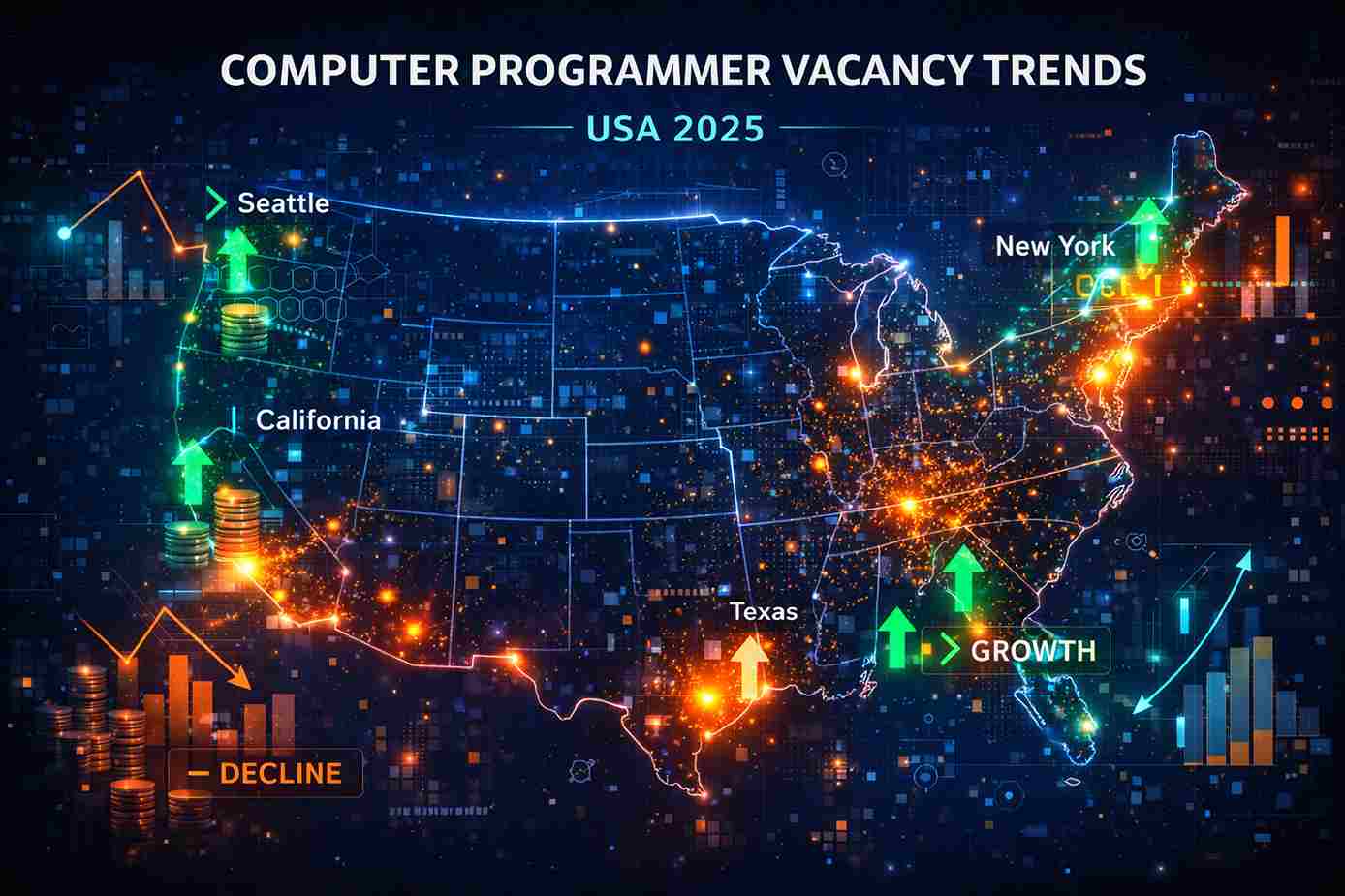
The traditional answer to “where are the tech jobs?” was simple: San Francisco Bay Area, Seattle, New York. That answer is still partially true, but it’s significantly less true than it was in 2019 — and the shift matters enormously for where you should be looking.
The Legacy Hubs (Still Dominant, But Not What They Were)
San Francisco Bay Area remains the highest-density tech employment market in the country. Silicon Valley — Santa Clara County, San Mateo County, and San Francisco proper — houses the headquarters of Apple, Google (Alphabet), Meta, Salesforce, Stripe, and hundreds of mid-size tech companies. The raw volume of programmer job postings here remains unmatched.
But here’s what’s changed: Bay Area programmer hiring has become significantly more selective since the 2022–2023 correction. The era of companies posting 50 junior developer openings simultaneously is over. What’s left is concentrated demand for mid-to-senior level engineers with specific skill sets — and a housing market that’s genuinely brutal even on tech salaries. According to the U.S. Bureau of Labor Statistics Occupational Employment and Wage Statistics, software developer median wages in the San Jose–Sunnyvale–Santa Clara metro sit at $174,560 — the highest in the nation — but that premium is offset by a median home price that crossed $1.4 million in 2024.
Seattle — specifically the Eastside corridor of Bellevue and Redmond — remains enormously important because of Microsoft’s campus presence and Amazon’s headquarter operations. Both companies are still among the largest employers of programmers in the country. The Seattle metro also has a growing mid-tier ecosystem: Zillow, Expedia, Redfin, T-Mobile’s tech operations, and a cluster of aerospace-tech companies tied to Boeing. Programmer wages in the Seattle metro average around $162,000 for software developers, with lower housing costs than the Bay Area (though not low by any national standard).
New York City is the third pillar, and it’s specifically strong in financial technology, media technology, healthcare IT, and enterprise software. The concentration of major financial institutions — JPMorgan Chase, Goldman Sachs, Bloomberg, Citadel — drives extraordinary demand for programmers who understand financial systems, quantitative modeling, and low-latency infrastructure. NYC programmer salaries rival the Bay Area for roles in finance tech specifically, though the cost of living math is similarly challenging.
The Rising Second-Tier Markets (Where the Real Opportunity Growth Is)
This is where it gets genuinely interesting, and where most career guides stop giving you useful information.
Austin, Texas has had a dramatic tech hiring expansion over the last five years. Tesla’s Gigafactory and headquarters relocation brought engineering employment. Apple built a $1 billion campus. Oracle relocated its headquarters. Samsung has a major chip fabrication facility in Taylor (30 miles outside Austin). Meta opened large data center operations. The result is a tech employment market that grew faster than any other major metro between 2020 and 2024, according to CompTIA’s geographic workforce data.
The Austin advantage: no state income tax, lower housing costs than coastal hubs (though Austin’s housing prices rose sharply during the migration wave), a strong University of Texas engineering pipeline, and a culture that’s attracted enough tech workers to create self-reinforcing network effects. The trade-off is that the Austin market is now more competitive than it was three years ago — the easy early-mover advantage is gone, but it’s still significantly more accessible than the Bay Area for mid-level programmers.
Raleigh-Durham, North Carolina — specifically the Research Triangle Park area connecting Raleigh, Durham, and Chapel Hill is one of the most underrated tech employment markets in the country. IBM, Cisco, Red Hat (now part of IBM), Epic Systems, and a growing cluster of biotech-adjacent software companies have created a dense employer ecosystem around Duke University, UNC Chapel Hill, and NC State. Tech unemployment in the Triangle region runs consistently below the national tech average. Housing costs remain meaningfully below coastal levels. The programmer talent pipeline from three major research universities within 30 miles of each other is exceptional.
Denver-Boulder, Colorado has established itself as a legitimate tier-two tech hub, with particular strength in cybersecurity (a disproportionate concentration of federal contractors and defense tech companies), aerospace software (Lockheed Martin, Raytheon, Ball Aerospace), and outdoor-industry technology. The quality-of-life factor draws tech talent from coastal markets, and a growing number of companies have opened engineering offices specifically to access Denver’s talent pool. State income tax is moderate, housing is expensive but not California expensive, and the University of Colorado and Colorado State produce strong CS graduates.
Atlanta, Georgia has quietly become one of the strongest mid-market tech employment centers in the Southeast. Delta Air Lines, UPS, Coca-Cola, Home Depot, and NCR Voyix all have major technology operations in the Atlanta metro — and these large enterprise tech employers create steady, stable programmer demand that doesn’t swing with the volatility of pure-play tech companies. Atlanta also has a growing fintech presence (Fiserv, Global Payments, NCR) that makes it one of the top fintech employment markets nationally. Georgia Tech’s pipeline of CS graduates is one of the strongest in the South.
Chicago, Illinois — often overlooked in tech employment discussions dominated by coastal narratives — is actually the third-largest tech employer market in the country by absolute headcount. The Chicago tech ecosystem is anchored by finance (trading firms like Citadel, Getco, Belvedere Trading), enterprise software (Salesforce’s large Chicago office, SAP, IBM), and a growing startup scene in the West Loop neighborhood. Trading and quantitative finance companies in Chicago pay among the highest programmer salaries in the country — competitive with or exceeding Bay Area rates for the right skill sets (C++, low-latency systems, quantitative algorithms).
The Remote Revolution’s Real Effect on Geography
Here’s something the “where are the jobs?” conversation usually underweights: remote and hybrid work has genuinely changed the geographic calculus, but not in the way most people think.
Remote-first programmer roles exist, are real, and are actively posted. But the companies offering genuinely location-independent remote positions with top-tier compensation are a smaller subset than the “remote work revolution” narrative suggests. Most major tech employers have moved toward hybrid models requiring 2–3 days on-site. Fully remote roles at competitive salaries disproportionately go to mid-senior and senior engineers with established track records.
What remote work has done is allow programmers in second-tier markets Columbus, Pittsburgh, Kansas City, Salt Lake City — to access salaries that would have required relocation five years ago. That’s a real change. But it requires you to be competitive enough to get those roles in the first place, which means competing against the full national (and sometimes international) applicant pool, not just your local market.
By Industry: Where Programmer Hiring Is Actually Accelerating
Geography is one dimension. Industry is another — and in 2025, the industry breakdown of programmer hiring tells a story that’s completely different from what the tech news cycle suggests.
Financial Technology and Financial Services
Banks, trading firms, insurance companies, and payment processors are among the largest employers of programmers in the United States — and they’re consistently underrepresented in the career content aimed at CS graduates because they’re less culturally visible than consumer tech companies.
JPMorgan Chase alone employs approximately 62,000 technology workers globally, with a significant concentration in the U.S. Goldman Sachs describes itself explicitly as a technology company that does finance. Citadel and its market-making arm Citadel Securities recruit aggressively from top CS programs specifically for high-performance systems programming roles.
Financial services programmer roles tend to be more stable than pure tech company roles (financial services companies didn’t go through the same 2022–2023 mass layoff cycle), pay extremely competitively — especially in trading and quant finance — and offer significant long-term career development. The trade-off is that financial systems are often older, more complex, and more constraint-bound than greenfield tech company environments.
Healthcare Technology
The U.S. healthcare system is undergoing a technology transformation that’s generating enormous programmer demand — and it’s not concentrated in any single geography. Electronic health record systems, patient engagement platforms, healthcare analytics, medical device software, and telehealth infrastructure all require substantial programming talent.
Epic Systems in Verona, Wisconsin is one of the largest employers of CS graduates in the Midwest — not a company people outside healthcare IT usually know, but a company that processes records for over 250 million patients and whose software runs in the majority of major U.S. hospitals. Cerner (now part of Oracle Health), Meditech, and a constellation of health-tech startups are all actively hiring.
The healthcare tech market is specifically strong in markets like Nashville (HCA Healthcare, Cigna’s operations center), Minneapolis (UnitedHealth Group’s technology operations), and Cleveland (Cleveland Clinic’s extensive technology development). These aren’t markets that appear in the standard “tech hub” conversation, but they offer real programmer employment at competitive salaries with significantly lower cost of living than coastal hubs.
Defense and Aerospace Technology
This is the category that genuinely surprises people when they see the salary and stability data. Defense contractors — Lockheed Martin, Raytheon (RTX), Northrop Grumman, Booz Allen Hamilton, Leidos — are among the largest employers of software engineers in the United States. And they’re hiring aggressively.
Defense tech is experiencing a funding boom driven by geopolitical factors, drone and autonomous systems development, cyber warfare capabilities, and space systems. The Space Force, established in 2019, has become a significant driver of aerospace software demand. SpaceX’s growing government contract portfolio has brought commercial space tech compensation norms (high) into closer contact with defense contractor norms (historically more moderate).
The geographic concentration: Northern Virginia / D.C. metro (the largest defense contractor employment hub in the country), Huntsville, Alabama (Redstone Arsenal anchors significant aerospace tech employment), San Diego (Navy systems), Colorado Springs (Space Command), and Seattle/Bellevue (Boeing defense, Blue Origin).
The requirement that differentiates this market: most defense programmer roles require a U.S. security clearance, which eliminates a significant portion of the talent pool. If you’re a U.S. citizen willing to pursue clearance, this represents one of the least-competitive programmer job markets in the country relative to compensation.
E-Commerce, Logistics, and Supply Chain Technology
Amazon’s fulfillment infrastructure. Walmart’s technology operations. Target’s engineering teams. Shopify’s distributed development. The logistics and retail technology sector employs tens of thousands of programmers in roles that get minimal attention in the CS career press because they lack the glamour of consumer tech companies but they pay well, hire consistently, and didn’t lay off at the rates consumer tech companies did in 2022–2023.
Amazon is the obvious elephant in the room — it’s one of the three largest programmer employers in the country, with massive operations in Seattle, Nashville (where Amazon relocated its HQ2 operations), and distributed tech centers in Columbus, Dallas, and Phoenix. But the broader logistics tech sector — FedEx’s technology operations in Memphis, UPS’s tech hub in Atlanta, the growing warehouse automation software sector — creates programmer demand that maps to geographic markets far outside the traditional tech hubs.
What the Job Postings Are Actually Saying: Skills That Are Opening Doors Right Now
Geography and industry tell you where to look. Skills tell you whether you’ll get an interview.
I’ve looked at the pattern of job postings across major boards (Indeed, LinkedIn, Dice, Glassdoor) in early 2025, and a few signals are coming through clearly.
Cloud-native development is table stakes, not a differentiator. AWS, Azure, and GCP experience was a premium skill in 2019. In 2025, posting after posting lists it as a baseline requirement. If you don’t have at least working familiarity with one major cloud platform, you’re at a disadvantage in the majority of posting markets.
AI integration experience is the current differentiator. Specifically: experience building applications that integrate with LLM APIs (OpenAI, Anthropic, Google Gemini), familiarity with prompt engineering, and understanding of retrieval-augmented generation (RAG) architectures. This isn’t primarily a research skill — it’s an application development skill. Companies want programmers who can build AI-powered features, not necessarily ones who can train models from scratch.
Cybersecurity awareness has become embedded in programming job postings. Secure coding practices, OWASP familiarity, and understanding of common vulnerabilities (injection attacks, authentication flaws, supply chain vulnerabilities) now appear in a meaningful percentage of general software engineering job postings, not just security-specific roles. The integration of security into the development lifecycle (DevSecOps) has pushed security literacy into the core programmer skill set.
Python continues its multi-year dominance in job posting frequency. JavaScript/TypeScript remains the dominant language for web development roles. Rust is growing in postings related to systems programming, embedded systems, and security-critical applications — still a niche, but a growing and well-compensated one. Java and C# remain heavily represented in enterprise, financial services, and Android development contexts. Go has established a solid presence in backend infrastructure roles at tech companies.
The Vacancy Trends Nobody Is Talking About
Here’s the part of the market that doesn’t get coverage because it doesn’t fit the “big tech is the tech industry” narrative.
State and local government technology is massively understaffed. Every state government, county system, and major city in the U.S. runs on software much of it decades old, much of it maintained by a workforce that’s aging out of the profession. The programmer vacancy rate in government technology is extraordinary, and the competition for these roles is significantly lower than private sector tech.
The compensation has historically been lower too, but that’s changing. Several states have run emergency pay reclassifications specifically to compete for programming talent. California, New York, and Washington have all increased technology compensation scales meaningfully since 2022. The stability, benefits (including genuine pensions in many jurisdictions), and work-life balance of government tech roles attract a different candidate profile and they’re actively understaffed relative to their needs.
Rural and small-city markets are underserved but increasingly viable. The combination of remote work normalization and regional economic development initiatives has created genuine programmer employment in markets like Des Moines (insurance tech anchor employers), Kansas City (a growing tech scene centered on Sprint’s legacy network infrastructure and agricultural technology), Pittsburgh (Carnegie Mellon’s research commercialization and a significant robotics tech cluster), and Salt Lake City (a growing startup scene sometimes called “Silicon Slopes” with lower cost of living than coastal markets).
These markets aren’t for everyone. But for programmers willing to live in them — or willing to do hybrid work that requires occasional travel rather than full relocation they represent significantly lower competition for available roles.
The National Science Foundation’s Science and Engineering Indicators report documents the geographic spread of technology employment and consistently finds that second-tier markets have been absorbing a growing share of STEM employment as technology becomes embedded in industries traditionally not associated with tech work.
What Employers Are Actually Looking For Beyond the Technical Skills
Job postings tell you what companies say they want. Hiring managers tell you what they actually filter for. The gap between those two things is worth understanding.
The skill that’s most consistently described as differentiating in engineering hiring conversations is the ability to communicate technical concepts to non-technical stakeholders. Not just documentation. Not just comments in code. The actual ability to sit in a meeting with a product manager, a finance executive, or a customer, and translate between the technical reality and the business reality.
This sounds soft. It is soft. It’s also genuinely rare at the programmer level, and companies pay premiums for it both in initial compensation and in promotion velocity. The programmers who advance fastest in most organizations are not always the most technically brilliant. They’re the ones who can make their technical work legible to the people deciding what to build and how to invest.
The second differentiator that hiring managers cite consistently: comfort with ambiguity and the ability to ship functional work under conditions of incomplete information. Academic CS training tends to emphasize clean problem definitions with known solution spaces. Real software development involves making judgment calls constantly which feature to prioritize, when “good enough” is actually good enough, how to balance technical debt against delivery timelines. The programmers who can navigate that ambiguity without requiring complete specifications before starting are genuinely more valuable.
According to research published by the Stanford Human-Computer Interaction Group, the engineers who advance most rapidly into senior and principal roles are disproportionately those who combine technical proficiency with systems-level thinking the ability to understand how their code fits into broader organizational, product, and user contexts. Pure execution skill, while necessary, is not the differentiating variable at the career progression level.
The Apprenticeship and Alternative Pathway Programs Worth Knowing About
One trend that hasn’t gotten enough coverage: the expansion of registered apprenticeship programs in technology occupations is creating a meaningful pipeline for people entering programming careers without traditional CS degrees.
The Department of Labor’s Registered Apprenticeship program has expanded technology apprenticeships significantly since 2021. Companies including IBM, Accenture, Amazon, and Salesforce have developed apprenticeship tracks that pay participants while they train — bridging the gap between bootcamp graduates or career changers and employment at technology companies.
These programs don’t pay at the same level as traditional full-time engineering roles during the apprenticeship period, but they do provide structured on-the-job training, mentorship, and a pathway to full employment that bypasses the catch-22 (“need experience to get a job, need a job to get experience”) that affects many non-traditional entrants.
The U.S. Department of Labor’s ApprenticeshipUSA initiative maintains a searchable database of registered technology apprenticeship programs by state. If you’re a career changer or non-traditional candidate, this is a genuinely underused resource.
How to Actually Use This Information
Let me bring this down to practical terms.
If you’re a CS student or recent graduate, the most important thing this data tells you is not to anchor your job search entirely on big tech company name recognition. The organizations hiring the most programmers in 2025 include financial services companies, defense contractors, healthcare technology companies, and enterprise software providers none of which have the cultural cachet of Google or Meta, but many of which offer comparable compensation and substantially better job security.
If you’re an experienced programmer navigating the current market, the geographic data suggests that secondary markets — Austin, Denver, Raleigh-Durham, Atlanta, Chicago — offer a combination of genuine opportunity density and cost-of-living advantages that are hard to match in coastal hubs. The jobs are there. The competition is real but more manageable than San Francisco.
If you’re considering a career transition into programming, the skills signal from job postings in 2025 is unusually clear: Python, cloud fundamentals, and the ability to build applications that integrate AI capabilities are the combination that opens the most doors at the entry and early-mid level right now. Not because everything else is irrelevant, but because those three areas represent the highest density of unfilled demand relative to available supply.
The Bottom Line on Programmer Vacancies in 2025
The narrative that “programming jobs are declining” and the narrative that “tech can’t hire fast enough” are both pointing at real data they’re just looking at different slices of the market.
Traditional “computer programmer” roles narrow, execution-focused, specification-dependent are contracting. Software engineering, application development, AI integration development, cloud-native development, security-aware software development all expanding. The work is growing. The label that BLS tracks is shrinking. If you understand that distinction, the job market picture resolves from confusing to navigable.
The jobs are in financial services. In healthcare technology. In defense and aerospace. In logistics and retail technology. In government systems (understaffed almost everywhere). In second-tier cities that have built genuine tech employment ecosystems. And in remote roles at companies willing to pay for the right skills regardless of where the candidate lives.
The map is bigger than it looks. You just have to know where to look on it.
