


Here’s a scenario every QA lead knows too well.
Your team ships a release every two weeks. Your regression suite has 8,000 test cases. Running them manually takes six days. Your sprint is ten days long. Do the math and you’ll immediately see why most organizations either cut testing short, skip edge cases, or maintain a graveyard of “tests we meant to write eventually.” None of those options are good.
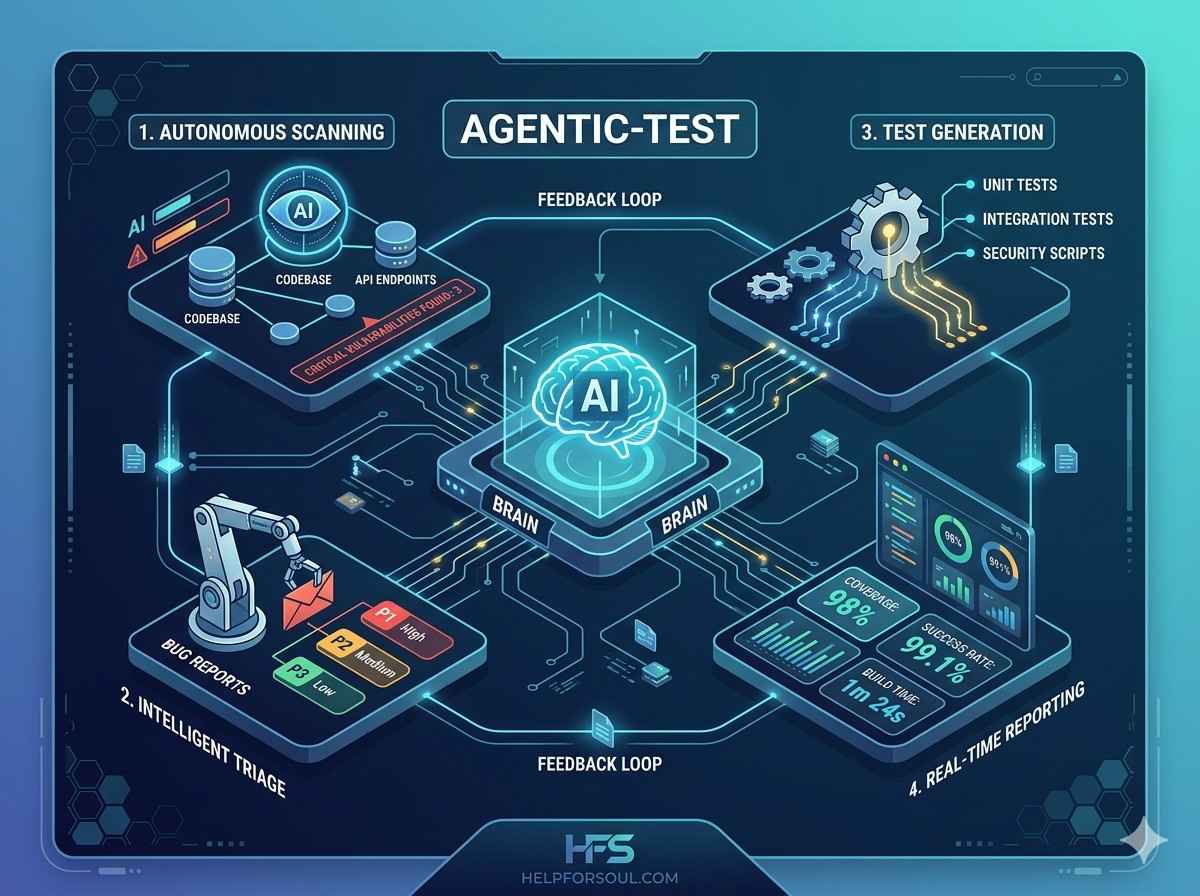
Now picture something different. An AI agent reads your latest pull request, understands what changed, writes the relevant test cases, executes them against your staging environment, triages the failures, traces each one back to a specific commit, and files a structured bug report all before your morning standup.
That’s not a product pitch. That’s agentic-test in practice. And it’s already running in production at teams you’ve heard of.
If you’re hearing this term for the first time, you’re about to get the full picture. If you’ve heard it but aren’t sure what separates agentic-test from the AI-assisted testing tools you already have, this guide will make that crystal clear. And if you’re evaluating vendors, comparing agentic testing against manual QA, or trying to understand how agentic search, analytics, and voice fit into the broader picture we’re covering all of it, methodically and honestly.
Let’s go.
What Is Agentic-Test?
Agentic-test is the practice of deploying autonomous AI agents to plan, generate, execute, analyze, and iterate on software tests or to rigorously evaluate the behavior of AI agent systems themselves without requiring step-by-step human direction. It works by combining large language model reasoning with tool-use capabilities: the agent reads codebases, specifications, or system logs; generates relevant test cases; executes them via code interpreters or CI/CD integrations; observes the results; and loops through triage and reporting autonomously. Unlike traditional AI-assisted testing, which augments human testers with suggestions, agentic-test systems own entire testing workflows end-to-end. As of 2025, agentic-test represents one of the fastest-growing applications of agentic AI across software engineering, with adoption accelerating in DevOps, enterprise QA, and AI system validation.
Part 1: Why Traditional Testing Is Breaking Under Modern Pressure
The problem isn’t that QA teams are bad at their jobs. The problem is that the job has outgrown the tools.
Software delivery velocity has increased by roughly 200% over the last decade, according to the 2024 DORA State of DevOps Report. Elite engineering teams deploy to production multiple times per day. Meanwhile, test suite size has grown proportionally but human QA capacity hasn’t. You can’t hire your way out of this gap. The math doesn’t work.
And it gets worse. Modern software systems aren’t monolithic anymore. They’re distributed microservices, third-party API integrations, serverless functions, and frontend frameworks that update every six months. A single user flow might touch twelve services. Testing that flow comprehensively requires understanding the entire dependency graph context that a human tester has to rebuild mentally every time they sit down. An AI agent with access to your codebase and architecture docs can hold that entire context simultaneously.
Researchers at MIT’s Computer Science and Artificial Intelligence Laboratory (CSAIL) studying software reliability found that the majority of production bugs in complex distributed systems escape detection not because testers aren’t capable, but because the search space for edge cases is too large for manual exploration to cover adequately. The problem is combinatorial, not motivational.
Here’s the kicker: most organizations aren’t failing at testing because they lack effort. They’re failing because they’re using linear human capacity to solve an exponentially scaling problem. Agentic-test is the first credible answer to that mismatch.
What changed to make agentic-test possible right now, in 2025? Three converging developments:
Foundation models learned to code. Large language models trained on code repositories – GitHub Copilot’s training data, Stack Overflow, open-source projects developed genuinely strong software comprehension. They can read a function, understand its contract, and generate test cases that probe its boundaries. This wasn’t reliably true before 2023.
Tool-use APIs matured. Models can now call external functions code interpreters, test runners, CI/CD APIs, bug trackers — reliably and contextually. An agent that can think about a test and also run it closes the loop that kept AI suggestions disconnected from actual execution.
Long-context windows arrived. Earlier models lost context after a few thousand tokens. Modern foundation models hold 100K–200K tokens in working memory. That means an agent can read your entire test file, your implementation file, your recent git diff, and your failing CI log simultaneously and reason across all of it without losing the thread.
Those three developments, landing within roughly 18 months of each other, created the conditions for agentic-test to become viable at production scale.
Part 2: The Two Meanings of Agentic-Test -And Why Conflating Them Causes Problems
This is where most articles go wrong. They treat agentic-test as a single thing. It’s not. There are two distinct meanings, and knowing the difference matters enormously when you’re evaluating tools, vendors, or internal initiatives.
Meaning 1: AI Agents That Do the Testing
The first meaning and the one most people encounter first is using agentic AI as a testing system. The AI agent owns the testing workflow: reading specs, writing tests, running them, analyzing results, and reporting findings. Humans define the goal and review the output. The agent does the work in between.
This is agentic-test as a productivity and coverage tool. It’s aimed at solving the velocity gap described in Part 1.
Here’s what a mature implementation looks like in practice. When a developer opens a pull request:
- The agentic-test system reads the diff and understands which modules changed
- It retrieves related test files and existing coverage data
- It generates new test cases targeting the changed behavior happy paths, boundary conditions, regression cases for previously reported bugs
- It executes those tests via a sandboxed code interpreter or direct CI integration
- It analyzes each failure: is this a genuine regression, a flaky test, an environment issue, or a test case error?
- It files a structured report — with the failing test, the relevant code diff, the probable root cause, and a suggested fix directly in your issue tracker or PR comments
- If the fix is straightforward, it may implement it, commit to a branch, and re-run to verify
That full loop — from PR opened to failure triaged can run in under ten minutes. Humans review the output, make judgment calls on ambiguous findings, and handle anything that falls outside the agent’s confidence threshold.
Meaning 2: Testing AI Agents Themselves
The second meaning is less intuitive but arguably more important as AI adoption grows: evaluating, validating, and monitoring agentic AI systems to ensure they behave correctly before and after deployment.
This is agentic-test as an assurance and safety practice. It’s aimed at solving the trust problem how do you know an autonomous agent will do what you expect when it’s operating without human oversight?
The challenge here is fundamentally different from traditional software testing. Traditional QA validates that a function returns the right output for a given input. But an agentic AI system operates in partially observable environments, makes probabilistic decisions, uses tools that have their own failure modes, and can produce different outputs for the same input on different runs. Pass/fail is not sufficient.
According to research from Stanford’s Human-Centered AI Institute (HAI), evaluating agentic systems requires methodology built around five dimensions that don’t exist in traditional software QA:
- Goal completion rate: Does the agent finish multi-step tasks end-to-end, or does it stall or hallucinate midway?
- Tool use accuracy: Does it call the right tool at the right time with correctly structured parameters?
- Error recovery: When an API call fails or a tool returns unexpected data, does the agent adapt gracefully or spiral into a failure loop?
- Safety boundary recognition: Does the agent know when not to act? Can it recognize requests that fall outside its defined scope and escalate appropriately?
- Cost and latency per task: Agentic workflows burn tokens quickly an agent that completes tasks but takes twenty tool calls to do what three would achieve is not production-ready.
Building evaluation harnesses for these dimensions requires constructing realistic task environments, adversarial test cases, and longitudinal monitoring dashboards. It’s not trivial. But skipping it is how organizations end up with autonomous agents taking actions in production systems that nobody authorized.
Both meanings of agentic-test matter. Organizations building with agentic AI need Meaning 1 to maintain software quality at velocity. Organizations building agentic AI systems themselves need Meaning 2 to ship responsibly. Many teams need both simultaneously.
Part 3: The Agentic Operating System – The Infrastructure Underneath Agentic-Test
To understand how agentic-test actually works at a technical level, you need to understand the agentic operating system that powers it. This isn’t a metaphor it’s a real architectural concept that’s emerging across the industry.
Just as a traditional operating system allocates CPU, memory, and I/O so that individual software applications can run, an agentic operating system manages tools, memory, context, and agent coordination so that individual AI agents can operate without stepping on each other or losing task state.
In an agentic-test context, the agentic OS handles:
Tool orchestration – deciding when the testing agent should call the code interpreter vs. the git API vs. the bug tracker, and managing the handoffs between them without losing context.
Memory management – storing test results, failure histories, codebase knowledge, and prior agent decisions in a retrievable format. A testing agent that “forgets” what it found three runs ago will keep filing duplicate bugs and missing patterns.
Agent coordination – in larger deployments, multiple specialized agents collaborate: one agent analyzes the codebase, another generates test cases, another executes and triages. The agentic OS ensures they share information correctly and don’t produce conflicting outputs.
Safety guardrails – defining what the testing agent is and is not allowed to do. Can it write to the production database? Can it push commits directly? Can it close tickets without human review? The agentic OS enforces those boundaries.
Frameworks like Microsoft’s AutoGen, LangChain’s LangGraph, and CrewAI all function as partial implementations of this agentic operating system concept. They provide the orchestration and tool-management layers that make complex agentic-test workflows possible.
The reason this matters for practitioners is simple: you can’t evaluate or improve an agentic-test system you don’t understand architecturally. When an agent produces a wrong test case or a bad triage, you need to know which layer of the agentic OS failed was it a perception problem (the agent misread the spec), a planning problem (it reasoned incorrectly about what to test), an action problem (the tool call was malformed), or a memory problem (it forgot relevant context from earlier in the session)?
Each failure mode has a different remediation, and conflating them leads to wasted debugging effort.
Part 4: What Powers Agentic-Test – Pre-Trained Multi-Task Generative AI Models
Here’s a question that comes up constantly in technical evaluations: what are the AI models inside agentic-test systems actually called, and what makes them different from the models in a basic coding assistant?
The answer: pre-trained multi-task generative AI models are called foundation models and the distinction between a foundation model and a narrow task-specific model matters a great deal in the context of agentic testing.
A narrow model is trained to do one thing: write unit tests, or classify bug severity, or generate documentation. It does that one thing reasonably well and falls apart outside its training distribution.
A foundation model — GPT-4o, Claude 3.7 Sonnet, Gemini 1.5 Pro is pre-trained on massive, diverse datasets spanning natural language, code across dozens of programming languages, scientific literature, and structured data. That broad pretraining gives it the ability to handle multiple task types within a single model and within a single context window.
Pioneering research on multi-task learning from Carnegie Mellon University’s Language Technologies Institute established much of the theoretical foundation for why models trained across diverse task distributions generalize better than those trained narrowly. That insight — that breadth of training improves robustness on novel tasks — is exactly why foundation models outperform narrow models in agentic-test scenarios.
In practice, this means an agentic-test system powered by a foundation model can:
- Read a Python function and write a Jest test for the equivalent JavaScript implementation (cross-language reasoning)
- Understand a failing integration test, read the relevant API documentation, and determine the fix requires a timeout configuration change — not a code bug (multi-domain reasoning)
- Adapt its test generation strategy when it discovers the codebase uses a non-standard testing framework it hasn’t seen before (generalization from pretraining)
Narrow task-specific models break on all three of those scenarios. Foundation models handle them not perfectly, but well enough to be genuinely useful in production environments.
The practical implication for teams building or buying agentic-test systems: ask vendors which foundation model powers the agent’s reasoning layer, and ask specifically about multi-task performance. A vendor who can only demonstrate their system on a single language or framework should raise flags.
Part 5: AI in Testing – Smarter Solutions Compared to Manual Testing
Let’s have the honest conversation that most vendor comparisons avoid.
Manual testing isn’t dead. It’s not going away. And anyone telling you that agentic-test will fully replace human QA engineers is selling something. What’s true and what the evidence actually shows — is that the division of labor between human testers and AI agents is shifting fundamentally, and teams that understand that shift will build better software faster than those who don’t.
Here’s where the evidence is clear.
Where agentic-test decisively outperforms manual testing:
Regression testing at scale is the most unambiguous case. Running 10,000 regression tests every time someone merges a PR is exactly the kind of high-volume, rule-governed, repetitive task that human teams handle poorly — not because of incompetence, but because attention degrades over repetition and context switching. An AI agent executes every test with identical attention to every other test, every time, without fatigue. A 2024 analysis from Georgia Tech’s Software Engineering research group found that automated test execution with AI-assisted triage reduced the average time to identify a regression-introducing commit from 4.2 hours to under 23 minutes in studied enterprise environments.
Test case generation from specifications is the second strong case. Feed an agentic-test system a user story, an OpenAPI spec, or a database schema, and it generates comprehensive test cases — happy paths, edge cases, negative tests, boundary conditions in minutes. A senior human tester does this well, but it takes time and cognitive effort. The agent is faster and more systematic at coverage breadth, even if the human is better at creative edge case invention.
Failure triage and root cause analysis is where many teams underestimate AI’s value. Parsing logs, correlating failures to commits, identifying which of 200 failing tests share a common root cause this is pattern-matching at scale, and it’s precisely what large language models are built for. Teams that use agentic triage consistently report significant reductions in the time engineers spend on failure investigation.
Where manual testing still wins and why that matters:
Exploratory testing is the clearest human advantage. Finding the weird, unintuitive failure that no spec predicted, no prior bug suggested, and no pattern in the codebase indicated that requires human curiosity, creativity, and the ability to follow an instinct that something feels wrong even without evidence. No agentic-test system has matched this. Full stop.
Usability and accessibility evaluation still requires human judgment. An agent can check that a button exists and is clickable. It cannot tell you that the button placement creates confusion, that the error message is condescending, or that a workflow feels exhausting even though it’s technically functional. That subjective, embodied judgment remains human territory.
Novel system evaluation — when a codebase is brand new, poorly documented, and architecturally unfamiliar still favors human testers who can build mental models through exploration and conversation with engineers. Agents rely on patterns from training and existing documentation; they struggle more than humans when those anchors don’t exist.
The bottom line: the teams winning with agentic-test aren’t asking “AI or humans?” They’re asking “which tasks should AI own so our human testers can spend their time on work only humans can do?” That reframing changes everything about how you structure your QA organization.
Part 6: Evaluating the Transportation Company Bolt on Agentic-Test
If you’re in a technical leadership or procurement role, you’ve almost certainly encountered Bolt in the context of AI-powered development. Let’s evaluate it specifically through the agentic-test lens because the honest answer is more nuanced than most reviews give it.
Bolt (specifically Bolt.new, developed by StackBlitz) is an AI-powered full-stack development agent that spins up, builds, and deploys web applications from text prompts, entirely in the browser. No local environment. No CLI setup. Describe what you want, and Bolt writes the code, installs dependencies, and renders a live preview.
From an agentic-test perspective, here’s what the evaluation actually reveals:
What Bolt does genuinely well:
The test-execute-iterate loop is its natural habitat. Because Bolt runs code directly in its integrated Vite and Node.js environment, it can generate a component, render it, observe the output, and refine essentially performing a form of continuous visual validation. That tight feedback loop is genuinely valuable for rapid development workflows.
For frontend testing specifically, Bolt can generate basic test scaffolding using Vitest or Jest when prompted. The generated tests are syntactically correct and cover the obvious happy paths.
Where agentic-test evaluation reveals gaps:
Bolt’s test generation is prompt-dependent and surface-level by default. Unlike purpose-built agentic testing platforms, Bolt doesn’t autonomously analyze coverage gaps, identify untested code paths, or generate adversarial edge cases. You get tests if you ask for them not because the agent proactively identified the need.
Complex state management in larger applications introduces hallucinations. The agent starts confidently and sometimes degrades on projects spanning many files, losing coherence between components in ways that produce tests which look plausible but don’t accurately reflect the implementation.
No native integration with enterprise CI/CD pipelines means Bolt-generated tests live in the browser environment, not in your production testing infrastructure. For individual developers and rapid prototyping, that’s fine. For teams with established DevOps maturity and compliance requirements, it’s a significant limitation.
Verdict for agentic-test use cases: Bolt is an exceptional development acceleration tool for individual contributors and early-stage projects. Evaluate it as a prototyping agent that can generate test scaffolding on request not as an autonomous agentic-test platform. Teams looking for genuine autonomous test generation, execution, and triage should evaluate purpose-built alternatives like Mabl, Launchable, or Cognition’s Devin for software engineering workflows.
Part 7: Evaluating Scale AI on Agentic Solutions and AI/ML Transformation Services
Scale AI occupies a different position in the ecosystem entirely, and evaluating it through an agentic-test and AI transformation lens requires separating what Scale is genuinely excellent at from what it’s still building toward.
Founded by Alexandr Wang in 2016, Scale AI built its reputation on high-quality data labeling the unglamorous, essential work of annotating training data that powers foundation models. That origin shapes both Scale’s greatest strengths and its current limitations in the agentic space.
Where Scale AI genuinely excels for agentic transformation:
Scale’s RLHF (Reinforcement Learning from Human Feedback) infrastructure is arguably the most mature in the industry. If you’re fine-tuning a foundation model for agentic-test applications training it to generate better test cases, improve triage accuracy, or reduce hallucination rates in code analysis Scale’s human feedback pipelines and evaluation frameworks are the gold standard. Major AI labs have used Scale’s infrastructure to produce the models that power agentic systems today.
The Donovan enterprise platform offers something most agentic AI vendors don’t: audit trails, access controls, compliance logging, and integration with government-grade security requirements. For regulated industries financial services, healthcare, defense where agentic-test deployments need to meet strict data governance standards, this matters enormously.
Scale’s model evaluation capabilities extend naturally to agentic-test Meaning 2 (evaluating AI agents themselves). Their red-teaming services, adversarial evaluation pipelines, and behavioral testing frameworks are among the most rigorous available commercially.
Where evaluation reveals honest limitations:
Scale’s roots are in data annotation, not agentic orchestration. The Donovan platform is evolving rapidly, but teams looking for agentic-test tooling with native code analysis, autonomous test generation, and CI/CD integration will find Scale’s current offering less mature than purpose-built agentic testing platforms.
Cost is a genuine consideration. Scale AI’s enterprise contracts are not structured for small or mid-size engineering teams. The ROI case is strongest for organizations with large model fine-tuning budgets and complex AI safety requirements — not for teams primarily looking to augment their QA workflow.
Verdict for agentic AI/ML transformation: Scale AI is a credible, enterprise-grade partner for organizations pursuing serious AI/ML transformation particularly if that transformation involves fine-tuning custom models, evaluating agentic system safety, or navigating regulated-industry compliance. Evaluate them rigorously on agentic-specific workloads. Ask to see live demonstrations of agentic evaluation pipelines rather than data annotation dashboards. The two capabilities are related but meaningfully distinct.
Part 8: What Is Agentic Search And What It Means for Agentic-Test Documentation
Here’s something the agentic-test community doesn’t talk about enough: how people find information about testing AI systems is itself changing, and that change has practical implications for how teams build and share knowledge.
Agentic search refers to AI-powered information retrieval systems that don’t just return a ranked list of links — they autonomously decompose your query, search multiple sources, evaluate source credibility, synthesize findings, and return a cited, reasoned answer. Perplexity AI is the clearest consumer-facing example. Enterprise equivalents are proliferating fast.
When a QA engineer searches “how to evaluate tool-use accuracy in an agentic system,” agentic search doesn’t return ten blog posts and leave the engineer to synthesize them. It reads those sources, identifies the most credible and relevant information, and produces a structured answer with citations in seconds.
The practical implication for teams building agentic-test knowledge bases and internal documentation: the content you create needs to be optimized for citability by AI, not just findability by humans. That means:
- Every major claim needs clear attribution and a source
- Each section should be understandable as a standalone passage without requiring the reader (or AI) to have read prior sections
- Author expertise should be explicit and verifiable
- Statistics and findings should include dates and specific numbers, not vague references
Research from Oxford Internet Institute on information retrieval behavior found that AI-synthesized answers increasingly serve as the first point of contact for professional queries with users only drilling into source documents when the synthesized answer is insufficient. That means if your agentic-test documentation isn’t structured for AI citability, it effectively doesn’t exist in agentic search environments.
For internal knowledge management, this shift means restructuring your QA wikis, runbooks, and evaluation frameworks to be machine-readable and AI-citable not just human-navigable.
Part 9: Agentic Analytics with Natural Language Query Capability —Applied to Testing Data
Most QA teams are sitting on more data than they know what to do with. Test execution logs, failure histories, coverage metrics, flakiness rates, mean time to detection it’s all there, somewhere, in a combination of CI dashboards, spreadsheets, and tribal knowledge.
The problem is that accessing that data requires either technical SQL literacy or the patience to navigate dashboards that weren’t designed for the questions you’re actually asking.
Agentic analytics with natural language query capability changes that equation directly. Instead of writing a query to find “all test failures in the payment module over the last 30 days, grouped by root cause category,” you ask the system in plain English and it writes the query, runs it, generates a visualization, and explains what the data shows, including anomalies and suggested follow-ups.
Applied to agentic-test environments specifically, natural language analytics enables QA leads to ask questions like:
- “Which test suites have the highest flakiness rates this quarter, and which ones correlate with deployment failures?”
- “Show me the test coverage delta between last release and this release, broken down by module”
- “Which engineers’ pull requests most commonly introduce regressions caught only at the integration test level?”
These are genuinely useful questions. Getting answers used to require either a dedicated data engineer or significant dashboard configuration time. Agentic analytics with NLQ capability makes them answerable in seconds.
The 2024 Gartner Data & Analytics Summit identified natural language querying as the top priority for enterprise analytics modernization, with 68% of surveyed data leaders planning deployment within 24 months. In quality engineering specifically, the adoption curve is accelerating testing data is structured, queryable, and rich with signal. It’s exactly the domain where NLQ analytics delivers fast, measurable value.
One honest caveat worth making: the quality of NLQ analytics output is entirely dependent on the quality of the underlying data. An agentic analytics layer sitting on top of inconsistently tagged test results, incomplete coverage data, or poorly maintained CI logs will return confident, articulate wrong answers. Get your data hygiene right before investing in the NLQ layer.
Part 10: Agentic AI Voice The Emerging Interface for QA Workflows
This one surprises people. What does voice AI have to do with software testing?
More than you’d expect.
Agentic AI voice systems which combine real-time speech recognition, large language model reasoning, and downstream action-triggering are beginning to appear in DevOps and QA workflows in several distinct ways.
The first is voice-driven test status reporting. Engineering managers can ask their CI/CD interface, in natural speech, “What’s the current test health across all active branches?” and receive a spoken, synthesized summary no dashboard navigation required. For leadership reviews, daily standups, and mobile access, voice interfaces reduce the friction of staying informed about testing status.
The second is incident response voice workflows. When a production incident fires at 2 AM, an agentic voice system can call the on-call engineer, verbally summarize the failure, read the relevant alerts and logs, and accept verbal instructions “run the regression suite on service X and page the backend team if failures exceed 10%” which it then executes autonomously. That use case is live at several enterprise teams today.
The third is QA documentation via voice. Testers performing exploratory testing can narrate findings in real time — “I found a race condition when clicking submit twice within 500 milliseconds on a slow connection” — and an agentic voice system transcribes, structures, and files the bug report automatically, complete with severity classification and reproduction steps inferred from context.
The technical underpinning of agentic AI voice combines automatic speech recognition (ASR systems like Whisper, Deepgram, or AssemblyAI), large language model reasoning for understanding and planning, text-to-speech synthesis for response generation, and the agentic action layer for downstream execution. The critical improvement in 2025 is latency modern agentic voice systems operate at under 500ms end-to-end, crossing the threshold where voice interaction feels natural rather than robotic.
By Q1 2025, agentic voice systems were handling an estimated 15 million AI-driven interactions per day across enterprise deployments, according to Juniper Research’s 2025 Conversational AI forecast a number that was under 2 million in 2022.
Part 11: The Agentic Labs Building Agentic-Test’s Future
If you want to understand where agentic-test is heading over the next 24 months, the most reliable signal is what’s being built inside agentic labs today.
The term “agentic labs” refers to two things: dedicated research divisions within major AI companies focused on autonomous agent development, and independent product studios building agent-native applications. Both are moving faster than most practitioners realize.
Inside the major research labs:
Berkeley Artificial Intelligence Research (BAIR) at UC Berkeley has published significant work on autonomous agent evaluation — specifically on how to construct reliable benchmarks for agents operating in partially observable, multi-step environments. Their research on SWE-bench (a benchmark for AI software engineering) provided the evaluation infrastructure that many agentic-test vendors now use to validate their systems. When Cognition AI reported Devin resolving 13.86% of SWE-bench tasks unassisted compared to a previous state-of-the-art under 2% it was BAIR’s evaluation framework that gave that number its credibility.
Anthropic’s alignment research explicitly addresses the agentic-test challenge from a safety perspective specifically, how to evaluate and constrain autonomous agents so their actions remain within intended boundaries even as their capabilities grow. Their work on scalable oversight and Constitutional AI is being extended into multi-agent evaluation frameworks directly relevant to agentic-test Meaning 2.
Microsoft Research’s AutoGen lab is advancing multi-agent testing architectures — systems where one agent generates tests, another executes them, and a third performs critical review — mirroring how human QA teams work, but operating at machine speed.
The independent studios accelerating the field:
Cognition AI’s Devin demonstrated that an autonomous coding agent could resolve real GitHub issues end-to-end, including writing tests, fixing failures, and verifying solutions. That’s the agentic-test loop running on open-source software at a level of autonomy that didn’t exist 18 months ago.
Letta (formerly MemGPT) is solving the memory problem that limits agentic-test systems on long-running projects — giving agents persistent, queryable memory of prior test runs, historical failures, and codebase evolution. Without that memory layer, every agentic-test session starts from scratch. With it, the agent accumulates institutional knowledge about your codebase over time, improving its test generation and triage accuracy with each run.
The common thread is the move from episodic agentic-test (each run independent, no accumulated learning) toward continuous agentic-test (agents that improve from experience, remember your codebase, and build expertise in your specific system over time). That transition is the next major step in the field.
Part 12: The Honest Risks What Could Go Wrong With Agentic-Test
Let me be direct here, because the hype around agentic-test can obscure some genuine risks that deserve serious attention.
False confidence is the most dangerous failure mode. An agentic-test system that generates and passes 10,000 tests can create the impression of comprehensive coverage when significant gaps still exist. If the agent systematically avoids a class of test cases because they’re underrepresented in its training data, or if it generates plausible-looking but semantically wrong assertions, passing tests become misleading signals. Teams that treat agentic-test output as ground truth without human review are accepting a risk most don’t fully appreciate.
The evaluation problem is genuinely unsolved. How do you know if your agentic-test system is performing well? Traditional software testing has clear pass/fail semantics. Evaluating an agentic-test system requires assessing whether its generated tests are good tests comprehensive, correct, maintainable which is a judgment call that requires human expertise. Research from Harvard’s Data Science Initiative on AI system reliability emphasizes that automated evaluation of AI-generated artifacts inherits the blind spots of the evaluating system. You can’t use an AI to fully validate another AI’s output without human ground truth in the loop.
Autonomy scope creep is real. As agentic-test systems prove their value, there’s organizational pressure to expand their action scope from read-only to write access, from filing draft bugs to closing resolved ones, from suggesting fixes to committing them. Each expansion increases the error surface. Organizations should expand action scope deliberately and incrementally, with audit trails and rollback capability at each stage.
Organizational over-reliance creates brittleness. Teams that shift all test case creation to agentic systems lose the human expertise that makes test case design a craft. When the agent fails and it will, in unfamiliar contexts teams without that embedded human knowledge struggle to compensate. Agentic-test augments QA expertise; it shouldn’t replace it entirely.
None of these are reasons to avoid agentic-test. They’re reasons to implement it thoughtfully, with governance structures that match the level of autonomy you’re granting.
Part 13: A Practical Framework for Implementing Agentic-Test in 2025
Enough theory. Here’s the framework I use when helping teams build agentic-test capability from scratch. I call it TRACE:
T -Target a Specific Workflow First
Don’t try to automate your entire testing practice simultaneously. Pick one workflow where the pain is acute and the boundaries are clear. Regression testing on a stable, well-documented module is ideal. New feature testing on a rapidly changing codebase is not a good starting point. Early wins build organizational trust, which is the prerequisite for expanding scope.
R -Restrict the Action Surface Deliberately
Define explicit boundaries before your first agentic-test deployment. Can the agent write to your test database? Can it close tickets, or only open them? Can it push commits to a branch, or only create draft PRs? Start restrictively. Expand the action surface as trust is established through demonstrated performance.
A – Audit Everything from Day One
Instrument your agentic-test deployment with comprehensive logging: every action the agent takes, every tool call it makes, every decision path it follows. This is not optional. When something goes wrong and something will go wrong in the first month you need to understand exactly what happened. Auditing also provides the ground truth data you need to improve the agent’s performance over time.
C – Create Human Review Checkpoints
Early deployments should include mandatory human review before the agent’s output reaches production whether that’s a test suite being merged, a bug being filed, or a fix being committed. Remove these checkpoints selectively and only after you’ve accumulated evidence that the agent performs correctly on that specific action type. Progressive autonomy expansion is safer and more sustainable than trying to deploy fully autonomous from day one.
E — Evaluate Rigorously and Continuously
Define your agentic-test evaluation metrics before you go live: task completion rate, test coverage delta, false positive rate on triage, cost per test cycle, and engineer satisfaction scores. Run red-team sessions where you deliberately try to make the agent fail give it malformed specs, ambiguous requirements, adversarial inputs. Fix what breaks. Then monitor those metrics continuously in production, not just at launch.
Frequently Asked Questions About Agentic-Test
What is agentic-test in simple terms?
Agentic-test is when an AI system autonomously handles testing work — generating test cases, running them, analyzing failures, and reporting findings without needing a human to direct each step. It’s AI that owns a testing workflow end-to-end, rather than just assisting a human tester with suggestions.
How is agentic-test different from automated testing?
Traditional automated testing requires humans to write the test scripts that machines then execute. Agentic-test goes further: the AI agent writes the test scripts itself, executes them, interprets the results, and decides what to do next all autonomously. Automation executes predefined scripts. Agentic-test creates and adapts those scripts without human direction.
What are pre-trained multi-task generative AI models called?
Pre-trained multi-task generative AI models are called foundation models. Examples include GPT-4o, Claude 3.7 Sonnet, and Gemini 1.5 Pro. They power the reasoning layer of agentic-test systems enabling agents to understand code across multiple languages, generate semantically correct test cases, and reason across complex multi-file codebases.
Is agentic-test ready for enterprise production use?
Yes, with appropriate governance. Teams implementing agentic-test with restricted action surfaces, human review checkpoints, comprehensive audit logging, and rigorous evaluation frameworks are seeing strong results. Teams that rush to full autonomy without those safeguards face elevated risk of false confidence and scope creep issues.
How do you evaluate an agentic AI system using agentic-test?
Evaluating an agentic AI system requires assessing goal completion rate, tool use accuracy, error recovery behavior, safety boundary recognition, and cost-per-task efficiency across adversarial test cases and realistic task environments. Stanford HAI’s research on agentic evaluation provides a foundational methodology. The key difference from traditional QA is that pass/fail testing is insufficient probabilistic behavior requires statistical evaluation across many runs.
What is the difference between agentic-test and agentic search?
Agentic-test involves autonomous AI agents that generate, execute, and analyze software tests. Agentic search involves autonomous AI agents that decompose information queries, retrieve from multiple sources, and synthesize cited answers. They share the same underlying agentic architecture autonomous multi-step action loops but apply it to different domains: software quality assurance versus information retrieval.
Can agentic-test replace manual QA engineers?
No — not fully, and probably not in the foreseeable future. Agentic-test excels at high-volume regression testing, test case generation from specifications, and failure triage at scale. Human QA engineers retain decisive advantages in exploratory testing, usability evaluation, and assessing novel systems without prior documentation. The productive framing is division of labor, not replacement.
Conclusion: Agentic-Test Is the Infrastructure Layer for Software Quality at AI Speed
Here’s the honest summary.
Software delivery is accelerating beyond what manual testing can keep pace with. The combinatorial complexity of modern distributed systems exceeds what human attention can cover comprehensively. And the emergence of AI agent systems in production creates a new category of quality assurance that didn’t exist three years ago — evaluating agents, not just code.
Agentic-test is the response to all three of those pressures simultaneously. It brings autonomous, persistent, scalable testing capability to engineering teams that can’t hire their way out of the velocity gap. It provides the evaluation frameworks that responsible AI deployment requires. And it connects to the broader agentic operating system — search, analytics, voice, and multi-agent orchestration — that is becoming the foundation layer of modern enterprise software.
The teams that treat agentic-test as a curiosity to evaluate later are making the same mistake that teams made with CI/CD in 2012, or cloud infrastructure in 2015. The practice isn’t mature yet. But the trajectory is clear, the early results are real, and the window for building genuine capability before it becomes table stakes is open right now.
Start narrow. Audit everything. Expand deliberately. And keep your human testers focused on the work only humans can do.
