
Quick Answer
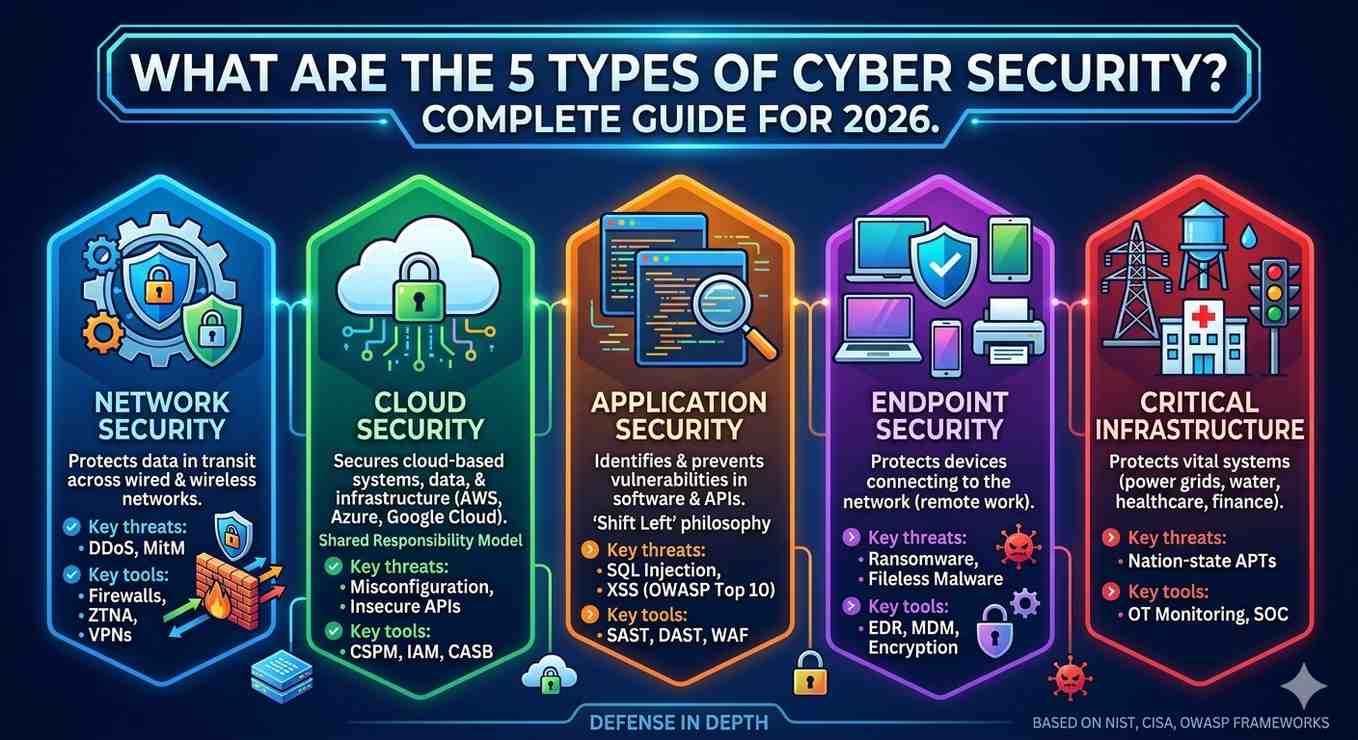
The 5 types of cyber security are: Network Security, Cloud Security, Application Security, Endpoint Security, and Critical Infrastructure Security. Each one protects a different layer of your digital environment. Together, they form a complete defense strategy that every organization needs in 2026.
Why Understanding Cyber Security Types Matters
Cyber attacks are no longer rare events. According to the Cybersecurity and Infrastructure Security Agency (CISA), a cyber attack happens every 39 seconds somewhere in the world. Businesses lose an average of $4.45 million per data breach, and cybercrime is expected to cost the global economy $10.5 trillion annually by 2025.
Despite this, most people treat cyber security as one single thing. It is not. It is a collection of five distinct disciplines, each protecting a different surface area of your digital world.
Whether you are an IT professional, a business owner, or a student studying for a security certification, understanding these five types gives you the mental model you need to build real protection, not just patch holes as they appear.
The 5 Types of Cyber Security Explained
Type 1: Network Security
What It Is
Network security is the practice of protecting computer networks from unauthorized access, misuse, malfunction, modification, destruction, or improper disclosure. It covers everything that travels across your organization’s wired and wireless networks.
Think of your network as a highway system. Network security is the combination of traffic police, checkpoints, speed cameras, and road barriers that keep dangerous vehicles off the road while letting legitimate traffic flow freely.
Why It Matters in 2026
Modern organizations run entirely on their networks. Every email, every file transfer, every video call, every database query travels across network infrastructure. If that network is compromised, every single piece of data moving through it becomes vulnerable.
According to NIST (National Institute of Standards and Technology), network-based attacks remain the most common entry point for enterprise breaches. Attackers scan for open ports, exploit unpatched routers, and intercept unencrypted traffic every single minute of every day.
Common Network Threats
- Distributed Denial of Service (DDoS) attacks that overwhelm servers with fake traffic
- Man-in-the-Middle (MitM) attacks where hackers intercept communications
- DNS Spoofing that redirects users to fake websites
- Packet Sniffing that captures unencrypted data in transit
- Port Scanning that maps open entry points into your network
Key Tools and Technologies
Firewalls, Intrusion Detection Systems (IDS), Intrusion Prevention Systems (IPS), VPNs, and network monitoring platforms form the foundation of network security. In 2026, Zero Trust Network Access (ZTNA) has become the gold standard. Under Zero Trust, no user or device is automatically trusted, even if they are already inside the network. Every access request must be verified.
Type 2: Cloud Security
What It Is
Cloud security is the set of policies, technologies, and controls that protect cloud-based systems, data, and infrastructure. As organizations move from physical servers to platforms like Amazon Web Services, Microsoft Azure, and Google Cloud, securing those environments requires a fundamentally different approach.
The Shared Responsibility Model
One of the most important concepts in cloud security is the Shared Responsibility Model. Cloud providers are responsible for securing the physical infrastructure, hardware, and core services. You are responsible for securing your data, your user accounts, your configurations, and your applications running on top of that infrastructure.
Many organizations misunderstand this and assume their cloud provider handles everything. This misunderstanding leads directly to breaches.
Why It Matters in 2026
The Cloud Security Alliance (CSA) reports that cloud misconfiguration is the number one cause of cloud data breaches. A single misconfigured storage bucket or exposed API key can expose millions of customer records. With 94 percent of enterprises now using cloud services, getting cloud security right is not optional.
Common Cloud Threats
- Misconfigured cloud storage exposing sensitive data publicly
- Insecure APIs allowing unauthorized access
- Account hijacking through stolen credentials
- Insider threats from employees with excessive access permissions
- Shadow IT where employees use unauthorized cloud tools
- Data loss from accidental deletion or lack of backup
Key Tools and Technologies
Cloud Security Posture Management (CSPM) tools continuously scan your cloud environment for misconfigurations. Identity and Access Management (IAM) policies control who can access what. Cloud Access Security Brokers (CASBs) act as gatekeepers between users and cloud services. Multi-Factor Authentication (MFA) adds a critical second layer of identity verification.
Type 3: Application Security
What It Is
Application security, often called AppSec, focuses on identifying, fixing, and preventing security vulnerabilities within software applications. This includes web applications, mobile apps, APIs, desktop software, and any code your organization builds or uses.
Every application you run is a potential doorway into your organization. If that application has a vulnerability, an attacker can walk right through it.
The Shift Left Philosophy
The most important trend in application security is “Shift Left” – integrating security testing early in the software development lifecycle rather than treating it as a final step before launch. When developers catch a vulnerability during coding, fixing it costs almost nothing. When that same vulnerability is discovered after a product is live, the cost explodes.
The Open Web Application Security Project (OWASP) publishes the OWASP Top 10, a globally recognized list of the most critical web application security risks. Security teams and developers use this list as a benchmark for building secure software.
Common Application Threats
- SQL Injection where attackers insert malicious code into database queries
- Cross-Site Scripting (XSS) that injects malicious scripts into web pages
- Broken Authentication allowing attackers to impersonate legitimate users
- Insecure Direct Object References (IDOR) exposing internal data
- API vulnerabilities that leak data or allow unauthorized actions
- Buffer overflow attacks that crash or hijack applications
Key Tools and Technologies
Static Application Security Testing (SAST) analyzes source code for vulnerabilities before the application runs. Dynamic Application Security Testing (DAST) tests running applications by simulating attacks. Web Application Firewalls (WAFs) filter malicious requests in real time. Software Composition Analysis (SCA) tools scan third-party libraries for known vulnerabilities.
Type 4: Endpoint Security
What It Is
An endpoint is any device that connects to a network: laptops, desktop computers, smartphones, tablets, smart printers, IoT sensors, and more. Endpoint security is the discipline of protecting each of these devices from being compromised and used as an entry point into your broader network.
Why It Is Critical in 2026
Remote work changed everything. Before 2020, most corporate devices stayed inside a secure office network. Today, employees connect from home networks, coffee shops, airports, and hotel rooms using personal devices that may not meet corporate security standards.
According to the SANS Institute, endpoint attacks account for more than 70 percent of successful data breaches. Every device outside your office perimeter is a potential weak link.
Beyond Traditional Antivirus
Traditional antivirus software works by comparing files against a database of known malware signatures. This approach is no longer sufficient. Modern attacks, especially fileless malware that runs entirely in system memory, leave no files for antivirus tools to detect.
Endpoint Detection and Response (EDR) platforms replaced traditional antivirus as the standard. EDR tools monitor device behavior continuously, using machine learning to detect anomalies that signature-based tools would miss entirely.
Common Endpoint Threats
- Ransomware that encrypts files and demands payment
- Fileless malware that operates entirely in RAM without writing files to disk
- Spyware that silently monitors user activity and sends data to attackers
- Trojan horses disguised as legitimate software
- Zero-day exploits targeting unknown vulnerabilities
- USB-based attacks using infected physical devices
Key Tools and Technologies
Leading EDR platforms in 2026 include CrowdStrike Falcon, SentinelOne, and Microsoft Defender for Endpoint. Mobile Device Management (MDM) tools enforce security policies across company-owned and personal devices. Automated patch management ensures every device runs the latest security updates. Full-disk encryption protects data if a device is physically stolen.
Type 5: Critical Infrastructure Security
What It Is
Critical infrastructure security protects the systems and assets that society cannot function without: power grids, water treatment plants, hospitals, financial systems, transportation networks, telecommunications, and emergency services. A successful attack on these systems does not just cause data loss. It can cut off electricity for millions of people, contaminate drinking water, or disrupt emergency response during a crisis.
The Real-World Stakes
In 2021, the Colonial Pipeline ransomware attack shut down fuel supplies across the United States East Coast, causing fuel shortages and panic buying across multiple states. In the same year, attackers briefly accessed the water treatment system in Oldsmar, Florida and attempted to increase sodium hydroxide levels to dangerous concentrations. These attacks demonstrate that cyber threats to physical infrastructure are not theoretical.
Nation-state actors, meaning government-backed hacking groups, are the primary threat to critical infrastructure. They conduct Advanced Persistent Threat (APT) campaigns: long, slow, stealthy operations designed to infiltrate systems months or years before launching an attack.
Common Critical Infrastructure Threats
- Nation-state sponsored APT campaigns targeting government and utility systems
- Ransomware attacks against hospitals and emergency services
- Industrial control system attacks targeting SCADA and OT environments
- Supply chain attacks that compromise software or hardware before it reaches the target
- Insider threats from employees or contractors with privileged access
Regulatory Frameworks
Most governments now mandate specific cyber security standards for critical infrastructure operators. In the United States, CISA oversees infrastructure protection across 16 critical sectors. The NERC CIP standards govern cybersecurity for the energy grid. HIPAA covers healthcare organizations. PCI DSS applies to financial payment systems.
According to MIT Lincoln Laboratory’s cybersecurity research, critical infrastructure attacks have increased by more than 300 percent since 2020, making this the fastest-growing area of cyber security investment worldwide.
Comparison Table: All 5 Types at a Glance
| Type | What It Protects | Biggest Threat | Key Technology |
|---|---|---|---|
| Network Security | Data in transit across networks | DDoS, MitM attacks | Firewalls, ZTNA, SIEM |
| Cloud Security | Cloud data and configurations | Misconfiguration | CSPM, IAM, CASB |
| Application Security | Software and APIs | SQL Injection, XSS | SAST, DAST, WAF |
| Endpoint Security | Devices and remote users | Ransomware, fileless malware | EDR, MDM, Encryption |
| Critical Infrastructure | National systems and utilities | Nation-state APTs | OT monitoring, SOC |
The CIA Triad: The Foundation Behind All 5 Types
Every type of cyber security is ultimately designed to protect one or more elements of the CIA Triad:
Confidentiality means that data is only accessible to authorized users. Encryption, access controls, and authentication mechanisms enforce confidentiality.
Integrity means that data is accurate and has not been tampered with. Hashing, digital signatures, and audit logs protect integrity.
Availability means that systems and data are accessible when needed. Redundancy, backup systems, and DDoS protection protect availability.
When a security team evaluates any risk or invests in any tool, they are always asking: does this protect confidentiality, integrity, or availability?
How the 5 Types Work Together
Security professionals use a strategy called Defense in Depth, which means layering multiple types of security so that if one layer fails, others stop the attack.
Here is a practical example. An attacker sends a phishing email to an employee. Email security, which falls under application security, catches it and marks it as spam. The employee clicks it anyway. Endpoint security detects suspicious behavior on the device and blocks the malware from executing. The malware attempts to connect to an external command and control server. Network security blocks that outbound connection. The attacker attempts to access cloud storage using stolen credentials. Cloud security flags the unusual login and requires additional verification.
No single layer stopped the attack. All of them working together did.
Frequently Asked Questions
What are the 5 types of cyber security?
The 5 types are Network Security, Cloud Security, Application Security, Endpoint Security, and Critical Infrastructure Security. Each protects a different layer of your digital environment and they work best when deployed together.
Which type of cyber security is most important?
There is no single most important type. The right priority depends on your organization. A remote-first company should prioritize endpoint and cloud security. A hospital must prioritize critical infrastructure and network security. A software company needs strong application security. The best approach uses all five layers together.
What is the difference between cyber security and network security?
Cyber security is the broad field covering protection of all digital assets. Network security is one specific discipline within cyber security that focuses on protecting data as it travels across networks. Network security is a subset of cyber security.
What is the CIA Triad in cyber security?
The CIA Triad stands for Confidentiality, Integrity, and Availability. These three principles are the foundation that all cyber security frameworks are built on. Every security control is designed to protect one or more of these three properties.
How do I know which type of cyber security my business needs most?
Start with a risk assessment. Identify your most valuable digital assets, then map the threats most likely to target them. Most small and medium businesses should start with endpoint security and network security as their first priority, then expand to cloud security as they adopt more cloud services. Consulting a certified professional or reading NIST’s Cybersecurity Framework is a strong starting point.
Final Thoughts
Cyber security is not a single product or a single decision. It is a layered discipline with five distinct types, each protecting a different surface area of your digital world.
Network Security protects your data as it moves. Cloud Security protects your infrastructure in the cloud. Application Security protects the software your business depends on. Endpoint Security protects every device connecting to your network. Critical Infrastructure Security protects the systems that society cannot afford to lose.
Understanding these five types is not just for IT professionals. It is for every business leader, developer, and individual who depends on digital systems, which in 2026, means everyone.
Start with an audit of your current defenses. Identify the gaps. Then build your security stack layer by layer, using the frameworks published by trusted sources like NIST, CISA, and OWASP as your guide.