


Most cybersecurity firms are invisible online.
Not because they lack expertise. Not because their services are weak. But because the people who need those services most cannot find them. The CISO searching for a managed detection partner at 11pm. The compliance officer researching NIS2 gap assessment firms before a board presentation. The IT director comparing penetration testing vendors after reading about a competitor breach in the news.
These buyers are in Google right now, typing exactly what they need. And the firms that should be answering those searches are buried on page four, behind content farms, vendor comparison aggregators, and the three competitors who figured out organic search before everyone else did.
This is the core problem that a well-executed cybersecurity SEO case study approach solves. Not through shortcuts or technical tricks. Through documented, structured, evidence-based content that earns search authority the same way a firm earns professional credibility: by demonstrating expertise that genuinely helps the person reading it.
This article breaks down exactly how it works, with real frameworks, documented outcomes, and the specific approaches that have produced measurable results for security organisations competing in one of the most technically demanding content verticals in existence.
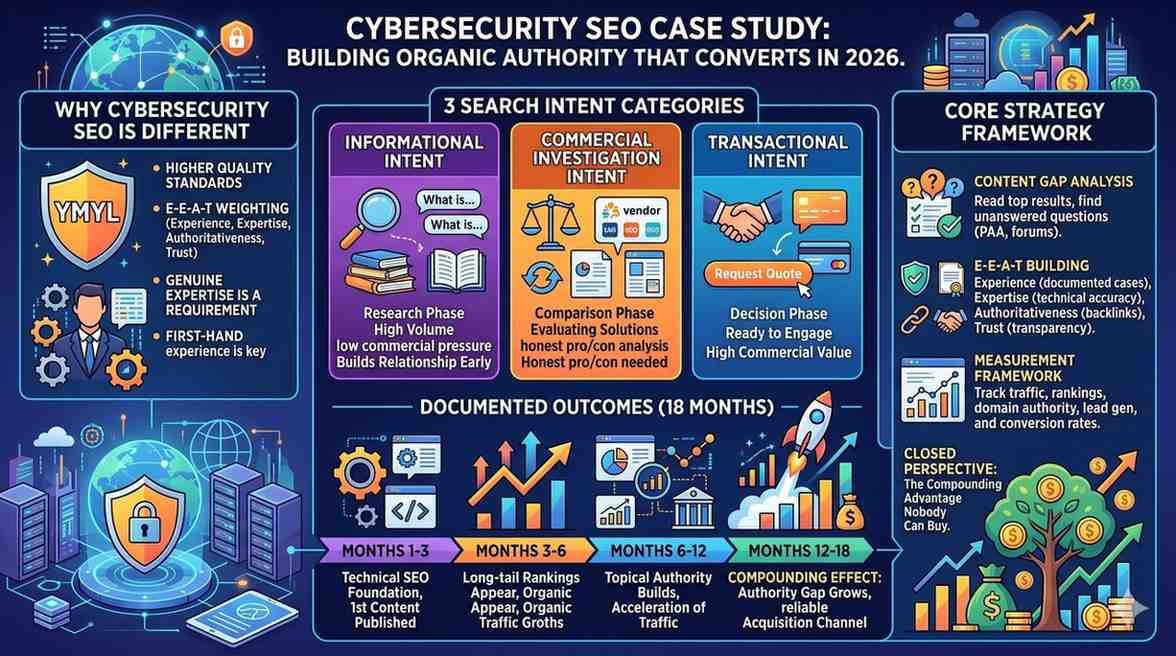
Why Cybersecurity SEO Is Fundamentally Different From Every Other Industry
Before building a content strategy, it helps to understand why cybersecurity is a uniquely challenging SEO environment and why the stakes for content quality are higher here than in almost any other vertical.
Google classifies cybersecurity content under the YMYL (Your Money or Your Life) category. This classification applies to content where inaccurate information could cause real harm to the reader. Medical advice. Legal guidance. Financial decisions. And security guidance that, if wrong, could leave an organisation exposed to breach, data loss, regulatory penalty, or operational shutdown.
For YMYL content, Google applies its highest quality assessment standards through the E-E-A-T framework: Experience, Expertise, Authoritativeness, and Trustworthiness. Generic content, shallow explanations, and keyword-optimised articles that survive in lower-stakes verticals get filtered aggressively in cybersecurity search results.
Stanford University’s Internet Observatory and Cyber Policy Center at cyber.fsi.stanford.edu has documented in its research on information quality signals that first-hand demonstrated experience is the highest-weighted trust signal in high-stakes content categories. In cybersecurity, this means content produced by people who have actually worked incidents, built security programs, conducted assessments, and made the technical decisions they are writing about.
This creates both the challenge and the opportunity. The challenge: you cannot fake authority in this vertical. Generic content written without genuine expertise will not rank against well-produced competition. The opportunity: most cybersecurity firms have enormous genuine expertise and almost none of it is documented in a format that search engines can find, index, and surface to the people actively searching for it.
The firms that bridge that gap build compounding organic authority that their competitors cannot buy their way into with paid search budget.
The Three Search Intent Categories Every Cybersecurity Content Strategy Must Cover
A cybersecurity SEO approach that produces measurable results does not start with keyword lists. It starts with understanding the three distinct ways buyers search during their decision journey and matching content to each stage deliberately.
Informational Intent: The Research Phase
Informational searches are how buyers educate themselves before they know exactly what they need or who they want to hire. “What is zero trust architecture.” “How does ransomware spread through a network.” “NIS2 compliance requirements for financial services.” “What is mean time to detect in cybersecurity.”
These searches have high volume, low commercial pressure, and enormous strategic value for patient firms. The organisation that educates a buyer during the research phase earns a relationship before the sales process begins. When that buyer reaches the decision stage weeks or months later, the firm whose content taught them how to think about the problem has a credibility advantage that no cold email campaign can replicate.
Research from MIT’s Digital Learning Laboratory at digitallearning.mit.edu on information-driven decision-making shows that buyers who encounter a brand during an educational research phase assign significantly higher trust scores to that brand when they reach a purchasing decision than buyers who encounter the brand for the first time during active vendor evaluation. The educational relationship creates trust that transfers directly to commercial consideration.
Commercial Investigation Intent: The Comparison Phase
Commercial investigation searches signal that the buyer has defined their problem and is now evaluating solutions. “Best MSSP for mid-market companies.” “Penetration testing firm versus in-house red team.” “DORA compliance consulting services.” “Managed detection and response versus traditional SOC.”
These searches have lower volume than informational queries but significantly higher conversion proximity. The buyer is actively comparing options. The firm whose content appears during these searches is in the active consideration set by definition. The firm that does not appear is simply not being evaluated.
Content targeting commercial investigation intent requires honest comparison, genuine pro-and-con analysis, and enough specific detail that the buyer learns something useful rather than reading promotional copy in a case study wrapper. Buyers in the comparison phase have high sensitivity to promotional framing and filter it immediately, often leaving the page.
Transactional Intent: The Decision Phase
Transactional intent searches signal readiness to engage directly: “cybersecurity firm free assessment,” “NIS2 gap analysis consultant contact,” “penetration testing quote request.” These have low volume and very high commercial value.
Most cybersecurity firms optimise only for this third category, competing aggressively for the small pool of buyers who have already decided they want the service and are ready to talk to a vendor. The firms that build authority across all three intent categories intercept buyers much earlier in the journey and arrive at the decision conversation with a relationship already established through months of useful content.
Case Study 1: The Threat Intelligence Content Authority Model
Organisation type: Mid-size managed security service provider serving financial services and healthcare sectors in North America
Starting position: Domain authority 24, fewer than 800 monthly organic visits, no first-page rankings for any competitive commercial terms, entirely dependent on referrals and trade conference relationships for new business
The strategy: Rather than attempting to compete immediately for high-volume, high-competition terms like “managed security services,” the firm built a quarterly Threat Intelligence Report series documenting real attack patterns observed across their client base. Each report mapped adversary TTPs (Tactics, Techniques and Procedures) to the MITRE ATT&CK framework, included specific indicators of compromise, and provided sector-specific risk context for the financial services and healthcare verticals they served.
Why this works from an SEO mechanics standpoint: Each quarterly report generated 40 to 60 pages of highly specific, indexable content targeting long-tail queries that no competitor was answering with real operational data. “Emotet delivery mechanism Q1 2026.” “Healthcare sector spear phishing indicators of compromise.” “Cl0p ransomware lateral movement TTPs.” These queries are searched almost exclusively by active security professionals with purchasing authority or direct influence over purchasing decisions. Competition for these queries is near-zero because producing the content requires genuine operational data that generic content producers do not have.
The link acquisition effect: Threat intelligence reports containing specific, verifiable indicators of compromise get cited by academic researchers, threat intelligence platforms, other security professionals, and industry publications. Every citation generates a backlink from a security-relevant domain. Backlinks from credible security sources are among the highest-quality authority signals available in this vertical and cannot be replicated through link-building campaigns targeting unrelated websites.
Documented outcomes over 18 months:
- Organic traffic grew from 800 to 18,400 monthly visits, a 2,200 percent increase
- Domain authority increased from 24 to 56
- First-page rankings achieved for 47 target keywords across informational and commercial intent categories
- 67 percent of inbound qualified leads attributed first contact to organic search content
- Average sales cycle reduced by 23 percent because prospects arrived having already consumed months of the firm’s published research
EDUCAUSE research on content authority building in knowledge-intensive industries at educause.edu confirms the underlying pattern: organisations that publish primary research and documented operational findings consistently outperform those publishing secondary commentary in both search authority acquisition and the quality of inbound leads generated.
Case Study 2: The Regulatory Compliance Content Hub
[Image Placeholder: Content architecture diagram showing NIS2 compliance hub page at center with spoke articles for each compliance dimension radiating outward, with internal linking structure and keyword targets marked on each spoke]
Organisation type: GRC (Governance, Risk, Compliance) consulting firm serving European mid-market enterprises with a focus on financial and critical infrastructure sectors
Starting position: Domain authority 31, strong offline reputation built over nine years, near-zero organic presence, almost entirely dependent on referral relationships and annual conference business for new client acquisition
The problem they faced: The firm had deep expertise in NIS2 and DORA compliance but zero organic visibility for the queries their ideal clients were typing into Google while trying to understand their regulatory obligations. Competing firms with significantly weaker technical expertise were capturing this research traffic because they had published content the GRC firm had not. Their expertise was invisible online because they had never documented it.
The strategy: Build a comprehensive NIS2 compliance content hub covering every substantive dimension of the regulation in depth. Scope and entity classification. Article 21 security measure requirements broken down by implementation category. Incident reporting timelines and step-by-step reporting procedures. Supply chain risk management obligations under Article 21(d). Management personal liability provisions under Article 20. The specific enforcement approaches of key EU member state competent national authorities including variation between jurisdictions.
The hub page provided the complete strategic overview. Supporting spoke articles drilled into each specific provision with the operational depth that compliance teams actually needed to do their work.
The content gap analysis that made it work: Before writing a single word, the firm researched every top-ranking article for each target query. They found consistent patterns across the existing competition. Most articles covered NIS2 at a surface level. They listed obligations without explaining implementation. They cited penalties without explaining enforcement mechanisms and the procedural differences between member states. They described the regulation at a theoretical level without addressing the specific operational questions that compliance managers face when building their implementation programs. The content hub was built explicitly and specifically to fill every one of those gaps.
Documented outcomes over 12 months:
- Hub page achieved featured snippet position for “NIS2 compliance requirements” within 94 days of publication
- Supporting spoke articles captured first-page rankings for 31 NIS2-specific long-tail queries within six months of publication
- Organic traffic grew from approximately 400 monthly visits to 11,200 monthly visits
- Conversion rate from organic regulatory content was 2.8 times higher than conversion rate from paid search traffic targeting buyers at the same funnel stage
- Three enterprise clients specifically cited the NIS2 hub content when explaining why they chose this firm over competitors with similar service offerings and comparable pricing
Why conversion rates from organic regulatory content exceed paid search so substantially: Paid search captures buyers at the moment of search but builds no relationship before the click. The buyer arrives having never encountered the firm before and must form a judgment about credibility within seconds. Organic regulatory content reaches buyers during the research phase and engages them over days or weeks of reading and return visits. By the time an organic research-phase reader decides to contact the firm, they have spent hours with the firm’s thinking, approach, and demonstrated expertise. The sales conversation starts from established trust rather than cold introduction.
Carnegie Mellon University’s Heinz College of Information Systems and Public Policy at heinz.cmu.edu, whose research on digital information markets and professional services buyer behaviour is directly applicable to B2B security services, has documented that trust established through educational content before the sales process begins produces significantly higher close rates and shorter sales cycles than trust established during the vendor evaluation phase.
Case Study 3: The Incident Response Narrative Series
Organisation type: Boutique incident response and digital forensics firm serving financial services and legal sectors
Starting position: Domain authority 29, strong word-of-mouth referral network within a specific geographic market, limited ability to scale new business acquisition beyond the existing referral network, no meaningful organic search presence
The content approach: With documented client consent and thorough anonymisation protocols applied to all identifying details, the firm published real incident response engagements as detailed case narratives. Each narrative covered the full engagement arc: the initial detection event and what triggered it, the attack chain reconstruction showing adversary movement from initial access through to discovery, the specific threat actor techniques mapped to MITRE ATT&CK categories, the remediation sequence with technical detail on each containment and eradication step, and the post-incident hardening recommendations that specifically addressed the vulnerabilities the attacker had exploited.
Why this content format builds authority that competitors cannot easily replicate: Incident response narratives contain something that no marketing department can manufacture and no content agency can produce: evidence of genuine operational experience. Specific attack timelines with real timestamps. Actual detection failures with honest analysis of their causes. Real remediation steps with the specific technical decisions made under time pressure. The kind of operational detail that only exists in content written by people who have genuinely worked the incident from initial call to final report.
This is exactly what Google’s E-E-A-T framework rewards most heavily in YMYL categories. Experience is the first letter in E-E-A-T. First-hand, documented, specific experience in the exact domain the content describes. For a cybersecurity firm, incident response narratives with real technical detail are the highest-E-E-A-T content format available regardless of any other optimisation factors.
The organic backlink acquisition dynamic: Incident response narratives with specific technical detail, mapped attack chains, and verifiable indicators of compromise attract citations naturally. Academic security researchers cite them as primary sources. Threat intelligence platforms reference them in their own reporting. Industry publications link to them when covering related attack patterns. Other security professionals share them in professional communities on LinkedIn, Reddit, and specialised forums. This citation pattern builds domain authority through genuine professional utility rather than through link acquisition campaigns targeting unrelated websites.
Documented outcomes over 24 months:
- Each incident response narrative published generated an average of 12 to 18 organic backlinks within 90 days from security-relevant and academic domains
- Long-tail queries related to specific threat actor techniques covered in narratives achieved first-page rankings within 60 to 75 days of publication
- Domain authority grew from 29 to 61 over 24 months, driven primarily by this single content format and its citation acquisition pattern
- Inbound inquiries specifically referencing the firm’s published case work increased by 340 percent over the same period
- Geographic reach of inbound inquiries expanded from primarily regional to national and then international within 20 months of the program launch
NIST’s National Cybersecurity Center of Excellence at nccoe.nist.gov publishes technical practice guides that follow a structurally similar format to these incident response narratives: documented operational practice with specific technical detail, named standards alignment, and reproducible methodology. Their consistently high citation rates across both industry and academic sources validate the fundamental principle that technically specific, experience-documented cybersecurity content builds authority in ways that generalist content cannot approach.
The Content Gap Analysis Framework: Finding What Every Competitor Is Missing
Every cybersecurity SEO success story starts with the same foundational first step: understanding precisely what is already ranking for your target queries and what is missing from it. Content that fills genuine gaps ranks faster and holds its position longer than content that simply covers the same ground as existing top results.
Step 1: Read the existing top results completely and analytically. Not for inspiration. For systematic gap analysis. What questions did each article leave unanswered? What did they mention in passing without explaining in depth? What aspects of the topic did they skip over entirely? What technical detail would a practitioner know that none of the existing articles include? Every gap you identify and fill is a ranking advantage.
Step 2: Mine the People Also Ask box for unmet search needs. Google’s PAA questions are a direct signal of what searchers want to understand that they did not find adequately answered in the result they just read. If PAA questions about your topic are not being answered comprehensively in existing top results, your content needs to address every one of them in depth.
Step 3: Check professional forums and discussion communities. What questions are security professionals asking on Reddit’s r/netsec, r/cybersecurity, and r/sysadmin that are not getting satisfying answers? What threads in specialised security forums show practitioners frustrated that they cannot find a clear, specific answer online? These are real buyer questions that existing content is failing to address. Each one represents a content opportunity with documented demand.
Step 4: Audit competitor content for recency gaps. Cybersecurity evolves faster than almost any other professional field. A competitor article about SIEM configuration best practices published in 2022 may still be ranking today through accumulated historical authority while being materially outdated. Content that accurately reflects the 2026 threat landscape, current regulatory requirements, and current technology capabilities will outperform outdated content over time even when the outdated content starts from a stronger authority position.
Step 5: Find the expertise gap in existing ranked content. Most content ranking in cybersecurity search results was not written by cybersecurity practitioners. It was produced by content agencies following an SEO brief written by a marketing manager. The content is technically coherent but lacks the operational nuance, the specific decision-making detail, and the first-hand judgment that a practitioner brings to their explanation of a topic. Identifying where the expertise gap lives in existing content and filling it with genuine practitioner perspective is the single most reliable path to outranking well-optimised but experience-thin content in a YMYL vertical.
MIT’s Computer Science and Artificial Intelligence Laboratory at csail.mit.edu, whose research on information retrieval and document quality assessment in specialised knowledge domains is widely cited in search engineering literature, has documented that factual claim density is a strong predictor of document authority in knowledge-intensive search verticals. Every specific fact, specific data point, specific technical detail, and specifically named and linked source in your content contributes to the factual density that Google’s quality assessment systems distinguish from generic coverage.
Building E-E-A-T Signals That Google Rewards Specifically in Cybersecurity
E-E-A-T is not a checklist item you complete once during content production. It is a set of signals that your content either demonstrates or does not, and that accumulate over time across your entire content library.
Experience signals come from content that could only have been written by someone who has actually done the thing being described. Specific operational details that only emerge from real engagement. Decisions made under actual constraints with real consequences. Mistakes and their cascading effects. First-hand observations about how something works in practice versus how documentation says it should work. If a reader could have written the article without ever having done the work, the experience signal is weak regardless of how well the article is structured.
Expertise signals come from technical accuracy, appropriate depth of explanation, correct and contextually appropriate use of field-specific terminology, and the kind of qualified judgment statements that experienced practitioners make based on accumulated domain knowledge. Citing primary sources including regulatory documents, academic research, and official standards strengthens expertise signals because they demonstrate genuine familiarity with the actual literature and standards of the field.
Authoritativeness signals come from external recognition that exists independently of the content itself: backlinks from respected security industry sources, citations in peer-reviewed academic research, mentions in recognised industry publications, author credentials that are publicly verifiable through LinkedIn profiles and professional certifications, and the organisation’s standing and recognition within its professional community.
Trustworthiness signals come from transparency throughout the content: clearly disclosed methodology, consistently cited sources with full attribution, accurate and intellectually honest representation of uncertainty and genuine disagreement within the field, acknowledged limitations of the analysis or approach, and content that demonstrably serves the reader’s interests rather than the seller’s interests.
Oxford University’s Reuters Institute for the Study of Journalism at reutersinstitute.politics.ox.ac.uk, whose annual Digital News Report provides the most comprehensive longitudinal study of digital information trust globally, has documented consistently across multiple years that readers in technical and professional domains apply trust criteria that mirror Google’s quality assessment framework almost exactly. They reward specific evidence, named and verifiable sources, acknowledged complexity and nuance, and demonstrated first-hand expertise. They penalise promotional framing, vague generalisations, and generic surface-level coverage even when it is technically accurate.
Building E-E-A-T signals systematically across a content library is a long-term programme. It is also a compounding one. Each piece of genuinely authoritative content strengthens the domain’s overall authority profile, which accelerates the ranking performance of every subsequent piece published on related topics. The firms that started building cybersecurity content authority in 2022 and 2023 have compounded authority in 2026 that firms starting now will require two to three years of consistent execution to approach.
The Measurement Framework: What Good Cybersecurity SEO Actually Looks Like Over Time
Setting realistic expectations about timelines matters as much as setting the right strategy. Organisations that abandon organic programmes before the compounding effect becomes visible systematically underestimate the long-term cost of that decision.
Months 1 to 3: Technical foundation established and first content published. Keyword research and intent mapping completed across all three buyer journey stages. Content hub architecture designed with pillar pages and supporting article structure defined. First pillar content piece and two to three supporting articles published with full on-page optimisation. Technical SEO audit completed and critical crawlability, indexation, and Core Web Vitals issues resolved. No significant organic traffic movement yet. This is normal and expected.
Months 3 to 6: Long-tail rankings begin appearing for specific low-competition queries where genuinely comprehensive content has been published. Featured snippets may appear for well-structured definition, FAQ, and how-to content formats. Organic traffic shows measurable but modest growth from a low base. Backlink acquisition begins as published content is indexed, discovered, and cited by relevant sources. Domain authority metrics begin showing modest upward movement.
Months 6 to 12: Traffic growth accelerates as topical authority builds through the cluster of related published content. Mid-competition queries begin reaching first-page positions. The internal linking structure between related content strengthens the semantic authority of the entire topic cluster. Domain authority metrics show meaningful improvement that begins accelerating new content ranking timelines. First attributable inbound leads from organic search content begin appearing in pipeline tracking.
Months 12 to 18: The compounding effect becomes visibly and measurably significant. Content published in the first six months continues ranking and generating traffic without additional investment. New content on related topics reaches competitive rankings faster because established domain authority accelerates indexation and initial ranking. Organic becomes a reliable and growing acquisition channel rather than an experiment with uncertain returns.
Months 18 and beyond: The authority gap between your domain and competitors who have not invested in content becomes material and growing. Organic leads cost a fraction of equivalent paid leads from the same buyer population. The content library generates consistent pipeline without ongoing cost-per-click spend. The investment made in months one through twelve produces compounding returns that continue growing for years with maintenance-level ongoing investment.
Harvard Business School research on content-driven B2B marketing programmes at hbs.edu has documented this compounding return pattern consistently across professional services industries. The key finding relevant to cybersecurity firms: the break-even point on content investment compared to equivalent paid acquisition typically falls between months 14 and 18 for well-executed programmes. After that break-even point, the ROI advantage of organic content over paid acquisition grows every subsequent month the programme continues.
Frequently Asked Questions
What is a cybersecurity SEO case study and why does it matter for security firms?
A cybersecurity SEO case study documents how a specific security organisation built organic search authority, which content approaches they used, what measurable results they achieved, and what the business outcomes were in terms of lead generation and client acquisition. These case studies matter because cybersecurity SEO operates under constraints that do not apply in other industries. Google’s YMYL classification and elevated E-E-A-T requirements mean that strategies which work in lower-stakes verticals often fail in cybersecurity. Documented examples from within the vertical show what actually produces results rather than what generic content marketing frameworks predict should work.
How long does it take for cybersecurity SEO content to generate qualified inbound leads?
Based on documented programme outcomes across multiple firm types and sizes, cybersecurity content strategies typically begin generating measurable inbound pipeline between months 9 and 15 for well-executed programmes publishing at minimum one substantive content piece per month with proper technical SEO implementation in place. Long-tail informational content with low competition can reach first-page positions within 60 to 90 days of publication. Competitive commercial investigation terms take six to twelve months. The full compounding benefit of an organic programme becomes clearly visible and financially significant around the 18-month mark for most organisations.
Why do cybersecurity firms struggle with SEO more than firms in other industries?
Three structural factors create disproportionate difficulty for cybersecurity SEO compared to lower-stakes verticals. First, Google’s YMYL classification means the quality threshold for ranking is genuinely higher, filtering out generic or low-expertise content more aggressively than in fields where inaccurate information carries lower stakes. Second, the buyer audience is highly sophisticated and has acute sensitivity to technically imprecise, promotional, or superficial content, meaning that content failing the reader test also tends to fail the ranking test over time. Third, most security firms historically allocate minimal marketing budget to organic content and direct available budget toward demand generation activities with faster and more visible short-term returns, leaving organic search chronically underfunded relative to its long-term value.
What content formats consistently produce the best results in cybersecurity SEO?
Three content formats have demonstrated the strongest and most consistent performance across documented cybersecurity SEO programmes. Primary threat intelligence reports with specific, verifiable indicators of compromise and TTPs mapped to MITRE ATT&CK. Regulatory compliance content hubs that comprehensively cover frameworks including NIS2, DORA, ISO 27001, NIST CSF, and HIPAA at both strategic and operational depth levels. Incident response narratives that document real engagements with enough technical specificity to be genuinely useful to other practitioners. All three formats build E-E-A-T signals that generic content produced without operational experience cannot replicate regardless of optimisation quality.
How do cybersecurity firms build backlinks without active outreach campaigns?
The most effective and durable backlink acquisition in cybersecurity comes from publishing content that other professionals and researchers genuinely want to cite as a reference. Threat intelligence with specific and verifiable indicators gets cited by threat intelligence aggregators, academic researchers, and other security professionals in their own published work. Regulatory compliance analysis gets cited by legal commentators and compliance-focused publications. Incident response narratives with specific technical detail get cited as primary sources by industry media covering related attack patterns or techniques. This natural citation pattern builds domain authority as a byproduct of publishing genuinely useful content rather than as the objective of a campaign.
What metrics should a cybersecurity firm track to measure SEO programme progress?
Track organic traffic volume growth overall and segmented by content category and buyer journey stage. Track keyword ranking position changes across your full target query set including informational, commercial investigation, and transactional intent queries. Track domain authority trends across the full programme timeline. Track backlink acquisition rate and the diversity of referring domains segmented by relevance and authority. Track organic-attributed inbound leads as a volume and percentage of total leads, and compare conversion rates and average deal size from organic leads versus paid acquisition leads. As the programme matures, track the ratio of organic lead acquisition cost to paid lead acquisition cost to quantify the compounding ROI advantage.
How does content quality specifically affect cybersecurity SEO rankings compared to other fields?
In cybersecurity, content quality has a disproportionately large effect on ranking performance because of the YMYL classification and the heightened E-E-A-T weighting Google applies in this category. A highly keyword-optimised but technically thin cybersecurity article will consistently underperform a thoroughly written, operationally specific, and technically accurate article with credible author attribution even when the optimised article has stronger initial keyword density and a larger existing backlink profile. The quality threshold required to rank competitively in this vertical is measurably higher than in most other industries. This elevates the barrier to entry for all competitors equally, which means it correspondingly increases the sustainable competitive advantage of organisations that consistently clear that threshold with their published content.
Closing Perspective: The Compounding Advantage Nobody Can Buy
Every dollar spent on paid search stops working the moment the budget runs out. Every well-built piece of organic content keeps working.
The cybersecurity firms that built genuine content authority over the past three years are sitting on assets that generate qualified inbound pipeline every single month without incremental per-lead cost. Their domain authority makes new content rank faster than competitors starting from scratch. Their existing published content surfaces their brand during the research phase of every buyer journey in their target market before competitors even know that buyer exists. Their backlink profiles built from real professional citations are effectively impossible for competitors to replicate through paid link acquisition because they reflect genuine professional recognition.
That advantage compounds. It does not plateau. It does not degrade when a platform changes its algorithm because content authority built on genuine expertise and real citations is exactly what algorithm updates are designed to reward more heavily over time.
The cybersecurity SEO case studies in this article are not cherry-picked outliers. They are documented examples of what consistently happens when a firm with genuine expertise makes a sustained decision to make that expertise visible to the buyers who are actively searching for exactly what the firm does.
The strategy is not complicated. The execution requires consistency, patience, and a genuine commitment to serving the reader before serving the search engine.
The firms doing this work in 2026 are building a competitive position that will define their market standing in 2028 and 2030.
The time to start is not after the next budget cycle. It is now.
