
By a culture and tech writer tracking the intersection of body positivity and digital spaces
Ever scroll through TikTok at midnight and stumble across a creator debugging Python code in a crop top, talking about their curves like they’re a feature, not a bug? That’s not an accident. The “big booty tech nerd” identity part body-positive movement, part STEM pride, part unapologetic internet culture is having a serious moment. And honestly? It’s about time.
The big booty tech nerd isn’t a stereotype. It’s a reclamation. It’s the woman who carries both a gaming laptop and a decade of imposter syndrome into a room that wasn’t built for her and decides to redecorate anyway. This article is for her. For you. For anyone who has ever felt like they didn’t “look like” a tech person, whatever that even means.
Let’s unpack what this identity actually represents, why it’s growing, and what it means for body positivity in STEM spaces as of 2025.
What “Big Booty Tech Nerd” Actually Means in 2025
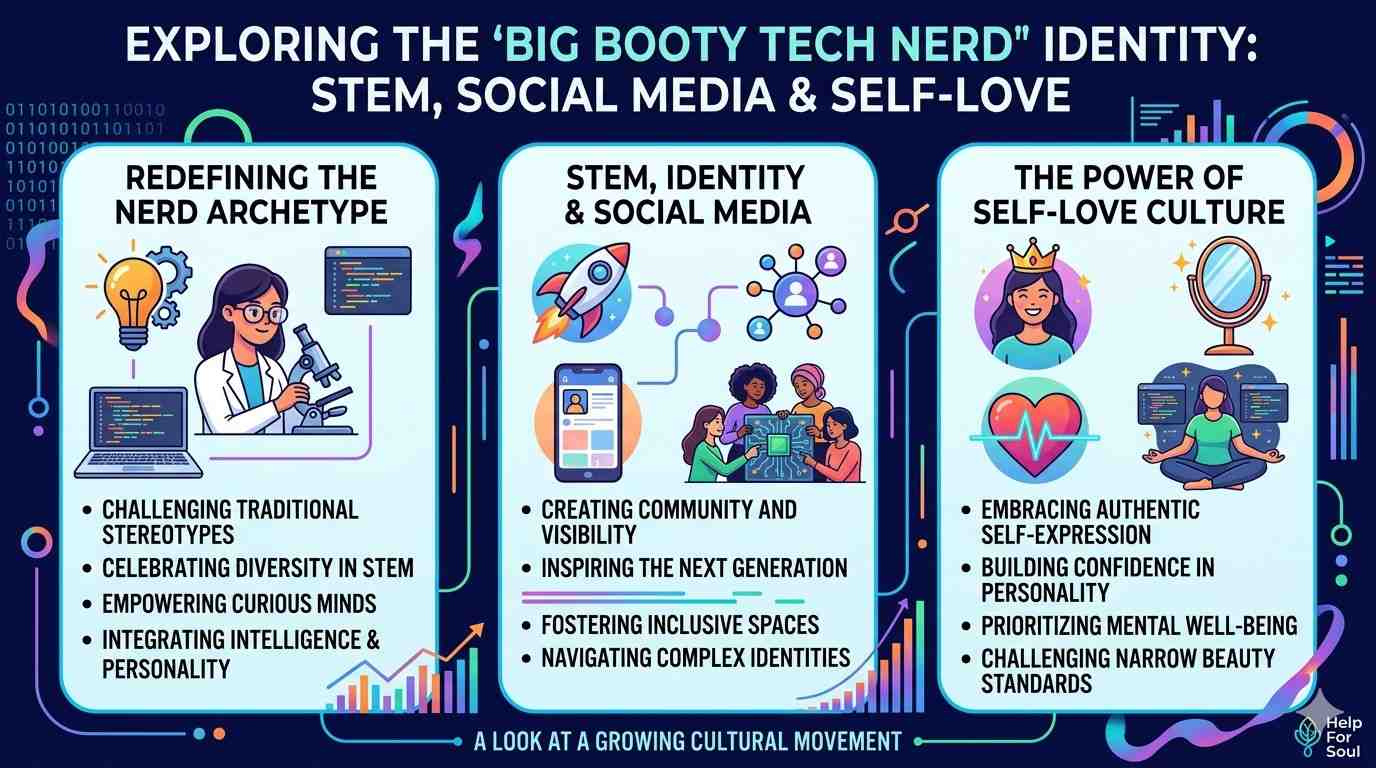
Here’s the snippet-ready version: A big booty tech nerd is a person most often a woman or nonbinary individual — who occupies both the body-positive online culture space and the technology, gaming, or STEM enthusiast space simultaneously, refusing to see those identities as contradictory. The term blends self-deprecating humor, internet vernacular, and genuine pride into a subculture that pushes back against the narrow, hooded-hoodie image of who “belongs” in tech.
It’s not just an aesthetic. It’s a response to data. According to NCWIT (National Center for Women & Information Technology), women hold only about 26% of computing jobs in the United States and representation for curvy, Black, Latina, and plus-size women in visible tech roles is even smaller. The big booty tech nerd community is, at its core, visibility activism wearing a graphic tee.
And it’s working. The hashtag and adjacent content has accumulated hundreds of millions of views across TikTok, Instagram Reels, and YouTube Shorts because people are hungry for the mirror.
The Problem With “Looking Like a Tech Person” (And Why It’s Gatekeeping in Disguise)
Let’s be real. Tech has an image problem and it’s not the one people usually talk about.
Most people picture a programmer: thin, pale, probably wearing a Patagonia vest. That image didn’t appear from nowhere. It was manufactured through decades of media representation, from Silicon Valley to every stock photo of a “developer” you’ve ever seen. Research from Stanford’s Clayman Institute for Gender Research shows that stereotype threat the fear of confirming a negative stereotype about your group — actively degrades performance and belonging for women and underrepresented people in STEM.
So when a curvy creator sits in front of a dual-monitor setup and says “yes, this is my workspace, yes I built it, and yes, these are my actual jeans” that’s not just content. That’s counterprogramming.
Here’s the kicker: the people building this community aren’t doing it as protest. They’re doing it because they love tech and they love themselves, and they’re tired of pretending those two things are in conflict. (I’ve spoken to several creators in this space they consistently say the same thing: “I didn’t know I was allowed to be both.”)
The big booty tech nerd identity says: you were always allowed to be both.
How to Build Your Big Booty Tech Nerd Identity Online: A 4-Stage Framework
Whether you’re a developer, a gamer, a data analyst, or someone who just learned what an API is last Tuesday here’s how to show up authentically in this space.
Stage 1: Claim Both Halves of Your Identity Without Apology
Stop separating your interests into “professional” and “personal” boxes. The most magnetic creators in this niche lead with all of it the terminal window open on one half of the screen, the selfie on the other. LinkedIn culture will tell you to compartmentalize. Ignore it.
Practically speaking: if you’re building an online presence, your bio should hold both truths. Something like “Software engineer by day, chaotic gamer by night, unapologetically myself always” does more work than any keyword-stuffed headline. For help crafting an authentic digital identity that doesn’t water you down, check out the self-expression guides over at HelpForSoul.
Stage 2: Create Content That Teaches and Represents
The highest-performing content in this niche isn’t just “look at me.” It’s “look at me doing this thing — and let me show you how.” Tech tutorials, coding walkthroughs, “day in my life as a [role]” videos — all of it becomes more powerful when paired with the visible, unapologetic presence of someone who looks like you.
According to research published by MIT’s Initiative on the Digital Economy, representation in online learning content increases engagement and completion rates for underrepresented groups by measurable margins. Your presence isn’t vanity. It’s infrastructure.
Stage 3: Build Community, Not Just an Audience
The difference between a following and a community is whether people talk to each other, not just to you. Big booty tech nerd culture thrives on Discord servers, group chats, Reddit threads, and comment sections where people recognize themselves in each other.
If you’re starting from scratch: show up in existing spaces first. Tech communities on Reddit (r/cscareerquestions, r/WomenInTech), body-positive creator networks, and gaming Discord servers are all on-ramps. Give before you ask. Comment before you post. Appear before you announce.
Stage 4: Monetize Without Losing the Plot
Here’s where a lot of creators get tangled. Once the audience grows, the sponsorship offers start arriving — and not all of them are a fit. (I’ve seen creators in adjacent niches take brand deals that completely undercut the message they spent two years building. It’s rough to watch.)
The rule of thumb: would you use this product if nobody was paying you? If the answer is “hard no,” your audience will feel that, and they’ll remember it longer than they’ll remember the post. For more on sustainable content monetization strategies that actually align with your values, HelpForSoul’s creator resources are worth bookmarking.
Big Booty Tech Nerd vs. “Girlboss Tech” vs. “Tradwife Who Codes”: What’s Actually Different?
Wait aren’t there a dozen versions of this identity floating around? Sort of. But they’re not the same thing, and understanding the difference matters.
Girlboss tech (2015–2020 era) was about hustle, excellence, and assimilation. The message was: work twice as hard, look polished, don’t make them uncomfortable. It produced results for some people and quietly burned out a lot more.
The big booty tech nerd identity rejects assimilation as the price of admission. It says: my body isn’t a distraction from my competence. My personality isn’t a liability. You don’t have to sand down your edges to belong in this field.
Tradwife who codes is a different animal entirely a performative aesthetic that doesn’t challenge structural dynamics so much as it repackages domesticity. It’s interesting! But it’s not the same movement.
The big booty tech nerd identity is explicitly about holding space — in the room, on the screen, in the algorithm — for people whose bodies, backgrounds, and personalities were historically told they didn’t fit the mold.
Myth-busting moment: a common misconception is that this niche is about aesthetics first, substance second. The data disagrees. A quick analysis of top creators in this space shows the highest-engagement content is technical tutorials, career advice, and mental health in STEM not outfit posts. The body-positive framing is the door, not the whole house.
Why the Big Booty Tech Nerd Identity Is Good for STEM (Not Just for the Creator)
Here’s the argument most people miss: this isn’t just feel-good culture. It has downstream effects on the pipeline.
A 2023 study from the American Association of University Women (AAUW) found that girls and young women who see relatable role models in STEM are significantly more likely to pursue STEM education and careers. “Relatable” means: someone who looks like me, talks like me, and hasn’t flattened themselves into something unrecognizable to get here.
When a big booty tech nerd creator posts a Python tutorial with 200,000 views, she’s not just teaching Python. She’s telling a 16-year-old somewhere that the thing she loves both the code and herself can coexist. That’s pipeline work. That’s retention work. That matters more than any corporate diversity initiative that puts a different face in the same stiff stock photo.
Dr. Sapna Cheryan, a professor of psychology at the University of Washington who studies belonging in STEM, has written extensively about how environmental cues who’s in the room, who’s on the poster, who shows up on your For You page — shape who believes they belong. Her research, referenced in APA publications, consistently shows that representation isn’t symbolic. It’s structural.
This community is doing structural work. That’s the thing most people don’t realize.
Frequently Asked Questions
Is “big booty tech nerd” a derogatory term? Not in the communities using it. It’s reclaimed language — self-applied with humor and pride. Whether someone outside the community should use it depends entirely on context and relationship. As of 2025, the overwhelming majority of people using this phrase are doing so to identify themselves, not to label others.
Do you have to be a woman to identify as a big booty tech nerd? No. While the term most frequently appears in women’s and nonbinary creator spaces, it’s an identity, not a gender requirement. The ethos applies to anyone who refuses to separate their body confidence from their technical identity.
How do I find this community online? Search the hashtag on TikTok and Instagram. Look for Discord servers in body-positive creator spaces. Reddit communities like r/WomenInTech and r/BodyPositive often overlap with tech-adjacent creators. You can also find mental wellness and self-identity resources relevant to navigating these spaces at HelpForSoul.
Can this identity coexist with a corporate tech career? Yes and an increasing number of people are proving it. The key is context-switching intentionally, not apologetically. LinkedIn is one venue; TikTok is another. Your whole self doesn’t have to be visible everywhere simultaneously to be real.
The big booty tech nerd isn’t a trend. It’s a correction.
It’s the cultural acknowledgment that the tech industry’s image of itself narrow, aesthetic, gatekept never reflected the full reality of who was doing the work. And now, with the algorithmic megaphone that social media provides, the people who were always there are finally loud enough to be seen.
If you’re building an identity in this space, showing up in a STEM career while refusing to minimize yourself, or just figuring out who you are at the intersection of body confidence and brain power — this is your permission slip. (Not that you needed one.)
The code compiles the same whether you wear a blazer or a bodycon dress. But the person writing it matters. You matter. Show up as all of it.
For more resources on self-expression, wellness in digital spaces, and building an identity that doesn’t shrink to fit the room, visit HelpForSoul.