



A sex-positive relationship is a partnership where both people treat sexuality as a normal, healthy part of life instead of something shameful or too awkward to discuss. It is built on open communication, ongoing consent, mutual respect for boundaries, and freedom from judgment about desires, orientation, or sexual history.
Being sex-positive does not mean having more sex or having no boundaries at all. It means honesty replaces silence, and curiosity replaces shame.
This guide draws on public health and university sexual health education sources, not opinion pieces, so you’re getting a definition grounded in how researchers and health educators actually use the term, not just how it trends on social media.
Table of Contents
What Sex-Positive Actually Means?
The phrase gets used loosely, so it helps to define it clearly. Sex positivity is a framework, not a lifestyle or a specific set of practices. It treats consensual sexual expression as a natural part of being human rather than something dangerous or dirty.
Public health experts and sexuality educators use the term in this exact way, focused on reducing stigma, increasing informed choice, and centering consent rather than encouraging any particular behavior.
Several U.S. universities now run sex-positive coaching programs for students, which shows how mainstream this framework has become in health education. The University of Kansas Sex-Positive Program describes its own approach as one that promotes sexual health and well-being, open communication, consent, respect for others, and clear boundaries, run through one-on-one coaching sessions with trained health educators.
Applied to a couple, a sex-positive relationship simply brings that same mindset inward. Sex becomes something you can talk about like any other shared part of life, such as finances or parenting, instead of a topic wrapped in silence or guilt.
The Core Principles Behind It
Communication comes before assumption. Partners talk directly about what they want, what they do not want, what they are curious about, and what makes them uncomfortable, instead of hinting and hoping the other person figures it out. This works best as an ongoing habit rather than one big, tense conversation.
Consent is treated as something that continues, not a box that gets checked once. It gets revisited as the relationship changes, and either partner can change their mind at any point without that being treated as a betrayal. The CDC’s research on sexual risk behaviors and healthy relationships underscores how central ongoing, clearly communicated consent is to both relationship health and violence prevention.
Non-judgment matters just as much. Desires, fantasies, past experiences, and mismatched libidos get discussed without shame or mockery. A partner bringing up a boundary or a curiosity should never be treated as a character flaw.
Respect for bodily autonomy is non-negotiable. Each person owns their own body and their own sexual decisions. Neither partner is entitled to sex, and neither has to justify saying no.
Shared responsibility for sexual health rounds it out. Sex-positive couples treat STI testing, contraception, and sexual health history as a joint and practical matter, the same way they would handle any other shared health decision. The HHS Office on Women’s Health relationships and safety resources page is a solid starting point for couples who want federally vetted guidance on this.
What a Sex-Positive Relationship Is Not
This is where a lot of people misunderstand the concept, so it is worth being direct.
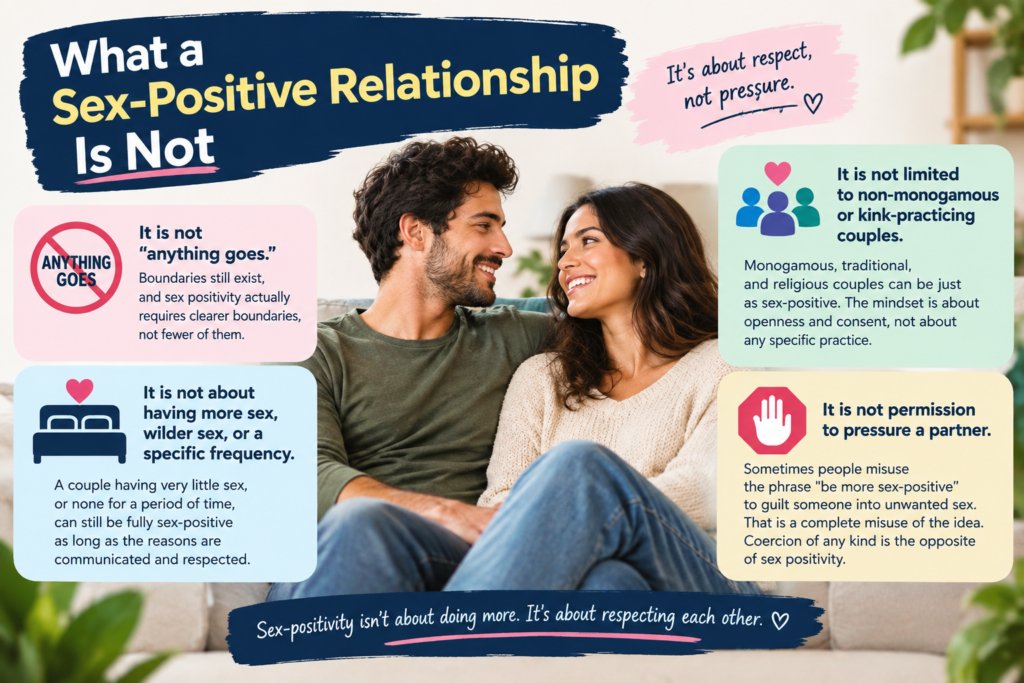
It is not “anything goes.” Boundaries still exist, and sex positivity actually requires clearer boundaries, not fewer of them.
It is not about having more sex, wilder sex, or a specific frequency. A couple having very little sex, or none for a period of time, can still be fully sex-positive as long as the reasons are communicated and respected.
It is not limited to non-monogamous or kink-practicing couples. Monogamous, traditional, and religious couples can be just as sex-positive. The mindset is about openness and consent, not about any specific practice.
It is not permission to pressure a partner. Sometimes people misuse the phrase “be more sex-positive” to guilt someone into unwanted sex. That is a complete misuse of the idea. Coercion of any kind is the opposite of sex positivity.
Signs You Are Building One
You can bring up a desire or a concern without rehearsing it for a week beforehand.
A “no” or a “not tonight” does not spark a fight or the silent treatment.
You have talked openly about sexual health rather than just assuming things are fine.
Mismatched desire feels like a puzzle to solve together instead of a personal rejection.
Neither partner uses sex as a reward or withholds it as a punishment.
You can admit you do not know something about sex without feeling embarrassed.
These signs do not mean that a relationship is perfect. They simply indicate that both partners are developing a healthier way of communicating about sexuality and intimacy.
How to Build a More Sex-Positive Relationship
Start with low-stakes conversations rather than saving every discussion for a tense moment. A relaxed chat over coffee about what is working and what is not takes the pressure off both people.
Try a recurring check-in. Some couples set aside time weekly or monthly to talk about their sex life the same way they would review a budget, as routine maintenance instead of a crisis conversation.
Separate the person from the preference. If your partner shares a boundary or a curiosity, respond to the information itself rather than treating it as an attack on the relationship.
Normalize saying “I don’t know.” Sex-positive couples are comfortable admitting uncertainty and learning together instead of performing expertise they do not have.
Get outside support if you need it. Ongoing communication breakdowns, mismatched desire, or lingering shame are common reasons couples see a licensed therapist, and that is a normal, proactive step rather than a sign of failure.
If you’re new to this site, you can learn more about who writes and reviews our relationship content on the HelpForSoul About Us page, and you can browse more of our latest guides from the HelpForSoul homepage.
Frequently Asked Questions
Does a sex-positive relationship mean having more sex?
No. It is about the quality of communication and consent around sex, not the amount of sex itself.
Can a monogamous couple be sex-positive?
Yes. Sex positivity is a mindset built around openness, consent, and non-judgment, and it applies just as much to monogamous couples as to non-monogamous ones.
Is sex-positive the same as being kinky or non-traditional?
No. It describes an attitude, not a set of practices. A traditional, low-key sexual relationship can be sex-positive, while a very adventurous one can still fall short if it lacks consent or respect.
What if my partner is not sex-positive yet?
Start small with low-pressure conversations rather than a confrontation. If shame or avoidance continues, a licensed couples or sex therapist can help both people build these communication skills.
Does sex positivity mean there are no boundaries at all?
It is the opposite. Because everything gets discussed openly, sex-positive relationships usually end up with clearer and better-communicated boundaries than relationships where the topic gets avoided.
Is sex positivity backed by health experts, or is it just a trend?
It is grounded in public health practice. University health centers, including the University of Kansas program referenced above, and federal health agencies both use sex-positive principles like consent and open communication as core parts of relationship and sexual health education.
A Final Note
A sex-positive relationship is not about being bold, adventurous, or unconventional. It is about honesty, consent, and respect becoming part of how two people talk to each other.
Once shame leaves the conversation, most couples find the rest becomes much easier to work through together.
