


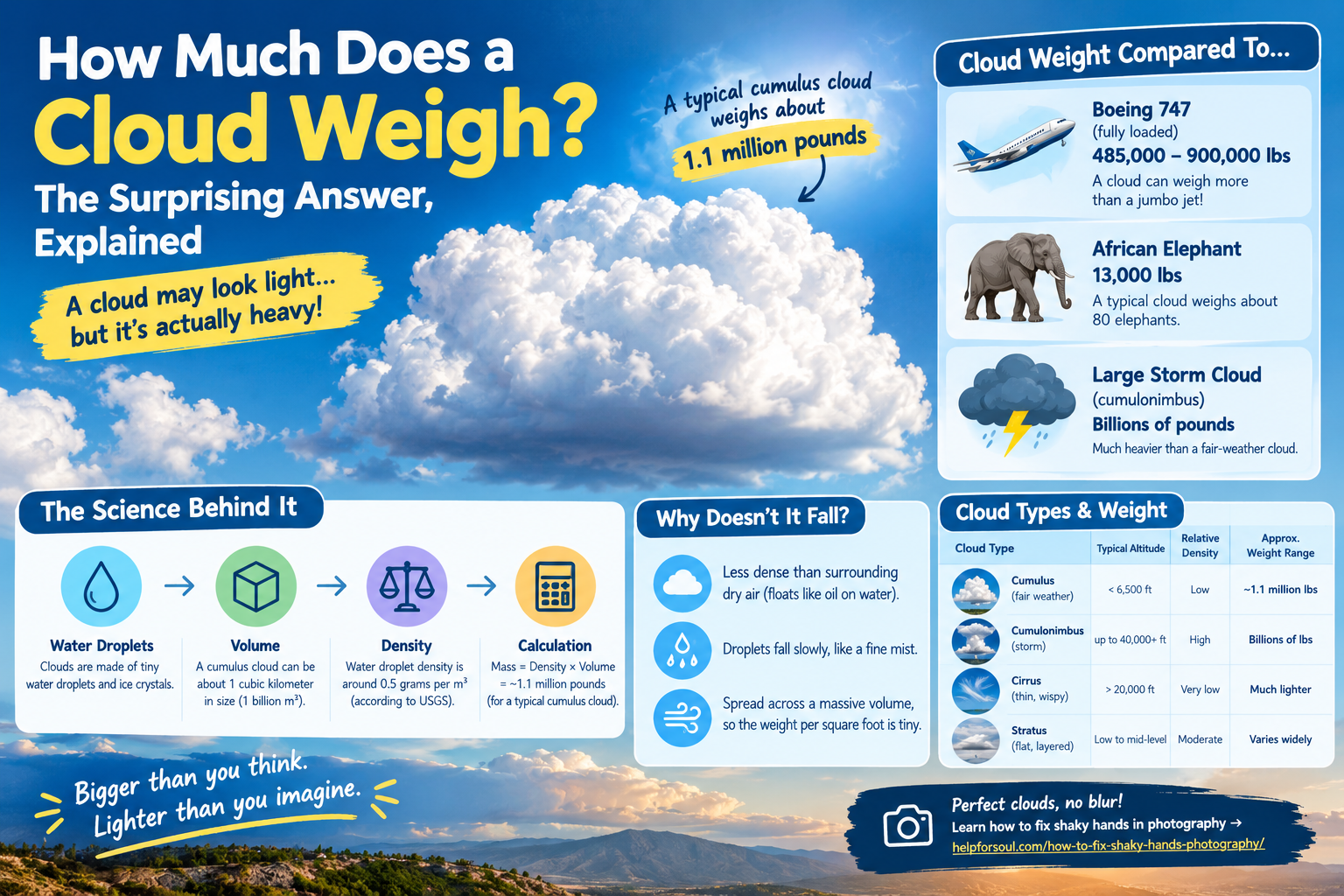
A single average cumulus cloud, the puffy white kind you see on a clear day, weighs about 1.1 million pounds. Some larger storm clouds weigh far more than that, in the billions of pounds. That number sounds impossible for something floating gently overhead, but it comes directly from how meteorologists and physicists calculate cloud mass using water density and cloud volume.
This guide breaks down exactly how scientists arrive at that figure, why something that heavy can float, and how different cloud types compare, using the same data NASA and the U.S. Geological Survey publish for students and researchers.
The Short Answer :
According to NASA Earthdata, a typical cumulus cloud might weigh more than one million pounds, even though an airplane can fly straight through it without feeling a thing.
That single fact captures the whole paradox of cloud weight: clouds are physically heavy, but they are spread across such an enormous volume of air that the weight per square foot is tiny.
Table of Contents
How Scientists Actually Calculate Cloud Weight
You cannot put a cloud on a scale, so researchers calculate its weight using a simple physics formula:
Mass = Density × Volume
The USGS Water Science School walks through this exact method.
Clouds are made of countless tiny water droplets or ice crystals, and because water has a known density, scientists can estimate the total water content of a cloud once they know roughly how much space it occupies.
A typical cumulus cloud has a water droplet density of around 0.5 grams per cubic meter, according to USGS calculations. That sounds like almost nothing until you consider the scale involved.
A single cumulus cloud can easily be a cubic kilometer in size, which contains one billion cubic meters of space. Multiply that volume by the density of the water inside it, and you get a total mass in the range of half a billion grams, which converts to roughly 1.1 million pounds.
NASA’s Goddard Space Flight Center publishes a related classroom exercise, Estimating the Mass of a Cloud, that walks students through this same density-times-volume math step by step, using real cumulus cloud measurements.
Why a Million-Pound Cloud Does Not Fall on You
This is the part that trips people up. If a cloud weighs over a million pounds, why doesn’t it crash to the ground?
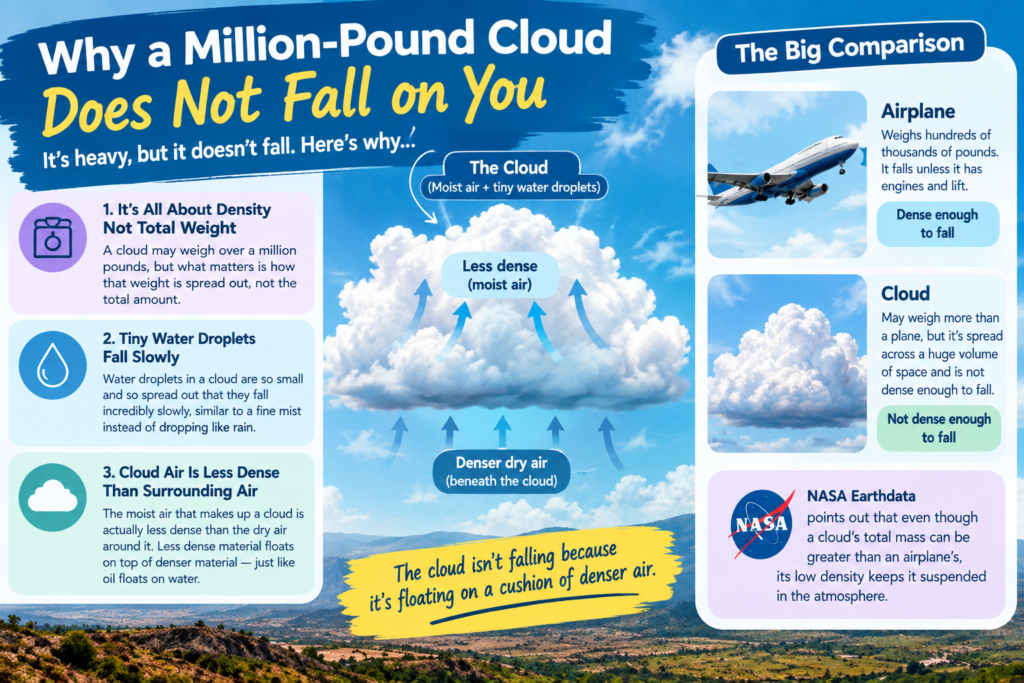
The answer comes down to density, not total weight.
Water droplets in a cloud are so small and so spread out that they fall incredibly slowly, similar to how a fine mist settles instead of dropping like rain.
More importantly, the moist air that makes up a cloud is actually less dense than the surrounding dry air around it. Since less dense material floats on top of denser material, the same way oil floats on water, the “lighter” cloud effectively rests on a cushion of heavier dry air beneath it.
NASA Earthdata makes the comparison directly: an airplane weighing hundreds of thousands of pounds is dense enough to fall through the sky unless powered by engines and lift, but a cloud spread across a cubic kilometer of space is not dense enough to fall the same way, even though its total mass is often greater than the plane’s.
Putting the Number in Perspective
A million pounds is hard to picture, so here is what it compares to using publicly available figures.
A Boeing 747 aircraft weighs roughly 485,000 to 900,000 pounds depending on the model and load, meaning a single large cumulus cloud can weigh more than a fully loaded jumbo jet, just spread across a far larger space.
An adult African elephant weighs around 13,000 pounds, so a typical cumulus cloud is roughly equal to 80 elephants floating quietly overhead.
Larger cloud systems weigh dramatically more.
A big cumulonimbus thunderstorm cloud, which can extend for miles and reach tens of thousands of feet into the atmosphere, can weigh in the billions of pounds once you scale up the volume calculation.
NASA’s cloud research program notes that clouds range from ground level up to 280,000 feet in altitude and come in more than a dozen distinct types, each with its own density and water content, which is why cloud weight estimates vary so widely depending on the type of cloud being measured.
If you like photographing big cumulus or storm clouds like these, camera shake becomes a real problem at telephoto range, so it’s worth checking HelpForSoul.com’s guide on how to fix shaky hands in photography before you head out to shoot the sky.
How Cloud Weight Varies by Type
| Cloud Type | Typical Altitude | Relative Density | Approximate Weight Range |
|---|---|---|---|
| Cumulus (fair weather) | Low, under 6,500 feet | Low | Around 1.1 million pounds |
| Cumulonimbus (storm) | Low to very high, up to 40,000+ feet | High water content | Can exceed billions of pounds |
| Cirrus (thin, wispy) | High, above 20,000 feet | Very low, mostly ice crystals | Much lighter per cubic meter than cumulus |
| Stratus (flat, layered) | Low to mid-level | Moderate | Varies widely with size and thickness |
These figures are estimates built from published density values, since exact weight depends on a specific cloud’s size and water content at the moment it is measured.
Why This Question Matters Beyond Trivia
Understanding cloud mass is not just a fun fact. It matters for weather forecasting, aviation safety, and climate science.
NASA’s Earth science missions study cloud formation and behavior specifically because cloud density and mass affect precipitation patterns, storm intensity, and how much heat clouds trap or reflect, which plays directly into climate modeling.
The same density principles that explain why a cloud floats also explain why storm clouds eventually release their water as rain: once water droplets combine and grow heavy enough, gravity finally overcomes the low density that was keeping them aloft, and the cloud releases precipitation.
Frequently Asked Questions
How much does an average cloud weigh in pounds?
A typical cumulus cloud weighs approximately 1.1 million pounds, based on NASA and USGS density calculations, even though it appears weightless from the ground.
Why doesn’t a cloud fall out of the sky if it’s that heavy?
Because the moist air inside a cloud is less dense than the dry air surrounding it, similar to how oil floats on water. The cloud’s total weight is spread across such a massive volume that it stays suspended rather than falling as a solid mass.
Do all clouds weigh the same amount?
No. Weight depends heavily on cloud type, size, and water content. A thin cirrus cloud weighs far less per cubic meter than a dense cumulonimbus storm cloud, which can weigh in the billions of pounds.
How do scientists measure the weight of something they can’t put on a scale?
They use the physics formula mass equals density multiplied by volume, combined with known water droplet density figures and satellite or radar-based cloud size measurements, a method detailed in NASA’s own cloud mass classroom materials.
Is a storm cloud heavier than a regular cloud?
Yes, significantly. Cumulonimbus storm clouds contain far more water and often extend across a much larger volume of the atmosphere, which is why their estimated total mass can run into the billions of pounds compared to roughly a million pounds for a fair-weather cumulus cloud.
What happens to all that weight when it rains?
Rain is essentially the cloud losing mass. As water droplets collide and grow too heavy for the surrounding air to keep aloft, they fall as precipitation, which is why a storm cloud visibly shrinks or dissipates after a heavy downpour.
Final Thought
The next time you look up at a cloud, you are looking at something that likely weighs more than a loaded jumbo jet, and it is only staying up there because of a density difference measured in fractions of a gram.
It is one of those facts that sounds unbelievable until you see the actual math behind it, which is exactly why NASA and USGS publish these calculations for public and classroom use in the first place..
