


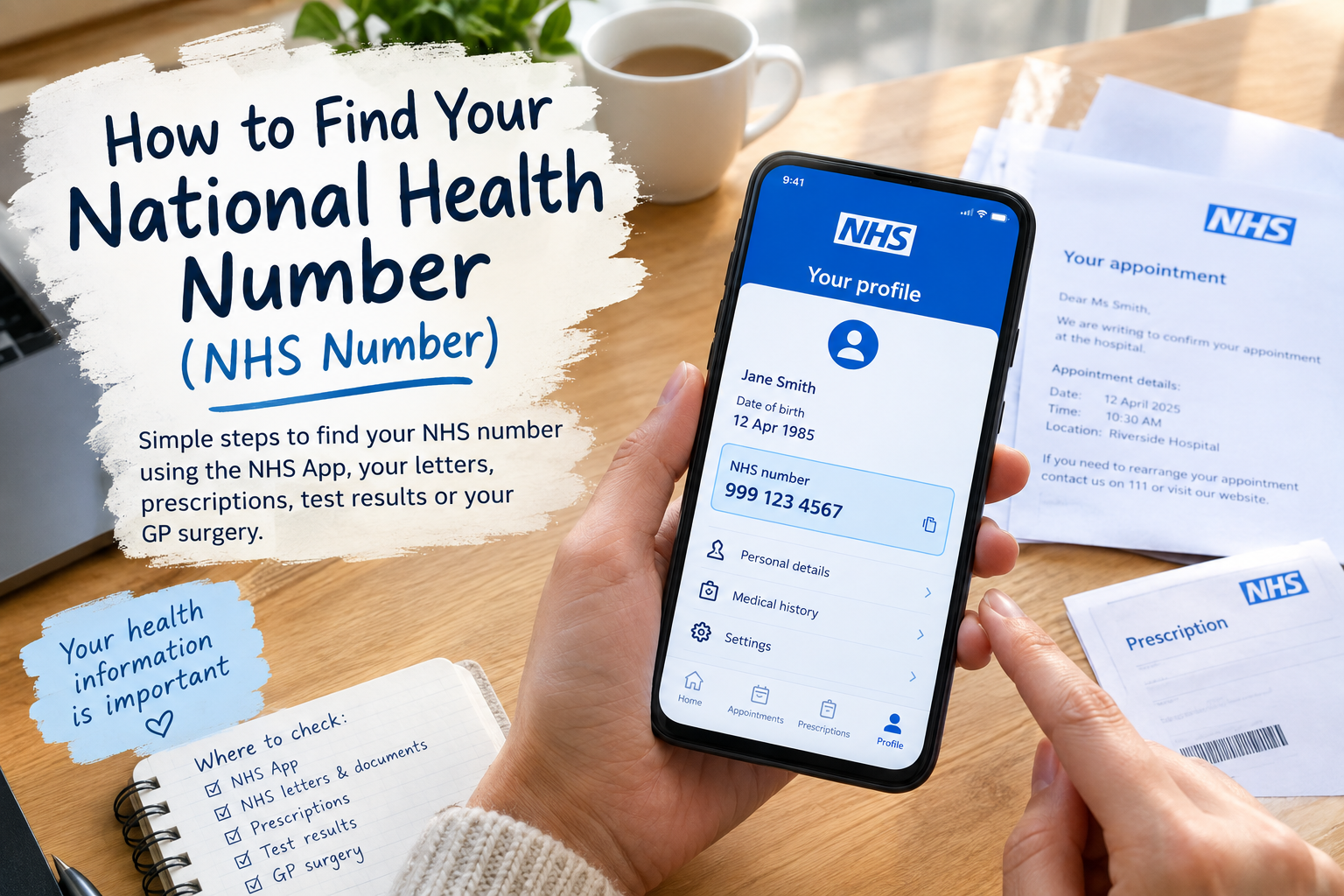
How to Find National Health Num
If you are searching for how to find national health number, you are most likely looking for your NHS number.
An NHS number is a unique 10-digit number used to help healthcare services identify you and correctly match you with your health records. If you have forgotten your number, you usually do not need to worry. There are several straightforward ways to find it.
The quickest method for many people is to check the NHS App. If you do not use the app, you can look through NHS letters, prescriptions, test results and hospital correspondence. You can also contact your GP surgery and ask them to help you find your number.
This guide explains how to find your NHS number, where to look, what to do if you cannot access the NHS App, whether you can find it online, and the difference between your NHS number, NHS login and National Insurance number.
Table of Contents
Quick Answer: How to Find My NHS Number
If you only need the answer quickly, try these options in this order:
- Open the NHS App and go to Profile.
- Look underneath your name and date of birth.
- Check recent NHS letters and documents.
- Look at prescriptions, test results and hospital appointment or referral letters.
- If you still cannot find it, contact your GP surgery.
The current NHS App guidance confirms that your NHS number can be viewed from your profile.
If you do not know your NHS number, you can still use NHS healthcare services. NHS England guidance states that patients do not need to know their NHS number to access GP or other health services.
What Is an NHS Number?
An NHS number is a unique 10-digit number used to help healthcare staff and service providers correctly identify an individual and match that person with their health record.
It is commonly written in this format:
999 123 4567
This is an example format, not a real patient’s number. NHS guidance recommends displaying an NHS number as two groups of three digits followed by a group of four digits because this makes it easier to read and reduces mistakes.
Your NHS number is different from your:
- NHS login
- National Insurance number
- GP practice telephone number
- Hospital reference number
- Prescription number
- Other healthcare booking references
NHS England explains that the NHS number is allocated to patients and is used to help healthcare providers correctly match patients with their records.
For more information, you can read the official NHS England guidance about the NHS number.
How to Find My NHS Number
There are several ways to find your NHS number.
The most convenient option depends on what you have access to.
1. Check the NHS App
If you already use the NHS App, this is usually one of the easiest ways to find your number.
According to the current NHS App guidance, you can find it by following these steps:
Step 1: Open the NHS App
Open the NHS App on your phone or access NHS App services through the NHS website.
Step 2: Go to Profile
From the home screen, select Profile.
Step 3: Find Your Personal Details
Look for your name and date of birth.
Step 4: Check Below Your Details
Your NHS number should be displayed underneath your name and date of birth.
The current NHS App guidance for viewing your NHS number confirms these steps.
This makes the NHS App particularly useful when you need your number quickly and do not have any NHS paperwork nearby.
How Do I Find My NHS Number Without the NHS App?
You do not need the NHS App to find your NHS number.
If you do not use the app, the next step is to check documents you have received from NHS services.
Your NHS number may appear on documents such as:
- GP letters
- Hospital letters
- Appointment letters
- Referral letters
- Prescription documents
- Test results
- Other NHS correspondence
NHS guidance specifically identifies NHS letters and documents, including prescriptions, test results and hospital referral or appointment letters, as places where you may find your NHS number.
Therefore, if you are asking how do I find my NHS number without the app, you should first search through your recent healthcare paperwork.
Where Can I Find My NHS Number?
If you are wondering where can I find my NHS number, use this checklist:
| Place to check | What to look for |
|---|---|
| NHS App | Profile → your name and date of birth |
| GP letters | Recent letters and correspondence |
| Hospital letters | Appointment and referral letters |
| Test results | Printed or electronic result documents |
| Prescriptions | Prescription-related documents |
| GP surgery | Ask the practice to help you locate it |
| GP online services | Check your personal information if available |
The NHS confirms that your number can be found through the NHS App and may also appear on letters from your GP surgery or hospital.
How to Find Your NHS Number on a Letter
If you have an NHS letter in front of you, look carefully at the personal information section.
The NHS number may be displayed alongside information such as:
- Your name
- Date of birth
- Address
- NHS number
- Appointment details
The exact position can vary depending on which healthcare organisation sent the letter.
Do not assume that every long number on a letter is your NHS number. Look for a label such as NHS Number or NHS No.
If you cannot identify the number confidently, do not guess. You can check another NHS document or contact your GP surgery.
How to Find Your NHS Number on a Prescription
Prescriptions and prescription-related documents can also contain your NHS number.
If you regularly receive prescription information, check the document carefully for your patient details.
NHS England lists prescriptions among the documents where a patient may find their NHS number.
If you cannot find it there, try your NHS App or another NHS letter.
How to Find Your NHS Number on Test Results
Recent test-result documents are another place worth checking.
Look through your electronic or paper correspondence and search for a section containing your personal information.
You may see your NHS number alongside your name and date of birth.
If you receive test results electronically, the exact format can vary between services. If you cannot find the number, use another method rather than assuming a particular number is your NHS number.
How to Find Your NHS Number on a Hospital Letter
If you have received a hospital appointment or referral letter, check it carefully.
NHS England specifically identifies hospital referral and appointment letters as documents that can contain an NHS number.
This can be particularly useful if you do not have the NHS App.
Before contacting your GP surgery, check your recent hospital correspondence. You may already have the number in front of you.
Contact Your GP Surgery
If you have tried the NHS App and checked your documents but still cannot find your NHS number, contact your GP surgery.
Explain that you need to find your NHS number and cannot locate it.
If you are registered with the practice, the surgery should be able to help. NHS England says that a GP practice can provide the number and may ask you to show proof of identity, such as a passport or driving licence.
This identity check is designed to protect your personal information.
You may be asked questions to confirm that you are the correct patient before the practice gives you the number.
Can I Find My NHS Number Online?
This is where it is important to use current information.
You may find older websites and articles referring to an online Find your NHS number service.
However, the current NHS website search results state that the Find your NHS number service is no longer available.
Therefore, if an old article tells you to use that specific service, its instructions may no longer reflect the current process.
Instead, use one of the currently available methods:
- NHS App
- NHS letters
- Hospital correspondence
- Prescriptions
- Test results
- GP surgery
This is particularly important when searching online because NHS services can change over time.
Always check the current NHS website before relying on an older guide.
Is There an NHS Number Finder?
You may see websites describing themselves as an NHS number finder or NHS number lookup service.
Be careful when using websites that are not official healthcare sources.
You should not enter sensitive personal information into an unfamiliar website simply because it claims that it can find your NHS number.
The current NHS website states that the old Find your NHS number service is no longer available.
The safest options are to use the NHS App, check your NHS documents or contact your GP surgery.
How Can I Find My NHS Number in the NHS App?
If you already have an NHS App account, follow these steps:
1. Open the NHS App
Log in to your account.
2. Select Profile
Go to Profile from the home screen.
3. Find Your Name
Your personal details should be displayed.
4. Look Under Your Name and Date of Birth
Your NHS number should be shown there.
The official NHS App help page for viewing your NHS number confirms the current process.
If you cannot see the number, check your NHS documents or contact your GP surgery.
What If My NHS Number Is Not Showing in the NHS App?
If you cannot see your NHS number, there are several things you can try.
First, make sure you are viewing your own profile.
The NHS also explains that if you manage health services for someone else through the NHS App, you cannot view that person’s NHS number through that access.
If you are looking at your own profile and still cannot find the number:
- Check your NHS letters.
- Check hospital correspondence.
- Check prescriptions and test results.
- Contact your GP surgery.
You do not need to guess the number or try to create another one.
How Do I Get My NHS Number?
The phrase how to get my NHS number can mean two different things.
You may already have an NHS number but have forgotten it.
Or you may genuinely never have had one.
These situations are different.
If You Already Have an NHS Number
Do not try to obtain a second number.
Instead, find your existing number through:
- NHS App
- NHS documents
- GP surgery
- GP patient-facing online services, where available
If You Have Never Had an NHS Number
NHS England explains that an NHS number is usually allocated at birth or when NHS care is accessed for the first time. Patients who have never had an NHS number should be encouraged to register with a GP practice, which results in an NHS number being created.
If you believe you have never had one, speak with a GP practice about registration.
Do I Need My NHS Number to Register With a GP?
No.
Not knowing your NHS number should not prevent you from asking about GP registration.
NHS England guidance states that patients who have never had an NHS number should be encouraged to register with a GP practice, which will result in an NHS number being created.
If you are unsure about your situation, speak directly with the GP practice.
Do I Need My NHS Number to See a Doctor?
No.
You do not need to know your NHS number to access GP or other health services.
NHS England specifically states that patients do not need to know their NHS number to access GP or other health services.
This is useful to remember if you have an appointment but cannot find your number.
Do not delay necessary healthcare simply because you have forgotten the number.
If a healthcare provider asks for it, explain that you do not currently know it and ask what you should do.
Is My NHS Number the Same as My NHS Login?
No.
An NHS number and an NHS login are different.
Your NHS number is a healthcare identifier used to help match you with your health record.
Your NHS login is used to access certain online NHS services.
This distinction matters because someone searching for how to find my NHS number may accidentally search for their login details instead.
If you are trying to recover your NHS App access, you may need your login information.
If you are trying to identify your healthcare record, you are looking for your NHS number.
Is My NHS Number the Same as My National Insurance Number?
No.
Your NHS number and National Insurance number are completely different identifiers.
NHS number
Used to identify you within healthcare records.
National Insurance number
Used for tax, National Insurance and related government purposes.
If a healthcare form asks specifically for your NHS number, do not enter your National Insurance number instead.
The numbers serve different purposes.
Does My NHS Number Change?
An NHS number is generally valid for life.
NHS England identifies limited circumstances in which a new NHS number may be issued, including adoption, gender reassignment or where changing the number is necessary to protect someone’s identity.
For ordinary circumstances such as changing your address or changing GP surgery, you should not normally expect your NHS number to change.
This is one reason it is useful to keep a secure record of your number.
What Happens If I Change GP Surgery?
Changing GP surgery does not normally mean receiving a new NHS number.
The NHS number is associated with your healthcare identity and is used to help connect your records across healthcare settings.
NHS England explains that the NHS number supports the accurate matching and sharing of patient information between healthcare providers.
Therefore, changing your GP surgery is not normally a reason to look for a new NHS number.
What Happens If I Move House?
Moving house does not normally result in a new NHS number.
Your address may change, and your healthcare records should contain your current personal information, but your NHS number generally remains the same.
If you move, make sure your GP practice has your updated contact information.
If you are unsure whether your details have been updated, contact your GP surgery.
What If I Lost My NHS Medical Card?
Some people remember older NHS medical cards that contained an NHS number.
Medical cards are no longer issued.
NHS England explains that if a previous medical card has been lost, it does not need to be replaced.
Instead, use the NHS App, check NHS correspondence or contact your GP surgery.
So if you have been searching for an old medical card because you think it is the only way to find your NHS number, you can use the newer methods instead.
Why Is the NHS Number Important?
You may wonder why healthcare providers use an NHS number when they already have your name and date of birth.
The main reason is accurate identification.
Many people can have similar or identical names. Personal details can also change over time.
A unique identifier helps healthcare providers match information with the correct patient.
NHS England explains that the NHS number is fundamental to patient safety because it reduces the risk of information being incorrectly matched with another person’s record and helps healthcare organisations share information more safely.
It can also help reduce the risk of duplicate patient records.
Should I Keep a Record of My NHS Number?
Yes, it can be useful to keep your NHS number somewhere secure.
For example, you may want to remember where you can access it through your NHS App or keep a private record with your important personal documents.
However, avoid posting your full NHS number publicly.
Do not share it casually on social media, public forums or websites.
If an organisation asks for your NHS number, make sure you understand who they are and why they need it.
Can I Find Someone Else’s NHS Number?
Your NHS number is personal information.
You should not try to obtain another person’s NHS number without appropriate authority.
The NHS App also states that if you manage health services for someone else through the app, you cannot view their NHS number through that access.
If you are responsible for managing someone else’s healthcare, use the appropriate official process rather than trying to find their number independently.
What If I Cannot Find My NHS Number Anywhere?
If you have checked everything and still cannot find your number, follow this simple process.
Step 1: Check the NHS App
Go to Profile and look underneath your name and date of birth.
Step 2: Search your NHS paperwork
Check:
- GP letters
- Hospital letters
- Appointment letters
- Referral letters
- Prescriptions
- Test results
Step 3: Contact your GP surgery
Explain that you cannot find your NHS number.
Step 4: Confirm your identity
The practice may ask you to provide identification before giving you personal information. NHS England says a passport, driving licence or other proof of identity may be requested.
This is usually the best route if you have exhausted the other options.
NHS Number vs NHS Login vs National Insurance Number
The following table makes the difference easier to understand:
| Number or account | Main purpose |
|---|---|
| NHS number | Identifies you within healthcare records |
| NHS login | Provides access to certain online NHS services |
| National Insurance number | Used for tax, National Insurance and related government purposes |
If a healthcare organisation asks for your NHS number, do not assume that your National Insurance number or NHS login is the same thing.
NHS Number: Important Things to Remember
If you only remember a few points from this guide, remember these:
Your NHS number has 10 digits
It is generally displayed as three groups:
999 123 4567
You can find it in the NHS App
Go to Profile and check beneath your name and date of birth.
It may appear on NHS documents
Check prescriptions, test results, GP letters and hospital correspondence.
Your GP surgery can help
If you cannot find the number, your GP practice can help verify it, subject to identity checks.
You do not need to know it to receive healthcare
Not knowing your NHS number should not stop you from accessing GP or other health services.
Do not rely on outdated online guides
The current NHS search results state that the old Find your NHS number service is no longer available.
Related NHS Information
If your search is related to NHS employment rather than your personal NHS number, you may also find our guide on ESR Log In NHS and accessing your Electronic Staff Record useful.
The Electronic Staff Record is separate from the personal NHS number system, but it can be relevant to people looking for information about NHS employee systems, staff records and payslips.
Frequently Asked Questions
What is my NHS number?
Your NHS number is a unique 10-digit healthcare identifier used to help healthcare services correctly identify you and match you with your health record.
How do I find my NHS number?
Open the NHS App, go to Profile, and look beneath your name and date of birth. You can also check NHS letters, prescriptions, test results and hospital documents or contact your GP surgery.
How do I find my NHS number without the NHS App?
Check NHS letters, hospital correspondence, prescriptions and test results. If you still cannot find it, contact your GP surgery.
Where can I find my NHS number?
You can find it in the NHS App, on many NHS documents and letters, or by contacting your GP surgery.
How do I find out my NHS number online?
The current NHS website states that the old Find your NHS number service is no longer available. The NHS App, NHS documents and GP surgery are the current practical options.
How do I find my NHS number on the NHS App?
Open the NHS App, select Profile, find your name and date of birth, and look underneath those details for your NHS number.
How do I get my NHS number?
If you already have an NHS number, you should find your existing number rather than request another one. If you have never had one, NHS England says registering with a GP practice will result in an NHS number being created.
Can I get another NHS number if I lose mine?
You should not request another number simply because you have forgotten your existing one. Your existing NHS number can usually be found through the NHS App, NHS documents or your GP surgery.
Do I need my NHS number to see a doctor?
No. NHS England states that patients do not need to know their NHS number to access GP or other health services.
Do I need my NHS number to register with a GP?
Not knowing your NHS number should not prevent you from asking about GP registration. People who do not have an NHS number can be allocated one through the appropriate registration process.
Is my NHS number the same as my National Insurance number?
No. They are different identifiers with different purposes.
Is my NHS number the same as my NHS login?
No. An NHS number identifies you within healthcare records, while NHS login is used to access certain online services.
Does my NHS number change if I move?
Generally, no. NHS numbers are valid for life except in limited circumstances.
Does my NHS number change when I change GP surgery?
Generally, no. Changing GP surgery does not normally result in a new NHS number.
What if I lost my NHS medical card?
Medical cards are no longer issued, and NHS England says a lost medical card does not need to be replaced.
Can I find my NHS number on a hospital letter?
Yes. NHS England identifies hospital appointment and referral letters as examples of documents where your NHS number may be shown.
Can I find my NHS number on my prescription?
Yes, your NHS number may appear on prescription-related documents. NHS England specifically lists prescriptions among the documents where you may find it.
What should I do if I cannot find my NHS number anywhere?
Check the NHS App and your NHS documents first. If you still cannot find it, contact your GP surgery. You may need to provide proof of identity before the practice gives you the number.
Final Answer: How to Find National Health Number
If you searched how to find national health number, the term you are generally looking for is your NHS number.
The easiest way to find it is to open the NHS App, go to Profile, and look underneath your name and date of birth.
If you do not use the NHS App, check your NHS paperwork. Your NHS number may appear on:
- GP letters
- Hospital letters
- Appointment letters
- Referral letters
- Prescriptions
- Test results
If you still cannot find it, contact your GP surgery. The practice can help you locate your number and may ask you to provide proof of identity.
One important point is that you do not need to know your NHS number to access GP or other health services.
Also, be careful with older online articles. The current NHS website says that the previous Find your NHS number service is no longer available.
So, if you have forgotten your number, the safest approach is simple: check the NHS App, check your NHS documents, or contact your GP surgery.
