


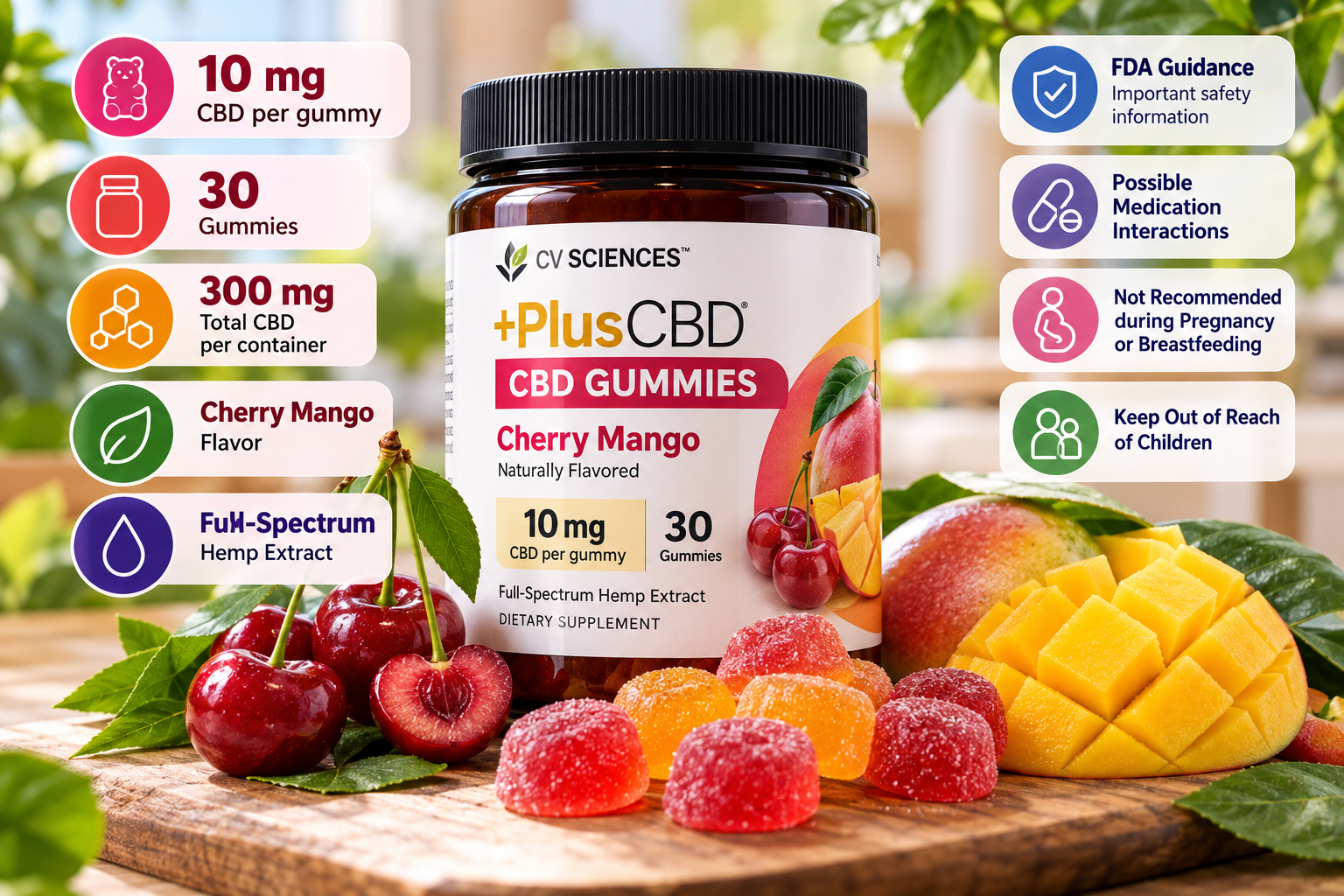
CV Sciences CBD Gummies 10mg Cherry Mango 30 Gummies refers to a +PlusCBD gummy product containing 10 mg of CBD per gummy in a 30-count Cherry Mango package.
That means a 30-gummy container provides:
10 mg CBD × 30 gummies = 300 mg of labeled CBD per container
For U.S. shoppers, however, the amount of CBD is only one part of the picture. Before buying or using CBD gummies, it is worth understanding the product format, what “10 mg” means, how CBD products are regulated, potential medication interactions, and why checking the current product label and batch information matters.
This guide focuses on those practical questions rather than making unsupported health claims.
CV Sciences CBD Gummies 10mg Cherry Mango – 30 Gummies at a Glance
| Feature | Details |
|---|---|
| Brand | +PlusCBD / CV Sciences |
| Product | CBD gummies |
| Flavor | Cherry Mango |
| CBD per gummy | 10 mg |
| Count | 30 gummies |
| Total labeled CBD | 300 mg |
| Format | Chewable gummy |
| U.S. market | Hemp-derived CBD product |
| Important check | Current label and batch-specific testing |
The exact 10 mg Cherry Mango 30-count product has appeared in U.S. product-registration records under CV Sciences.
The more important question for consumers is whether the bottle they are considering matches that exact strength, count and formulation, since CBD product packaging and product lines can change over time.
What Does 10 mg of CBD Per Gummy Mean?
The 10 mg on the product name refers to the labeled quantity of cannabidiol, or CBD, in each gummy.
If the bottle contains 30 gummies:
10 mg × 30 = 300 mg CBD
This calculation is useful when comparing one CBD product with another.
However, 10 mg per gummy should not automatically be interpreted as the right personal dose.
The U.S. Food and Drug Administration says important questions remain about the safety of nonprescription CBD products, including how different amounts affect people, how long-term use may affect health, and how CBD may interact with medicines.
The FDA consumer guidance on CBD products explains these concerns in more detail.
In practical terms, the 10 mg figure is best viewed as product-strength information, not a universal dosage recommendation.
What Is CBD?
CBD stands for cannabidiol, one of the cannabinoids found in Cannabis sativa.
CBD is different from delta-9-tetrahydrocannabinol, better known as THC. THC is primarily responsible for the intoxicating effects associated with marijuana.
The National Center for Complementary and Integrative Health explains that CBD and THC are among the main cannabinoids found in cannabis, while many additional cannabinoids have also been identified.
For readers who want a science-based overview, the NCCIH guide to cannabis and cannabinoids discusses CBD, THC, research findings and safety considerations.
Is This a Full-Spectrum CBD Gummy?
The CV Sciences / +PlusCBD Cherry Mango gummy line has historically been marketed using full-spectrum hemp extract terminology.
Full-spectrum hemp products may contain CBD together with other naturally occurring hemp compounds.
That is important because consumers sometimes assume a CBD gummy must be completely free of THC.
That assumption should not be made based on the word “CBD” alone.
If avoiding THC matters to you, check:
- the current product label;
- cannabinoid information;
- the batch or lot number;
- the corresponding certificate of analysis;
- any THC result reported for that specific batch.
Product formulations can change, so an old label or laboratory report should not automatically be treated as evidence for a newly purchased bottle.
Why a Certificate of Analysis Matters
Many CBD manufacturers provide a certificate of analysis, often called a COA, for individual product batches.
A COA may provide laboratory results for cannabinoids and, depending on the testing performed, certain contaminants.
When evaluating a COA, pay attention to the following information.
1. Product name
Make sure the laboratory document actually refers to the product you purchased.
2. Batch or lot number
The lot number on the test report should correspond with the number printed on your package when possible.
3. CBD result
Compare the laboratory result with the CBD amount claimed on the label.
4. THC result
If THC exposure matters to you, look carefully at the reported THC concentration rather than assuming the product contains none.
5. Testing date
A recent report for the relevant batch is generally more useful than an old report from a previous formulation.
6. Contaminant testing
Check whether testing covers substances such as heavy metals or other contaminants where applicable.
The FDA notes that some CBD products have raised quality concerns, including products that did not contain the amount of CBD consumers might expect from the labeling.
That makes independent batch information particularly useful when comparing CBD products.
Are CV Sciences CBD Gummies FDA Approved?
The CV Sciences CBD Gummies 10mg Cherry Mango – 30 Gummies are not the FDA-approved prescription CBD medicine.
This distinction is important.
The FDA has approved a prescription CBD drug for specific seizure disorders. Approval of that medicine does not mean ordinary CBD gummies sold to consumers are FDA-approved treatments.
The FDA explains this distinction in its regulatory information about cannabis and CBD products.
Consumers should therefore be cautious when a CBD product is promoted with claims that it can diagnose, prevent, cure or treat diseases.
A product containing CBD should not automatically be treated as medically equivalent to an FDA-approved CBD prescription drug.
What Does the FDA Say About CBD Safety?
One reason CBD product research can be confusing is that online product pages often focus heavily on potential benefits while giving much less attention to safety.
The FDA says CBD can present real risks.
Potential concerns identified by federal health authorities include:
- changes in alertness or drowsiness;
- diarrhea and other gastrointestinal effects;
- changes in appetite;
- possible liver injury;
- interactions with medications;
- increased sedation when CBD is combined with alcohol or other substances that slow brain activity.
The FDA also says substantial questions remain about long-term and cumulative CBD exposure.
That does not mean every person who uses CBD will experience these effects. It means CBD should not be treated as biologically inactive simply because it is widely available.
Can CBD Gummies Interact With Medications?
Yes. Drug interactions are one of the more important considerations before using CBD.
CBD can affect how certain medicines work in the body, and other medicines may also affect CBD.
This can potentially change drug levels or increase side effects.
People who regularly use prescription medicines, over-the-counter medications or other supplements should consider discussing CBD with a healthcare professional or pharmacist before using it.
This is especially useful if you take medicines associated with sedation or medicines that require careful monitoring.
The FDA CBD consumer information page specifically discusses CBD’s potential to affect other drugs.
Can Pregnant or Breastfeeding People Use CBD?
FDA guidance strongly advises against the use of CBD, THC and marijuana during pregnancy and while breastfeeding.
There are still major unanswered questions about how CBD may affect pregnancy, a developing fetus or a breastfed baby.
The FDA provides dedicated guidance about CBD use during pregnancy and breastfeeding.
Pregnancy is therefore not a situation where someone should assume a commercially available CBD gummy is safe simply because it is derived from hemp.
Keep CBD Gummies Away From Children
Flavored gummies deserve extra attention when it comes to storage.
A Cherry Mango CBD gummy may resemble ordinary candy, particularly to a child.
The Centers for Disease Control and Prevention recommends keeping CBD and THC products in child-resistant containers and out of children’s reach.
The CDC information about CBD and safe storage also notes that much remains unknown about the effects of CBD on developing brains.
Store CBD gummies separately from ordinary sweets and in a place children cannot access.
Is Hemp-Derived CBD Legal in the United States?
The legal position is more complicated than simply saying, “hemp CBD is legal.”
Federal law distinguishes hemp from marijuana based partly on THC concentration, but CBD products can still fall under FDA requirements governing food and drugs.
FDA states that the 2018 Farm Bill did not remove the agency’s authority over products containing cannabis-derived compounds.
Rules may also differ between states.
Therefore, a product being described as “hemp-derived” does not automatically answer every question about how it may legally be marketed or sold in a particular jurisdiction.
Consumers should distinguish among:
- federal controlled-substance rules;
- FDA food and drug requirements;
- state CBD or hemp laws;
- retailer policies.
For current federal information, refer to the FDA’s cannabis and CBD regulatory overview.
What Should You Check Before Buying CV Sciences CBD Gummies?
If you are considering CV Sciences CBD Gummies 10mg Cherry Mango – 30 Gummies, do not focus only on the flavor or the number printed on the front.
Check these details first:
- CBD amount: Confirm that the current label actually states 10 mg CBD per gummy.
- Gummy count: Confirm you are looking at the 30-count version rather than another package size.
- Ingredients: Read the complete ingredient list, particularly if you have food allergies or dietary restrictions.
- Batch number: Look for a lot or batch identifier.
- COA: Check whether laboratory results are available for that batch.
- THC information: Do not assume a full-spectrum CBD product is THC-free.
- Expiration or best-by date: Avoid relying on an old listing for product freshness.
- Warnings: Review any age, pregnancy, medication or health-condition warnings.
- Seller reliability: Be cautious with listings that lack clear product photos, batch information or manufacturer details.
These checks provide more useful information than relying entirely on customer testimonials.
CV Sciences CBD Gummies vs. Higher-Strength Gummies
A 10 mg gummy sits at a different labeled strength from products containing 25 mg, 50 mg or more CBD per piece.
For example:
| CBD per gummy | CBD in 30 gummies |
|---|---|
| 5 mg | 150 mg |
| 10 mg | 300 mg |
| 25 mg | 750 mg |
| 50 mg | 1,500 mg |
This table only compares labeled quantities.
It does not mean that higher-strength products are better, more effective or more appropriate.
Individual response, health conditions, other medications and product composition can all matter.
Should You Buy CBD Based on Online Reviews?
Reviews can tell you about things such as:
- flavor;
- packaging;
- texture;
- shipping experience;
- convenience.
They are much less reliable for establishing whether CBD treats a particular medical problem.
A customer saying that a gummy helped their sleep, anxiety or pain is an individual experience, not proof that the product will have the same effect for someone else.
Federal health authorities continue to emphasize that many health claims surrounding commercially available CBD products remain unsupported or insufficiently established.
That is why medical claims deserve a higher evidence standard than comments about taste or convenience.
The Main Takeaway
CV Sciences CBD Gummies 10mg Cherry Mango – 30 Gummies identifies a Cherry Mango CBD gummy product associated with the +PlusCBD/CV Sciences brand.
At the stated strength:
10 mg CBD per gummy × 30 gummies = 300 mg CBD per container.
For U.S. consumers, however, product strength is only part of the decision.
Before purchasing or using a CBD gummy, check the current label, ingredient list, batch information and available laboratory report. Remember that full-spectrum products should not automatically be assumed to be THC-free.
Most importantly, separate product marketing from medical evidence.
The FDA has not approved ordinary retail CBD gummies as treatments for anxiety, pain, insomnia or other diseases, and CBD can cause side effects or interact with medications.
Frequently Asked Questions
How much CBD is in CV Sciences Cherry Mango gummies?
The product name refers to 10 mg of CBD per gummy. A 30-count container therefore represents 300 mg of labeled CBD in total.
Are CV Sciences Cherry Mango CBD Gummies full spectrum?
The +PlusCBD Cherry Mango gummy line has historically been marketed as a full-spectrum hemp product. Because formulations can change, check the current package and batch information rather than relying solely on an older product listing.
Do CV Sciences CBD Gummies contain THC?
Do not assume that a full-spectrum CBD gummy is completely THC-free. Review the current label and batch-specific certificate of analysis if THC exposure is important to you.
Are CV Sciences CBD Gummies FDA approved?
No. Commercial CBD gummies should not be confused with the FDA-approved prescription CBD medicine used for specific seizure disorders.
Can CBD interact with prescription medication?
Yes. FDA and other federal health authorities warn that CBD can interact with certain medications. Discussing CBD with a physician or pharmacist is particularly important if you regularly take medication.
Can I use CBD gummies while pregnant or breastfeeding?
FDA strongly advises against CBD use during pregnancy and breastfeeding because important safety questions and potential risks remain.
Should CBD gummies be kept away from children?
Yes. CBD gummies should be stored securely in child-resistant packaging and kept out of children’s reach because they can resemble ordinary candy.
Disclaimer:
This article is for informational and educational purposes only and is not intended as medical advice, diagnosis, or treatment. CBD may cause side effects and can interact with prescription or over-the-counter medications. Speak with a qualified healthcare professional before using CBD, especially if you take medication, have a medical condition, are pregnant, breastfeeding, or considering CBD for a health-related purpose. Product formulations, ingredients, cannabinoid concentrations, availability, and legal requirements may change, so always check the current product label, batch-specific certificate of analysis, and applicable federal and state regulations before purchasing or using a CBD product. Mention of a product does not mean it is FDA-approved for treating or preventing any medical condition.
