


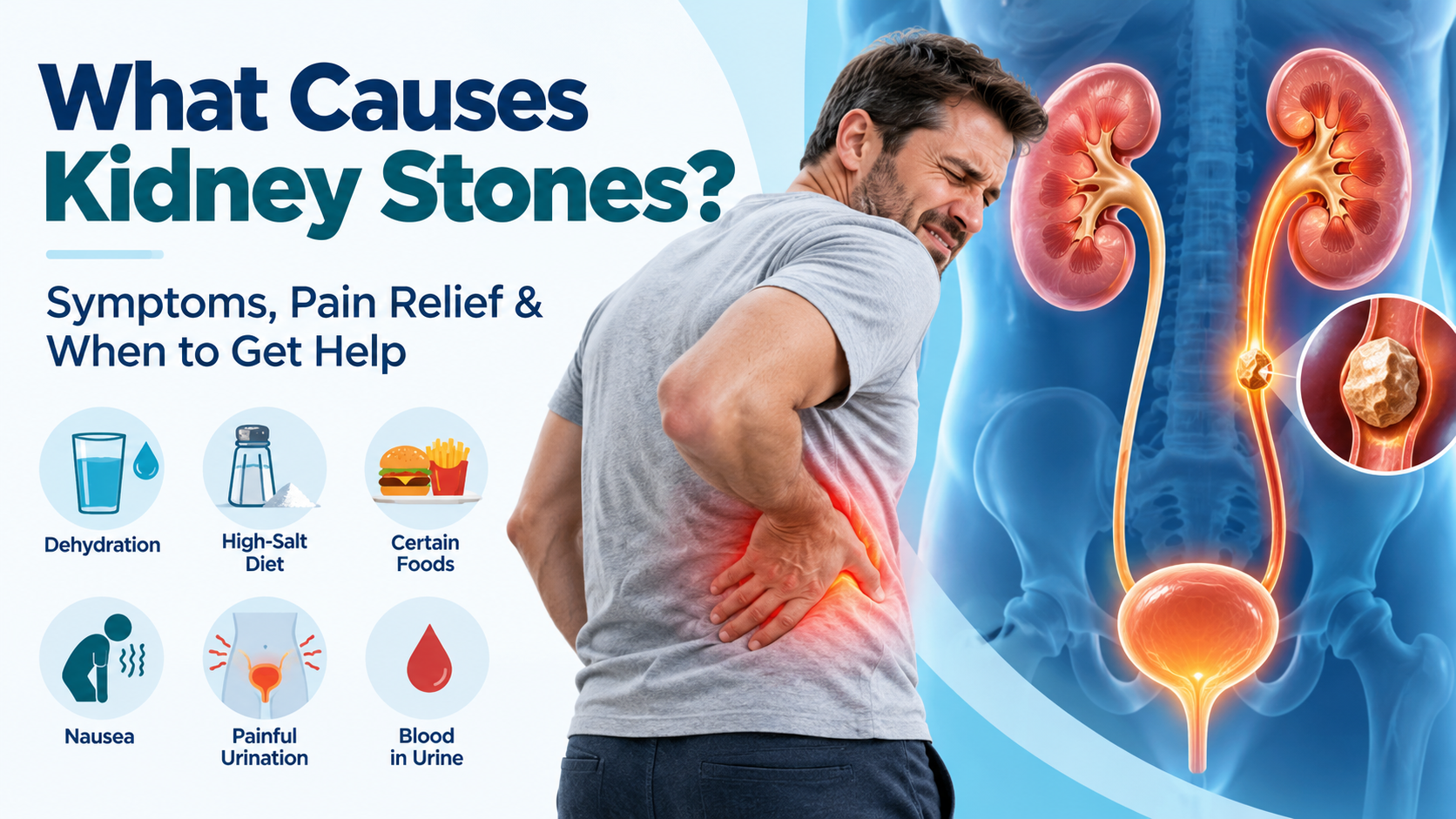
Kidney stones form when minerals and salts in urine become concentrated enough to crystallize and stick together. Not drinking enough fluid is one of the major risk factors, but kidney stones usually do not have just one cause. Diet, genetics, urinary infections, digestive problems, certain medical conditions, and some medicines can all increase the likelihood of developing them.
The National Institute of Diabetes and Digestive and Kidney Diseases explains that kidney stones form when high levels of certain minerals are present in urine. Its official kidney stone guidance also explains how symptoms, stone type, size and location can affect treatment.
Understanding what causes kidney stones is important because the best way to prevent another stone often depends on knowing what type of stone you formed.
Table of Contents
Why Do Kidney Stones Form?
Urine contains water along with dissolved minerals, salts and waste products. When there is enough fluid, these substances are more likely to remain diluted and leave the body during urination.
When urine becomes highly concentrated, however, minerals can begin forming crystals. Those crystals may gradually grow or stick together until they become a kidney stone.
There are four major types of kidney stones:
- Calcium stones
- Uric acid stones
- Struvite stones
- Cystine stones
According to MedlinePlus kidney stone analysis guidance, calcium stones are the most common. Struvite stones are often associated with urinary tract infections, while cystine stones result from an inherited disorder called cystinuria.
Because different stone types have different causes, prevention should ideally be based on the actual stone composition rather than guesswork.
What Causes Kidney Stones Most Often?
Not Drinking Enough Water
Low fluid intake is one of the clearest kidney stone risk factors.
When you do not drink enough, your urine becomes more concentrated. That makes it easier for calcium, oxalate, uric acid and other substances to crystallize.
People who live or work in hot environments, exercise heavily or lose a lot of fluid through sweating may need to pay particular attention to hydration.
A High-Sodium Diet
Eating large amounts of sodium can increase the amount of calcium released into the urine in some people, which may increase the risk of calcium-containing kidney stones.
This is why kidney stone prevention advice often includes reducing excessive sodium rather than simply eliminating calcium-containing foods.
Diet High in Certain Animal Proteins
High intake of meat and some other animal proteins may influence urine chemistry and increase uric acid production.
That does not mean everyone with kidney stones needs to stop eating meat. Dietary recommendations should depend on the stone type and the person’s overall health.
Digestive Disorders and Chronic Diarrhea
Digestive diseases, bowel surgery and chronic diarrhea may affect how minerals and fluids are absorbed.
Chronic diarrhea can also cause dehydration, indirectly increasing stone risk.
This is important because people often ask, “Do kidney stones cause diarrhea?”
Diarrhea itself is not considered a classic kidney stone symptom. However, persistent diarrhea can contribute to conditions that make stone formation more likely.
Family History and Genetics
Kidney stones can run in families.
Certain inherited conditions, such as cystinuria, directly increase the likelihood of stone formation.
If several close family members have had recurrent kidney stones, discussing this history with a healthcare professional can be useful.
Certain Medical Conditions
According to NIDDK information on kidney stone risk factors, conditions associated with increased kidney stone risk include:
- Gout
- Hyperparathyroidism
- Obesity
- Recurrent urinary tract infections
- Digestive disorders
- Hypercalciuria
- Hyperoxaluria
- Renal tubular acidosis
Some medicines may also increase stone risk.
Do not stop prescribed medication because you suspect it may be related to kidney stones. Discuss your concern with the prescribing clinician first.
What Does Kidney Stone Pain Feel Like?
Kidney stone pain can be extremely intense.
It commonly begins in the back or side and may move toward the lower abdomen or groin as the stone travels through the ureter.
Pain may come in waves rather than remaining constant.
Kidney stones can therefore cause lower back pain, but back pain alone does not confirm that a stone is present.
Common kidney stone symptoms include:
- Sharp pain in the back or side
- Lower abdominal pain
- Groin pain
- Blood in the urine
- Pain while urinating
- Frequent urge to urinate
- Nausea
- Vomiting
- Cloudy or bad-smelling urine
Fever and chills can be especially important because they may indicate an infection.
Do Kidney Stones Cause Nausea?
Yes.
Kidney stones can cause nausea, especially when pain is intense.
The severe pain and nerve responses triggered by obstruction of the urinary tract can cause nausea and vomiting.
This is why questions such as:
- Will kidney stones make you nauseous?
- Why do kidney stones cause nausea?
- Do kidney stones make you nauseous?
- Can kidney stones make you throw up?
all have the same general answer: yes, nausea and vomiting can occur with kidney stones.
However, vomiting can worsen dehydration, so repeated vomiting deserves medical attention.
Can Kidney Stones Cause Vomiting?
Yes.
Vomiting is a recognized kidney stone symptom.
However, you cannot literally vomit a kidney stone.
Kidney stones develop in the urinary tract and normally leave the body in urine. They cannot travel into the stomach and be thrown up.
Can Kidney Stones Cause Diarrhea?
Diarrhea is not considered a typical kidney stone symptom.
Someone with a kidney stone may experience nausea, abdominal discomfort or vomiting, which can make the episode feel like a gastrointestinal problem.
However, persistent diarrhea may have another cause.
If diarrhea occurs together with severe pain, fever, dehydration or blood in the stool, do not automatically assume that everything is being caused by the kidney stone.
Can Kidney Stones Cause Diarrhea and Nausea Together?
Nausea is common with kidney stone pain.
Diarrhea is less typical.
If both occur at the same time, possibilities include dehydration, another gastrointestinal illness or several problems occurring together.
Medical evaluation may be appropriate if symptoms are severe or persistent.
Can Kidney Stones Cause Lower Abdominal Pain?
Yes.
Kidney stone pain can move from the side or back toward the lower abdomen as the stone travels down the ureter.
Some people describe this discomfort as cramping.
The exact location of pain can change during the stone’s journey through the urinary tract.
Can Kidney Stones Feel Like Period Cramps?
They can sometimes feel similar.
A stone moving through the lower urinary tract may cause pelvic or lower abdominal discomfort that resembles menstrual cramping.
However, menstrual cramps and kidney stone pain have different causes.
Vaginal bleeding is not a typical kidney stone symptom, so unusual vaginal bleeding should not automatically be blamed on a stone.
Can Kidney Stones Cause Testicular Pain?
Kidney stone pain can radiate toward the groin and may sometimes be felt around the testicular area.
However, sudden severe testicular pain can have other urgent causes.
Do not assume severe testicular pain is simply caused by a kidney stone without medical evaluation.
Can Kidney Stones Cause Chest Pain?
Chest pain is not a typical kidney stone symptom.
Kidney stone pain generally occurs in the back, side, abdomen or groin.
New or unexplained chest pain should therefore not automatically be attributed to kidney stones.
Can Kidney Stones Cause Blood in Stool?
No, blood in the stool is not a typical kidney stone symptom.
Kidney stones commonly cause blood in the urine, not blood coming from the digestive tract.
Blood in stool should be evaluated according to its own potential causes.
Do Kidney Stones Make You Pee a Lot?
They can.
As a kidney stone moves closer to the bladder, it may create:
- Frequent urination
- A sudden urge to urinate
- Pain or burning during urination
- The feeling that you still need to urinate after going
However, these symptoms can also occur with urinary tract infections and other bladder conditions.
Can Kidney Stones Feel Like a UTI?
Yes.
A kidney stone and a UTI can both cause urinary urgency, discomfort and painful urination.
That is one reason urine testing is often useful when someone has suspected kidney stone symptoms.
Can UTIs Cause Kidney Stones?
Certain urinary tract infections can contribute to struvite stones.
However, this does not mean every UTI produces a kidney stone.
The relationship can also work in the other direction. A stone that interferes with urine flow can increase the risk of urinary infection.
Do Kidney Stones Cause Bladder Infections?
Kidney stones and urinary infections can occur together.
A stone that obstructs normal urine drainage may create conditions in which infection becomes more concerning.
Fever or chills combined with kidney stone symptoms should be taken seriously.
Can Kidney Stones Cause a Fever?
A simple kidney stone does not necessarily cause fever.
However, fever or chills with suspected kidney stones can indicate infection.
This becomes particularly important when a stone is blocking urine flow.
Seek prompt medical care if you have suspected kidney stone symptoms together with fever.
What Does a Kidney Stone Look Like in the Toilet?
Kidney stones vary significantly.
A passed stone may appear as:
- A grain of sand
- A rough crystal
- A tiny pebble
- A small jagged fragment
Colour also varies depending on stone composition.
Because some stones are extremely small, they may be difficult to notice in toilet water.
A healthcare professional may recommend urinating through a special stone strainer.
MedlinePlus notes that stones caught in a strainer can be sent for laboratory testing to determine what they are made of. Kidney stone analysis can help doctors develop a more specific prevention plan.
Do Kidney Stones Float or Sink?
Whether a kidney stone floats or sinks is not a reliable way to determine what kind of stone it is.
Stone composition should be identified through laboratory analysis instead.
Do not try to diagnose your kidney stone based solely on how it behaves in toilet water.
Will Kidney Stones Go Away?
Some kidney stones can pass naturally.
Very small stones may move through the urinary tract and leave the body during urination.
Other stones may become stuck and require treatment.
The likelihood of natural passage depends on factors such as:
- Stone size
- Stone location
- Urinary anatomy
- Obstruction
- Symptoms
- Infection
How Long Can It Take to Pass a Kidney Stone?
There is no single timetable.
Some kidney stones pass relatively quickly, while others can take days or weeks.
A stone that does not move may require medical treatment.
The more important question is not simply how long the stone has been present, but whether it is causing obstruction, infection or uncontrolled symptoms.
How Long Can a Kidney Stone Stay in the Bladder?
Once a stone reaches the bladder, it generally has less distance to travel before leaving through the urethra.
However, there is no universal number of hours or days that applies to everyone.
A stone can occasionally remain in the bladder, particularly when there are other urinary problems.
Can a 6 mm Kidney Stone Pass?
A 6 mm kidney stone may pass naturally, but it is less predictable than a very small stone.
Stone location matters significantly.
A 6 mm stone located lower in the ureter may have a different likelihood of passing than a similarly sized stone in another location.
Imaging and a clinician’s assessment are more useful than size alone.
Is a 9 mm Kidney Stone Dangerous?
A 9 mm kidney stone deserves proper medical assessment.
A stone of this size may have difficulty passing spontaneously and can potentially cause obstruction or severe symptoms.
That does not mean every 9 mm stone produces an immediate emergency.
Its location, associated symptoms, urine flow and presence or absence of infection all matter.
How to Pass a Kidney Stone Faster
There is no guaranteed home method that will force a kidney stone to pass quickly.
If your healthcare professional believes the stone can safely pass on its own, treatment may involve:
- Appropriate hydration
- Pain control
- Monitoring symptoms
- Prescription medication in selected cases
- Follow-up imaging when required
Larger stones or stones causing serious obstruction may require procedures to break them apart or remove them.
The NIDDK explains the available medical treatments for kidney stones, including situations where a stone cannot safely pass naturally.
What Helps a Kidney Stone Pass?
For stones suitable for natural passage, following your clinician’s hydration and treatment recommendations may help.
Do not try to force a stone through by drinking extreme amounts of water quickly.
More water is not automatically better, and excessive fluid intake can itself become dangerous.
Does Walking Help Kidney Stones Pass?
Gentle walking may be comfortable for some people waiting for a small stone to pass.
However, walking does not guarantee that the stone will move or pass faster.
If you have severe pain, repeated vomiting, fever or difficulty urinating, exercise should not replace medical care.
What Is the Best Position to Pass a Kidney Stone?
There is no universally proven body position that guarantees faster kidney stone passage.
Choose a position that makes you more comfortable while following your clinician’s treatment plan.
The stone’s size and location matter much more than body position.
Can You Have Sex With Kidney Stones?
In many uncomplicated cases, having sex is not automatically prohibited just because you have a kidney stone.
Kidney stones are not sexually transmitted.
However, pain, urinary discomfort or pelvic symptoms may make intercourse uncomfortable.
If you have fever, infection symptoms or severe pain, getting medical care should take priority.
Does Sex Help With Kidney Stones?
Sex should not be considered a standard kidney stone treatment.
Research has explored whether sexual activity might affect passage of certain small ureteral stones, but it should not replace conventional medical assessment or treatment.
Can Kidney Stones Be Passed Sexually?
No.
You cannot pass a kidney stone to another person through sexual activity.
The stone remains inside your own urinary tract until it passes or is medically removed.
Can a Woman Pass Kidney Stones?
Yes.
Women can develop and pass kidney stones just as men can.
The stone travels from the kidney through the ureter into the bladder and then exits through the urethra.
How Do Kidney Stones Pass in Males?
In men, a naturally passing stone travels:
Kidney → ureter → bladder → urethra → outside the body
The process can cause significant pain, especially while the stone is moving through the ureter.
Can You Poop Kidney Stones?
No.
Kidney stones normally leave through the urinary system.
They do not travel through the intestines and are not normally passed in stool.
Can Kidney Stones Cause Acid Reflux?
Acid reflux is not considered a classic kidney stone symptom.
Severe kidney stone pain can cause nausea, vomiting and abdominal discomfort, which may feel like digestive symptoms.
Persistent reflux may have another cause.
Can Kidney Stones Cause Gastric or GI Problems?
Kidney stones can cause nausea, vomiting and abdominal discomfort.
However, persistent gastrointestinal problems should not automatically be blamed on the stone.
Symptoms such as blood in stool or persistent diarrhea may indicate another condition.
Can Kidney Stones Affect Your Period?
Kidney stones do not normally alter the menstrual cycle itself.
However, kidney stone pain in the pelvis or lower abdomen can sometimes occur around the same location as menstrual discomfort.
Vaginal bleeding should not automatically be attributed to kidney stones.
Can Kidney Stones Cause Anemia?
Kidney stones are not usually considered a direct cause of anemia.
A stone can cause blood in the urine, but persistent anemia needs appropriate medical investigation.
Can Kidney Stones Raise Blood Pressure?
Severe pain can temporarily increase blood pressure.
However, a single high blood-pressure reading during intense kidney stone pain does not necessarily mean the stone has caused chronic hypertension.
Persistently elevated blood pressure should be evaluated separately.
Can Smoking Cause Kidney Stones?
Smoking is not usually described as one of the main direct causes of kidney stones.
Established kidney stone risk factors include concentrated urine, certain dietary patterns, inherited conditions, medical disorders, infections and some medications.
Smoking still carries many serious health risks, but a kidney stone should not automatically be attributed to smoking alone.
Can Vaping Cause Kidney Stones?
Current evidence does not establish vaping as a major direct cause of kidney stones.
However, vaping is not risk-free.
The better-established kidney stone prevention approach remains focused on hydration, urine chemistry, diet, underlying medical problems and stone type.
Can Baking Soda Cause Kidney Stones?
Baking soda should not be used casually as a kidney stone remedy.
Changing urine acidity can be useful for certain stone types under medical supervision, but sodium bicarbonate is not appropriate for everyone.
Taking excessive amounts can cause other health problems.
How to Ease Kidney Stone Pain
Kidney stone pain may require medical treatment.
If a doctor has already determined that your stone can safely pass at home, follow the prescribed pain-management and hydration plan.
Common treatment approaches may include pain medicines and, in selected cases, medicines intended to make stone passage easier.
Do not delay medical care when pain is uncontrolled or symptoms are getting worse.
When to Go to the ER for Kidney Stones
Seek urgent medical care when kidney stone symptoms are accompanied by concerning signs.
These include:
- Severe or uncontrolled pain
- Fever
- Chills
- Repeated vomiting
- Inability to keep fluids down
- Difficulty or inability to urinate
- Severe weakness
- Symptoms that are rapidly worsening
MedlinePlus lists extreme back or side pain, blood in urine, fever and chills, vomiting, cloudy or foul-smelling urine and burning during urination among symptoms that can require medical attention. MedlinePlus kidney stone guidance
What Can the ER Do for Kidney Stones?
An emergency department can assess whether your symptoms are caused by a kidney stone and check for complications.
Depending on the situation, care may include:
- Pain control
- Anti-nausea medication
- Urine testing
- Blood tests
- Imaging
- IV fluids when appropriate
- Assessment for infection
- Assessment for urinary obstruction
- Urgent urology consultation
Emergency treatment is particularly important when infection and urinary blockage occur together.
When Should You See a Doctor for Kidney Stones?
You should seek medical evaluation if you suspect a kidney stone and have persistent or significant symptoms.
Prompt care is particularly important with:
- Severe pain
- Blood in urine
- Fever or chills
- Persistent vomiting
- Difficulty urinating
- Repeated kidney stone episodes
Should You See a Urologist or Nephrologist for Kidney Stones?
A urologist commonly manages stones that require procedures, removal or treatment involving the urinary tract.
A nephrologist focuses on kidney function and may help investigate recurrent stones, abnormal urine chemistry or underlying kidney disease.
People with repeated kidney stones may sometimes benefit from both specialists.
How to Reduce the Risk of Future Kidney Stones
Prevention should be based on the type of stone whenever possible.
General measures often include:
- Drinking adequate fluids
- Avoiding excessive sodium
- Following stone-specific dietary advice
- Treating recurrent urinary infections
- Managing underlying medical conditions
- Taking prescribed preventive medicines when appropriate
One common misconception is that people with calcium stones should automatically eliminate calcium from their diet.
That is not generally correct.
NIDDK’s diet and nutrition guidance for kidney stones explains that dietary recommendations depend on stone type and may include changes to sodium, animal protein, calcium and oxalate intake.
Why Stone Analysis Matters
If you manage to catch a kidney stone, your clinician may send it to a laboratory.
Finding out whether it is made mainly from calcium oxalate, calcium phosphate, uric acid, struvite or cystine can make future prevention much more targeted.
This is more useful than trying to identify the stone from:
- Its colour
- Its shape
- Whether it floats
- Whether it sinks
- What you ate immediately before the attack
If you regularly read health and wellness information online, you can also explore other educational articles on HelpForSoul while remembering that online information should not replace individual medical care.
Key Takeaway
So, what causes kidney stones?
Kidney stones develop when minerals and other substances in urine become concentrated enough to form crystals and eventually solid stones.
The major factors include:
- Dehydration
- Certain dietary patterns
- Genetics
- Urinary infections
- Digestive disorders
- Metabolic conditions
- Certain medicines
- Abnormal urine chemistry
Small kidney stones can sometimes pass naturally, but not every stone should simply be waited out.
Fever, chills, inability to urinate, repeated vomiting or severe uncontrolled pain are warning signs that need prompt medical attention.
If kidney stones keep returning, identifying the stone type and investigating why it formed is usually much more useful than relying on generic home remedies.
This article is for general educational purposes and does not replace diagnosis, treatment or advice from a qualified healthcare professional.
Frequently Asked Questions
Why do kidney stones cause nausea?
Severe kidney stone pain and irritation of the urinary tract can activate nerve pathways that trigger nausea and vomiting.
Will kidney stones make you throw up?
They can. Vomiting is a recognized symptom of severe kidney stone episodes.
Can kidney stones make your back hurt?
Yes. Pain in the side and back is one of the classic symptoms of kidney stones.
Is diarrhea a symptom of kidney stones?
Diarrhea is not considered a typical kidney stone symptom. Persistent diarrhea may be unrelated or may contribute to dehydration.
Do kidney stones cause cramps?
Kidney stone pain can feel cramp-like because it often intensifies and eases in waves.
Do kidney stones cause discharge?
Genital discharge is not a typical kidney stone symptom. Unusual discharge should be evaluated for another cause.
What do kidney stones look like in a strainer?
They can look like tiny grains of sand, crystals, gravel or small jagged pebbles.
Can kidney stones float?
They may appear to behave differently in liquid, but whether they float or sink cannot reliably identify their composition.
How big is a 3 mm kidney stone?
Three millimetres is approximately 0.12 inches. It is relatively small, although size alone cannot determine whether it will pass without difficulty.
Can a 6 mm kidney stone pass?
Yes, some 6 mm stones pass naturally, but passage is less predictable than with smaller stones. Location and individual anatomy matter.
Should I go to the ER for a kidney stone?
Seek urgent care if pain is severe or uncontrolled, particularly with fever, chills, repeated vomiting, inability to urinate or rapidly worsening symptoms.
What helps a kidney stone pass?
For stones that are suitable for natural passage, appropriate hydration, prescribed pain management and sometimes specific medications may help. Larger or obstructing stones can require procedures.
.
