

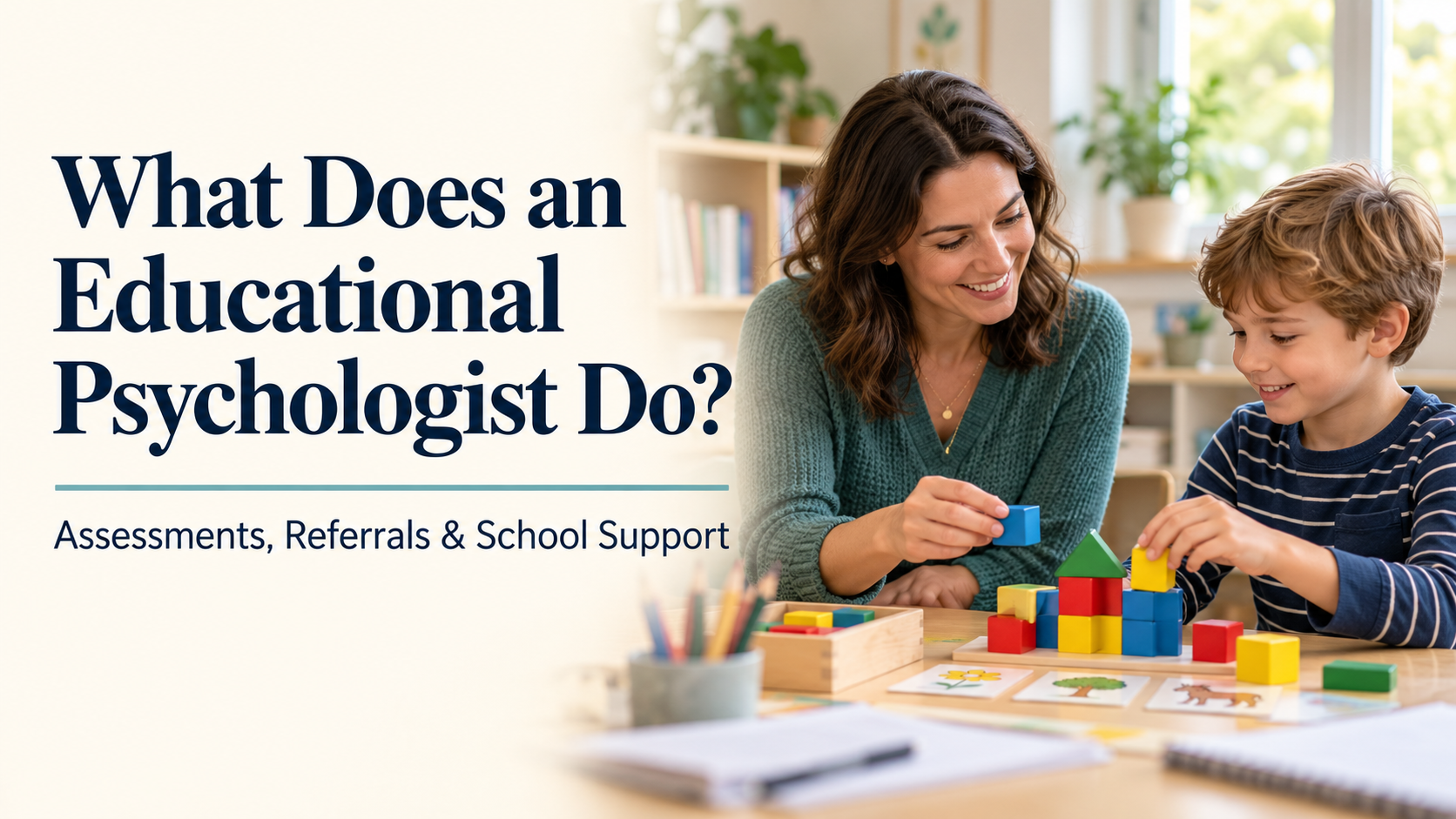
An educational psychologist helps children and young people understand and overcome barriers to learning, development and wellbeing. They work with families, teachers and other professionals to identify strengths and needs, then recommend practical support.
Their work may involve conversations, classroom observations, assessments, advice and staff training. They consider both the individual child and the environments in which they learn.
If your child is struggling at school, an educational psychologist can help answer an important question: what is getting in the way, and what changes could help?
Table of Contents
What Is an Educational Psychologist?
An educational psychologist, often shortened to EP, is a qualified psychologist who applies knowledge of learning, development and behaviour to education.
In the UK, “educational psychologist” is a protected professional title. Anyone using it must be registered with the Health and Care Professions Council, known as the HCPC.
Before booking privately, check the practitioner’s registration and relevant experience. The HCPC’s guidance on psychologist regulation explains how to check whether a psychologist is regulated.
What Does an Educational Psychologist Help With?
Educational psychologists support children and young people whose learning or participation is affected by developmental, emotional, social or behavioural difficulties.
Their work may concern:
- Progress with reading, writing or mathematics.
- Understanding and accessing classroom learning.
- Emotional wellbeing and worries about education.
- Relationships and participation at school.
- Behaviour that may reflect unmet needs.
- Transitions between educational settings.
- Planning support for additional learning needs.
They also explore strengths, interests and aspirations. Understanding what already works helps them recommend support that builds on a child’s abilities. www.enfield.gov.uk
Their Work Extends Beyond Individual Assessments
An EP may advise teachers, support parents, work with groups or help a school improve its approach to wellbeing and inclusion. Some also contribute to research and service development.
An appointment does not necessarily mean your child will complete a series of formal tests. Sometimes consultation and changes to everyday support are the most useful starting points.
When Should You Ask About Educational Psychology Support?
Raise concerns when difficulties persist, interfere with participation or remain unclear despite support already being tried.
Describe what you observe rather than trying to diagnose the cause. For example:
- “Reading homework regularly ends in distress.”
- “My child understands instructions individually but struggles during whole-class teaching.”
- “School mornings have become increasingly difficult.”
- “Extra practice has not helped us understand why progress is limited.”
In England, the government’s guidance on special educational needs recommends speaking to the school or nursery’s special educational needs co-ordinator, or SENCO. If your child is not attending a school or nursery, contact your local council.
Referral routes and terminology differ across the UK. Ask your local service how families can access support.
What Happens During an Educational Psychologist Assessment?
There is no single assessment format for every child. The approach should match the concerns being explored.
1. Discussing Concerns and Strengths
The EP may speak with you and school staff about:
- Your child’s experiences at home and school.
- What is going well.
- What feels difficult.
- Support already tried.
- What everyone hopes to understand.
Local-authority guidance describes this shared discussion as a way to make sense of the child’s situation and plan the next steps. Educational Psychology Service
2. Understanding Your Child’s Views
The psychologist will usually seek your child’s perspective. Depending on age and communication preferences, this might involve conversation, pictures, play or structured activities.
Ask how your child can participate comfortably and whether adjustments are needed.
3. Gathering Further Information
An EP may observe your child in the classroom or playground, review schoolwork, speak with staff or carry out individual activities and assessments.
The aim is to understand the difficulties and identify helpful changes. A formal test may be useful, but it is one possible source of information rather than the whole assessment.
4. Agreeing Recommendations
Feedback may describe strengths, needs and practical recommendations. It may also identify questions for another professional.
Ask what written record you will receive, who will receive it and when it should be available. Local services may provide a report after direct work or record consultation outcomes through a school support plan.
What Might Support Look Like in Practice?
Consider this illustrative example.
A child avoids written tasks and becomes upset when asked to start. Adults initially interpret this as unwillingness.
An EP might explore the child’s understanding of instructions, writing demands, confidence and classroom experience. The resulting plan could involve breaking tasks into smaller sections, changing how instructions are presented or allowing another way to demonstrate understanding.
This example shows the problem-solving process. It is not a recommendation for every child.
The important follow-up question is: “What will we try, and how will we know whether it helps?”
Can an Educational Psychologist Diagnose Dyslexia, Autism or ADHD?
The answer depends on the condition, the practitioner’s expertise and the service commissioned.
Dyslexia
An educational psychologist with relevant expertise can assess specific learning difficulties such as dyslexia. However, not every educational psychology service provides a diagnostic dyslexia assessment.
Some services focus on identifying literacy needs and support rather than issuing a diagnosis. Confirm what is included before booking.
Autism and ADHD
Educational psychologists may contribute information to neurodevelopmental assessments. However, a general educational psychology assessment should not be assumed to include an autism or ADHD diagnosis.
Diagnostic pathways may involve specialist clinicians and multidisciplinary teams. Ask whether a separate referral is required and what the proposed assessment can establish.
How Do You Get an Educational Psychologist Referral?
Start with your child’s teacher and the person responsible for additional learning support.
Ask:
- What needs have been identified?
- What support has already been tried?
- What evidence shows whether it is helping?
- What would an EP be asked to investigate?
- How does the school access educational psychology?
- What support can continue while we wait?
School and local-authority arrangements vary. Some services provide school-commissioned work alongside involvement in statutory assessments.
What if the School Does Not Recommend a Referral?
Ask the school to explain its reasoning and agree a written plan for the concerns you have raised.
You can request clarity about:
- The support being provided.
- How progress will be monitored.
- When the plan will be reviewed.
- What would prompt specialist involvement.
For families in England, a local Information, Advice and Support service can provide advice about SEND arrangements.
What Is the EP’s Role in an EHCP?
In England, educational psychologists provide psychological advice as part of an Education, Health and Care needs assessment.
Their advice helps explain educational needs and appropriate support. Other evidence is also gathered, and the local authority decides whether to issue an Education, Health and Care Plan, commonly called an EHCP.
An EP report does not automatically guarantee an EHCP or a particular school placement.
The EHCP framework applies to England. Other parts of the UK have different additional-needs systems and processes.
Should You Pay for a Private Assessment?
Private assessment may be an option, but clarify what you need before committing.
Ask the practitioner:
- Are you HCPC-registered as an educational psychologist?
- What experience do you have with my child’s age and needs?
- Which questions will the assessment address?
- Will you consult the school?
- Does the fee include written feedback and a discussion?
- Are follow-up meetings charged separately?
- When should we expect the report?
Discuss the proposed assessment with the school too. Ask how the findings could inform support and whether another assessment is already planned.
How Much Does an Educational Psychologist Cost?
There is no single private fee. Request a written quote covering the full scope of work.
Check whether it includes document review, school observation, individual assessment, travel, reporting and follow-up.
If work is being arranged through a school or public service, clarify how that involvement is funded before commissioning anything privately.
How Can You Prepare Your Child?
You do not need to coach your child to obtain a particular result.
Instead, ask the EP how to explain the appointment. A simple description might be:
“We are meeting someone who helps us understand what makes learning easier for you.”
Prepare useful information, including:
- Relevant school reports or work samples.
- A short summary of your concerns.
- Details of support already tried.
- Previous professional reports.
- Your child’s strengths, interests and views.
- Questions you want answered.
Also ask how information will be shared and who will receive the assessment findings.
What Should Happen After the Assessment?
Arrange a discussion with the school about turning recommendations into practical support.
| Question | What to agree |
|---|---|
| What will change? | A specific approach or adjustment |
| Who will do it? | A named person or team |
| When will it start? | An agreed start date |
| What will be monitored? | A meaningful measure of progress or participation |
| When will it be reviewed? | A clear review date |
In England, the SEND Code of Practice describes reviewing support with parents and taking the child’s views into account. assets.publishing.service.gov.uk
Teachers, the additional-needs lead and school leaders may have different responsibilities for delivering the plan. Our guide to educational leadership roles and responsibilities explains the wider responsibilities for teaching, staff development and resources.
A report is most useful when its recommendations are understood, implemented and reviewed.
Frequently Asked Questions
Is an Educational Psychologist the Same as a SENCO?
No. A SENCO co-ordinates special educational needs support within a school or nursery. An EP provides specialist psychological assessment, consultation and advice. They may work together.
Does My Child Need a Diagnosis Before Receiving Support?
Not necessarily. Support for identified learning needs can be provided without a diagnosis. Ask what the school can put in place now rather than waiting for a diagnostic label.
Will My Child Have an IQ Test?
Not automatically. Assessment methods should match the questions being explored. Ask which activities or tests are proposed and what they will help explain.
How Long Does an Assessment Take?
There is no universal duration. Ask separately about waiting time, direct assessment, school consultation and report preparation.
Do Educational Psychologists Work With Adults?
Some assess or support adult learners, particularly around specific learning difficulties. Check the practitioner’s age range and expertise.
What Is the Best First Step?
Write down your concerns and arrange a conversation with your child’s teacher or additional-needs lead. Ask what support is already in place, what remains unclear and whether educational psychology involvement could help.
This article provides general information. Local services and individual assessment arrangements vary.

