

Data sourced from the U.S. Bureau of Labor Statistics, Glassdoor, PayScale, and ZipRecruiter
You’re thinking about becoming a pharmacy tech or maybe you already are one and you’re wondering if you’re being paid fairly. Either way, you’ve landed in the right place. Because most salary articles give you one number, pat you on the head, and call it done.
One number isn’t the answer. Context is the answer.
A pharmacy tech in rural Arkansas and a pharmacy tech in a Seattle hospital can have the same job title and wildly different paychecks we’re talking a $20,000+ annual gap, sometimes more. Where you work, what you’re certified in, which state you’re in, and whether you’re dispensing pills at a CVS or compounding sterile IV drugs in an oncology unit all of it matters enormously.
So let’s go through all of it. Entry-level numbers. Top earner numbers. State-by-state breakdowns. The certification math. The setting comparison nobody talks about clearly enough. By the end, you’ll know exactly where you stand and exactly what levers to pull to earn more.
What Is the Average Pharmacy Tech Salary in 2025?
Here’s the snapshot answer: According to the U.S. Bureau of Labor Statistics (BLS), the median annual wage for pharmacy technicians is $43,460 per year, which works out to approximately $20.90 per hour. That’s as of May 2024 the most recent official federal data available.
“Median” means half of all pharmacy techs earn less than this, and half earn more. It’s the most honest single number to use because it doesn’t get skewed by outliers.
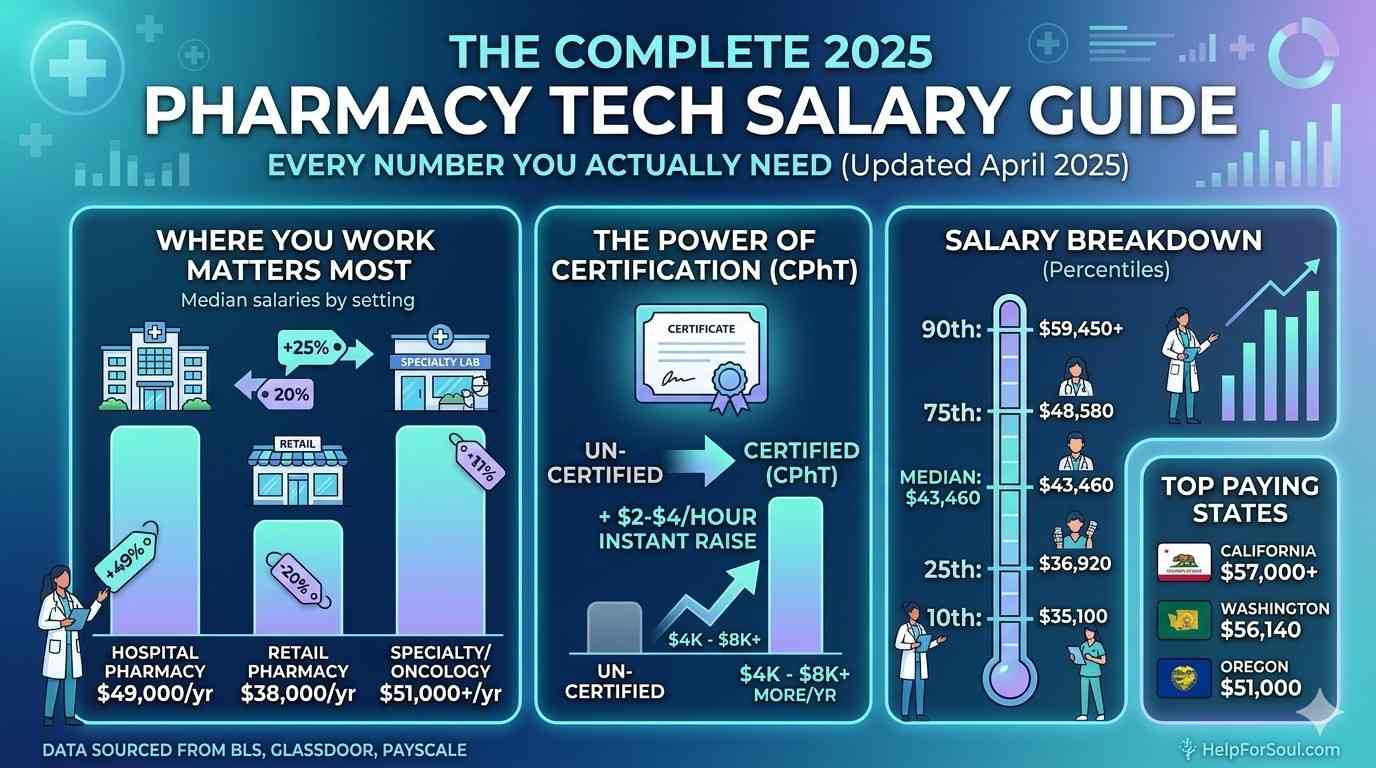
But median alone doesn’t tell you where you might fall. Here’s the full BLS percentile breakdown:
- 10th percentile: $35,100/year entry-level, no certification, high-turnover retail settings
- 25th percentile: $36,920/year
- Median (50th percentile): $43,460/year
- 75th percentile: $48,580/year
- 90th percentile: $59,450/year experienced, certified, hospital or specialty setting
So the realistic range for most working pharmacy techs sits between $36,000 and $59,000 annually, with the bulk clustering in the low-to-mid $40Ks. Top earners think senior hospital techs, specialty pharmacy leads, or those in high-cost states can push past $55,000. Six figures as a pharmacy tech? That’s not realistic without moving into management, becoming a pharmacist, or transitioning into pharmaceutical sales.
For an hourly breakdown: entry-level positions typically start around $15–$18/hour, while certified techs in high-demand environments can reach $28–$30/hour in the best-paying markets.
Pharmacy Tech Salary by Work Setting: This Is the Biggest Factor Nobody Talks About Loudly Enough
Here’s where it gets genuinely interesting and where most salary articles skim the surface when they should be diving deep.
Where you work matters more than almost anything else. The same certification, the same years of experience, the same skill set can produce dramatically different paychecks depending on your employer type.
Retail Pharmacy (CVS, Walgreens, Rite Aid, Walmart)
This is where most pharmacy techs start and it’s the lowest-paying setting. BLS data puts the median for retail drug stores at roughly $38,000/year. Entry-level techs at big chains typically start between $15–$17/hour, though some states with higher minimum wages push that floor up considerably.
The upside: abundant job availability, on-the-job training programs, company-sponsored certification reimbursement at some chains, and flexible scheduling. The downside: lower ceiling, high patient volume, and raise structures that tend to be flat often a fixed dollar amount per year (like $0.75/hour annually) rather than percentage-based increases.
Hospital Pharmacy
This is where the money is. BLS data shows median wages for hospital-based pharmacy technicians at approximately $49,000/year roughly $11,000 more annually than retail. In top-tier hospital systems in high-cost states, experienced certified techs can break $60,000.
The catch: most hospital positions require both national certification (CPhT) and prior work experience. You typically can’t walk straight out of a training program into a hospital role. The standard path is 1–2 years of retail experience, then transition. Hospital pharmacies also use percentage-based annual raises often 2% or more which compounds better over a career than flat retail raises.
For context: pharmacy techs earning as much as 20% more in a hospital than a drugstore is a widely cited industry benchmark, and BLS numbers support it.
Specialty Pharmacy
Specialty pharmacy is the sleeper pick for earning potential. These settings handle complex, high-cost medications oncology drugs, biologics, infusion therapy and they pay accordingly. Specialty pharmacy technicians have seen some of the fastest wage growth in the field, with median hourly pay jumping significantly in recent years as demand for specialized skills increases.
Outpatient care centers and specialty pharmacies consistently pay above retail chain averages, and the work is genuinely more complex and clinically interesting for many techs.
Long-Term Care and Nursing Facilities
Pay sits between retail and hospital — generally in the $40,000–$47,000/year range. These settings value experience and reliability, and scheduling tends to be more predictable than retail’s unpredictable patient rushes.
Mail-Order and PBM (Pharmacy Benefit Manager)
Mail-order pharmacy is an underrated setting. Less direct patient interaction, often better hours, and pay that frequently matches or exceeds retail. Some large PBM-affiliated operations offer solid benefits packages that make total compensation more competitive than base salary suggests.
The bottom line on settings: If you want to maximize your pharmacy tech income, the path is clear — get certified, get retail experience, then transition to a hospital or specialty setting. The salary jump is real and worth planning for.
Pharmacy Tech Salary by State: Where You Live Changes Everything
The 10 highest-paying metropolitan areas for pharmacy technicians in the U.S. are almost entirely in California — with one exception in Washington state, according to BLS data. That’s not an accident. California’s high cost of living, strong healthcare demand, and labor market dynamics push wages up substantially.
Here are the top-paying states according to BLS data:
| State | Annual Mean Salary (Approx.) |
|---|---|
| California | ~$57,000+ |
| Washington | ~$56,140 |
| Oregon | ~$51,000 |
| Alaska | ~$50,000 |
| District of Columbia | ~$49,000 |
At the lower end, states like Arkansas, West Virginia, and Florida tend to offer salaries that trail the national median significantly.
Important caveat and this is something most salary articles breeze past: higher pay doesn’t always mean more take-home money. A pharmacy tech earning $57,000 in San Francisco has a very different cost of living than one earning $43,000 in Memphis. If you’re considering relocating for a salary bump, always run the numbers against local housing costs, taxes, and transportation. A modest salary in a low-cost-of-living state can stretch further than a high salary in a major metro.
How Certification Changes Your Pay: The CPhT Math
Getting your Certified Pharmacy Technician (CPhT) credential through the Pharmacy Technician Certification Board (PTCB) is the single most impactful thing you can do to increase your earning potential especially early in your career.
Here’s the actual math: CPhT certification typically adds $2–$4 per hour to your base wage. Over a full-time work year (2,080 hours), that translates to $4,160–$8,320 more annually just for passing a certification exam. That’s a meaningful return on the modest cost and study time the exam requires.
According to PayScale, hourly pay for certified pharmacy technicians (CPhT) by experience level looks like this:
- Entry-level (under 1 year): ~$15.26/hour
- 1–4 years experience: ~$17–$18/hour
- 5–9 years experience: ~$19–$20/hour
- 10–19 years experience: ~$20–$21/hour
- 20+ years experience: ~$21.31/hour
Notice something? The jump from entry-level to certified is larger than the jump from 5 years of experience to 20. Certification early in your career pays off faster than simply waiting for experience to accumulate.
Beyond the basic CPhT, the PTCB also offers advanced certifications in areas like sterile compounding and medication history credentials that can unlock specialty pharmacy and hospital roles with materially higher pay.
Pharmacy Tech Salary by Experience: What to Expect Year by Year
If you’re entering the field now or considering it, here’s an honest progression picture:
Year 1 (Entry-Level): You’re looking at $15–$18/hour, likely in a retail setting, learning the ropes. Annual salary: roughly $31,000–$37,000. This is the proving ground.
Years 2–3: With some experience and hopefully your CPhT in hand, you’re in the $18–$21/hour range. You’re a known quantity to employers, and this is the prime window to start applying for hospital or specialty positions.
Years 4–7: In the right setting, you’re now looking at $21–$25/hour. Hospital techs, specialty techs, and lead techs in large retail operations can be at the higher end of this band.
Years 8+: Experienced certified techs, particularly in hospitals or specialty settings, can reach $25–$30/hour in competitive markets. Senior or lead technician roles add supervisory pay.
The ceiling without moving into management or pharmacist education: roughly $55,000–$60,000/year in most markets, $65,000+ in top-paying coastal metro areas.
5 Proven Ways Pharmacy Techs Can Earn More Right Now
You don’t have to wait for a raise to fall in your lap. These strategies actually work.
1. Get certified if you aren’t already. The CPhT credential through PTCB is the highest-ROI move available to pharmacy techs. Many employers reimburse exam fees, so ask before you pay out of pocket.
2. Transition to a hospital or specialty setting. That 20% pay premium over retail isn’t theoretical it’s documented by BLS data. If you have 1–2 years of retail experience and a CPhT, you’re qualified to apply. Do it.
3. Work high-demand shifts. Nights, weekends, and holidays typically come with differential pay — often $1–$3 more per hour. It’s not glamorous, but if you’re in a season of your life where the extra money matters more than the inconvenience, this is an immediate lever.
4. Pursue advanced PTCB certifications. Sterile compounding technician credentials, for example, qualify you for IV room and specialty oncology roles that pay above standard tech wages. More skills, narrower supply pool, higher pay.
5. Negotiate at hiring. This one is underused to a striking degree. Pharmacy tech pay at chains is often negotiable at the offer stage, especially if you’re certified and experienced. Bring your CPhT credential, your experience, any leadership roles you’ve held, and a specific number. “I was hoping for $X based on my certification and Y years of experience” is a sentence that works.
For more guidance on navigating healthcare career decisions, salary negotiation, and managing the mental load of career transitions, the resources at HelpForSoul are worth bookmarking.
Pharmacy Tech Salary vs. Similar Healthcare Roles
How does pharmacy tech pay stack up against adjacent roles? Here’s the honest comparison:
- Medical assistant: ~$40,000 median annually slightly below pharmacy tech median
- Pharmacy technician: ~$43,460 median annually
- Dental assistant: ~$44,820 median annually comparable
- Surgical technologist: ~$60,370 median annually significantly higher, but requires more training
- Pharmacist: ~$132,750 median annually the next step up the ladder, requiring a Doctor of Pharmacy (PharmD) degree
The pharmacy tech salary sits solidly in the middle of allied health compensation — better than many entry-level healthcare support roles, and a clear stepping stone toward the pharmacist career track if you want to invest in the education.
Job Outlook: Is Pharmacy Tech a Smart Career Investment in 2025?
Yes and the numbers back it up clearly. According to the U.S. Bureau of Labor Statistics Occupational Outlook Handbook, employment of pharmacy technicians is projected to grow 6% from 2024 to 2034 faster than the average for all occupations. That translates to approximately 49,000 new openings projected each year over the decade.
What’s driving that growth? An aging U.S. population requiring more prescription medications, expanded roles for pharmacy techs as pharmacists take on more clinical duties, and the ongoing expansion of specialty and mail-order pharmacy operations.
With roughly 450,000 pharmacy technicians currently employed across the United States in retail pharmacies, hospitals, long-term care facilities, and specialty operations this is a stable, in-demand career track with a genuine growth trajectory.
Frequently Asked Questions
How much do pharmacy techs make an hour? The national median is approximately $20.90/hour according to BLS data. Entry-level techs typically start at $15–$18/hour, while experienced certified techs in hospital settings can reach $28–$30/hour in competitive markets.
Do pharmacy techs make more in hospitals or retail? Hospitals pay significantly more — roughly 20% higher than retail drug stores, based on BLS data. Hospital techs earn a median of around $49,000/year versus roughly $38,000/year in retail pharmacy settings.
Does CPhT certification increase pharmacy tech salary? Yes, meaningfully. Certification typically adds $2–$4/hour to your base wage, translating to $4,000–$8,000 more annually. It also qualifies you for higher-paying hospital and specialty positions that require certification.
What state pays pharmacy techs the most? California consistently ranks as the highest-paying state for pharmacy technicians, with Washington, Oregon, Alaska, and the District of Columbia rounding out the top five. The 10 highest-paying metropolitan areas in the U.S. are almost all in California.
Can pharmacy techs make $50,000 a year? Yes experienced certified techs in hospital, specialty, or high-cost-of-living markets regularly earn $50,000 or more. The 75th percentile nationally sits at $48,580/year, meaning roughly 25% of all pharmacy techs earn above that threshold.
Is pharmacy tech a good career for the long term? The BLS projects 6% job growth through 2034, with about 49,000 openings annually. The field is stable, demand is rising with an aging population, and certification provides a clear path to higher pay. For those interested in healthcare but not clinical or bedside roles, it’s a solid long-term choice.
So how much do pharmacy techs make? Nationally, the median is $43,460/year ($20.90/hour). But that number is a starting point, not a ceiling.
Work in a hospital instead of retail: add $11,000/year. Get your CPhT certification: add $4,000–$8,000/year. Move to a high-paying state like California or Washington: add another $10,000–$15,000. Stack all three? You’re looking at a compensation picture that looks very different from the median.
The pharmacy tech career path rewards strategic thinking more than most people in the field realize. Know where the pay ceilings are in each setting. Get certified early. Target hospital or specialty positions once you have experience. Negotiate at hiring. Those aren’t complicated strategies. They’re just the ones that actually move the number.
And if you’re weighing whether to enter this field at all: job growth is solid, demand is rising, entry doesn’t require years of expensive education, and the work genuinely matters to patients. That’s a combination worth considering carefully.
For more resources on healthcare career planning, navigating workplace transitions, and building sustainable professional momentum, visit HelpForSoul.
Sources: U.S. Bureau of Labor Statistics Occupational Outlook Handbook (bls.gov), BLS May 2024 Occupational Employment Statistics, Glassdoor (52,782 pharmacy technician salaries, December 2025), PayScale, ZipRecruiter, Pharmacy Technician Certification Board (ptcb.org).