

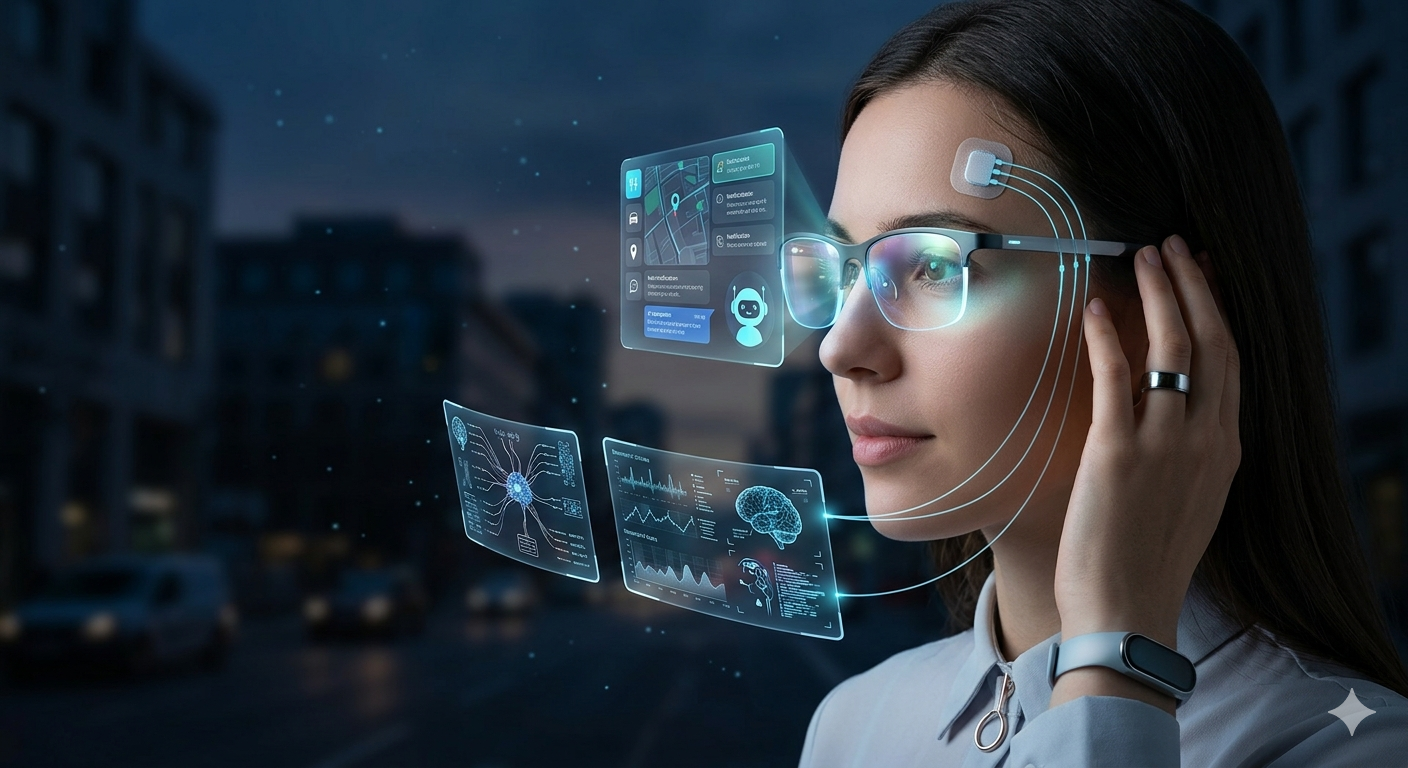
Tech giants envision future beyond smartphones through AR glasses, ambient AI, brain-computer interfaces, and spatial computing. Discover the $150B technology shift redefining human-device interaction in 2026 and beyond.
Table of Contents:
- Introduction: The Smartphone Era Is Ending
- Why Tech Giants Are Looking Beyond Smartphones
- Augmented Reality Glasses: The Screen You Wear
- Apple’s Vision: AR Glasses as the Next iPhone
- Meta’s Ambient Computing Bet
- Google and Samsung’s XR Alliance
- AI Wearables: Intelligence You Can Touch
- Brain-Computer Interfaces: Controlling Tech With Your Mind
- Spatial Computing: The $1.2 Trillion Market Reshaping Reality
- Ambient Computing: When Technology Disappears
- Challenges Standing Between Now and the Post-Smartphone World
- Timeline: When Will Smartphones Become Optional?
- What This Means for You
- FAQs
- Conclusion
Introduction: The Smartphone Era Is Ending
Think about the last time a smartphone launch genuinely surprised you. The feeling is distant, isn’t it?
For over a decade, the rectangular glass slab in your pocket was the most exciting object in consumer technology. People queued for hours outside stores. Unveiling events drew millions of livestream viewers. Now, most new models feel like incremental refinements – a slightly better camera, a marginally faster chip, a few more megapixels.
That creative stagnation is not an accident. It is a signal. Tech giants envision a future beyond smartphones, and they are already building it – spending over $150 billion collectively on the technologies that will succeed the device that has defined the past 15 years of modern life.
This is not a distant sci-fi scenario. It is unfolding right now, in 2026, across the product roadmaps of Apple, Meta, Google, Microsoft, and a wave of AI-native startups. The next computing platform will be worn, not held. It will listen before you speak, see what you see, and anticipate your needs before you articulate them.
This guide covers everything you need to understand about where personal technology is heading, who is building it, when it will arrive, and what it will mean for how you live, work, and connect.
Why Tech Giants Are Looking Beyond Smartphones ?
Market Saturation and Innovation Fatigue
The numbers tell a clear story. Smartphone sales growth slowed to single digits even as global smartphone shipments reached record volumes. In 2024, financing for smartphone accessories fell 23%, a direct signal that investors had lost confidence in the conventional mobile technology cycle.
The average smartphone replacement cycle stretched beyond three years, meaning consumers were increasingly satisfied with what they already owned. When a product stops generating excitement, the industry’s most ambitious minds start looking for what comes next.
A $3 Trillion Opportunity
The post-smartphone opportunity is vast. Industry analysts project the market for technologies beyond smartphones could exceed $3 trillion by 2030, driven by convergent breakthroughs in artificial intelligence, miniaturized optics, edge computing, and advanced materials science. The global AI market alone was projected to exceed $243.7 billion by 2025, growing at nearly 28% annually.
Three specific technological forces converged to make the transition possible right now:
First, AI reached conversational maturity. Large language models demonstrated that voice-first, screenless interactions could genuinely replace typing and tapping for a wide range of tasks. You no longer need a screen to communicate with software.
Second, miniaturization finally delivered. Qualcomm’s XR2+ chip achieves smartphone-level processing power in a form factor weighing just 5 grams – light enough to sit in an eyeglass frame without discomfort.
Third, cultural permission arrived. Screen addiction, notification fatigue, and growing public awareness of the psychological costs of smartphone overuse created genuine consumer demand for less intrusive technology. People are not just waiting for something better; many are actively looking for a way out of their current relationship with their phones.
The Enterprise Signal
Industry signals matter, too. Fortune 500 companies – 70% of which had adopted AI tools – were already reporting revenue gains of 6% to 10% from those implementations. Enterprise adoption of spatial computing and wearable AI for industrial training, remote collaboration, and digital twins pointed clearly toward a technology ecosystem no longer centred on the smartphone.
Augmented Reality Glasses: The Screen You Wear :
If one device category most clearly represents the post-smartphone future, it is augmented reality glasses. The concept is straightforward: rather than pulling a screen out of your pocket, you see information overlaid on the world in front of you.
AR glasses can:
- Display turn-by-turn navigation without looking down
- Show real-time translation as you read a sign or listen to a speaker
- Surface calendar reminders and messages in your peripheral vision
- Guide your hands through complex tasks like cooking, repair, or medical procedures
- Render 3D product previews in your physical space before purchase
Early versions of this technology already exist in consumer hands. Meta’s Ray-Ban AI glasses captured roughly 80% of the 2025 smart glasses market with around 4 million units shipped – a meaningful commercial proof of concept, even without full AR displays. The device proved that consumers would wear technology on their faces if it was genuinely useful and socially acceptable.
The critical transition – from audio-first smart glasses to full optical AR with transparent displays – is what the industry is now racing toward. It requires solving simultaneous engineering challenges in waveguide optics, battery density, heat dissipation, and processing power within a chassis weighing under 50 grams.
Market projections reflect the confidence of investors and analysts. Smart glasses are expected to scale from hundreds of thousands of units to 87 million annual shipments by 2027-2028 (IDC projection), as pricing drops from early-adopter premiums into mass-market ranges of $500-$700.
Apple’s Vision: AR Glasses as the Next iPhone :
Apple’s trajectory is perhaps the clearest indicator of where the entire industry is heading. CEO Tim Cook has personally championed augmented reality as Apple’s next defining technology. Multiple credible reports describe Cook as focused on Apple Glasses above almost every other product initiative.
The company’s roadmap, as detailed by analyst Ming-Chi Kuo, reveals a layered approach:
Stage 1 (2027): Ray-Ban-style AI smart glasses without a display, featuring cameras, voice interaction, audio playback, and AI-powered environmental awareness. Kuo estimates this version could ship 3 million to 5 million units in 2027 alone, potentially pushing the global smart glasses market past 10 million annual shipments.
Stage 2 (2028-2030): Full AR glasses with optical waveguide displays, capable of rendering persistent digital information in the user’s field of view. These will require microLED or similar display technology at production scale.
Stage 3 (2030+): AR contact lenses – a technology Apple is reportedly exploring for a decade-long development horizon.
Apple has already paused development of a Vision Pro 2 headset to redirect engineering resources toward smart glasses, a decision that signals the company’s conviction about which form factor has genuine mass-market potential. The Vision Pro, while technically impressive, requires a $3,499 investment and is too bulky and isolating for daily use. Glasses are the path to the pocket.
Pricing for initial Apple glasses is expected to range from approximately $499 for base models up to $1,000 for premium versions with additional sensors and prescription compatibility – consistent with Apple Watch’s launch pricing strategy.
For readers exploring how AI companions are already reshaping everyday digital experience, our deep dive on Claude vs ChatGPT vs Grok vs Gemini: The Brutally Honest 2026 Breakdown Nobody Else Is Giving You provides direct context for understanding the AI engines that will power these next-generation devices.
Meta’s Ambient Computing Bet :
Mark Zuckerberg has staked Meta’s future on a clear thesis: the smartphone will be replaced by ambient computing, and Meta intends to own the platform that makes that transition.
Meta’s Reality Labs division, despite recording a $4.43 billion operating loss in Q3 2025, generated $470 million in quarterly revenue – evidence that an audience for spatial computing hardware exists even at current prices and capabilities. Meta views these losses as necessary platform-building investment, the same way early smartphone operating systems required years of subsidy before generating commercial returns.
Meta’s current hardware roadmap is multi-pronged:
Ray-Ban AI Glasses represent the volume strategy – a socially acceptable, fashion-forward device that 4 million consumers have already integrated into their daily lives. The glasses provide real-time AI assistance through Meta AI, allowing wearers to ask questions, identify objects, translate text, and stream live video to social platforms without ever touching a phone.
Hypernova AR Glasses represent the technology strategy – a device with a small embedded AR display, targeted at early adopters willing to pay a premium for the first genuinely immersive glasses-based computing experience.
AI Pendant is Meta’s most recent addition, reported just days ago by The Information. Meta reportedly acquired Limitless, a startup whose pendant device recorded conversations for AI-powered summaries. The new pendant concept extends Meta’s ambient computing vision beyond eyewear to an always-present, context-aware AI companion worn around the neck – a device that responds to user requests and gathers contextual information throughout the day.
By 2026, Meta aimed to leverage partnerships with third-party studios to build applications exploiting generative AI and spatial computing, mirroring the App Store strategy that defined smartphone’s first decade.
Google and Samsung’s XR Alliance:
Google’s approach to the post-smartphone era is less about building a single iconic device and more about creating the platform intelligence that powers the entire ecosystem.
Google’s Gemini AI is positioned as the cognitive layer for ambient computing – a proactive assistant that understands context, anticipates needs, and delivers information without requiring screen interaction. Google has tested a new Assistant architecture integrated with Gemini that provides context-aware help based on location, schedule, and current activity.
Google and Samsung’s joint Android XR platform represents their combined bet on premium mixed-reality experiences. This collaboration, unveiled as a shared platform for spatial computing headsets and smart glasses, is designed to replicate for XR what Android achieved for smartphones: a common software foundation that multiple hardware partners can build upon.
Samsung’s contribution extends beyond software. The company’s mobile division has explicitly stated it is exploring devices you wear rather than carry. At CES 2026, Samsung showcased an “AI OLED Pendant” concept – a small screen worn around the neck, controlled by voice commands, designed to go beyond smartphones through hands-free interaction.
The competitive pressure is intensifying. Apple, Samsung, and Google all entering the smart glasses market in 2026-2027 means consumers will soon face genuine choices between competing ecosystems – the same dynamic that drove rapid smartphone adoption after 2008.
AI Wearables: Intelligence You Can Touch
Beyond glasses, a broader category of AI-native wearables is emerging that redefines what a personal device can be.
Smartwatches and health rings are advancing far beyond step counting. Health monitors are moving toward predictive analytics – devices that alert users to potential health issues before symptoms appear. AI-driven rings continuously monitor biometrics including heart rate variability, blood oxygen, sleep architecture, and stress indicators, offering insights that smartphones cannot match because wearables maintain continuous contact with the body.
AI pendants and clips – including the Meta-acquired Limitless Pendant and competing products from startups – record ambient audio, summarize conversations and meetings, surface relevant information proactively, and serve as an always-present AI companion. These devices are phone-adjacent rather than phone-replacing; they reduce how often you need to reach for your phone rather than eliminating it entirely.
AI earbuds are evolving into cognitive prosthetics – devices that provide real-time translation, hearing enhancement, contextual AI assistance, and spatial audio that understands your environment.
The integration of edge AI – processing intelligence directly on the wearable device rather than sending data to the cloud – addresses two critical consumer concerns: privacy and battery life. When data is processed locally, it is not transmitted; when processing is efficient, power consumption drops.
If you’re curious about how today’s AI systems compare in real-world developer and productivity tasks, our analysis of Claude Coding vs Other AIs: The 2026 Developer’s Verdict After 10,000 Real Tasks explores the AI capabilities increasingly being embedded into wearable hardware.
Brain-Computer Interfaces: Controlling Tech With Your Mind {#bci}
No technology better illustrates how far tech giants envision future beyond smartphones than brain-computer interfaces. BCIs translate neural signals directly into device commands – enabling people to control computers, communicate, and interact with digital systems using thought alone.
Neuralink is the most prominent player. In January 2024, the company implanted its first device in a human patient. By early 2025, at least five people had received the implant, with plans to expand to 20 or more participants by year’s end. These individuals – paralyzed by spinal cord injuries or living with ALS – demonstrated the ability to control computers, smartphones, and robotic arms using neural signals alone.
Neuralink’s N1 implant uses a robotic surgical system to insert 1,024 ultra-thin electrode threads into the motor cortex, reading electrical signals generated when a patient imagines movement. The company received FDA Breakthrough Device Designation in 2025 for its speech restoration technology, accelerating its path toward commercial application.
In December 2025, Elon Musk announced that Neuralink would begin high-volume production of BCI devices in 2026, alongside a transition to a nearly fully automated surgical procedure that no longer requires removing the dura mater – a significant reduction in surgical complexity and recovery time.
Neuralink’s CONVOY Study – testing participants’ ability to control robotic arms with BCIs – demonstrated precision manipulation of physical objects using the same neural implant used for computer control. This expansion of capability points toward a future where BCIs serve not just as communication tools but as complete interfaces for physical world interaction.
Beyond Neuralink, Synchron is advancing a less invasive endovascular approach, while academic institutions including UC Davis and Massachusetts General Hospital are pushing speech restoration research forward. No BCI is commercially available as of 2026; realistic timelines for limited commercial availability extend to 2028-2030, with broader applications following in subsequent years.
The ethical dimensions of this technology are significant. Frontiers in Human Dynamics published extensive analysis in 2025 examining the clinical, ethical, and regulatory questions BCIs raise, noting that miniaturized devices and robotic implantation techniques promise transformative applications while raising critical questions about data privacy, consent, and cognitive autonomy that regulators and technologists are only beginning to address.
Spatial Computing: The $1.2 Trillion Market Reshaping Reality :
Spatial computing – technologies that understand and augment physical space, placing digital objects within the 3D world – is the architectural framework upon which the post-smartphone era will be built.
The numbers convey the scale of the transformation. The Spatial Computing Platform Market was valued at $164 billion in 2025 and is projected to reach $1.2 trillion by 2035, growing at a 22% compound annual rate. Within that broader market, specific segments vary: the AR/VR hardware and software market is expected to exceed $100 billion in 2025 and reach $200 billion by 2030.
Spatial computing changes the fundamental design priorities of technology. Instead of pixels and frame rates, the key variables become geometry, persistence, ergonomics, and social acceptability. Digital content must exist somewhere in the physical world – attached to surfaces, floating in space, or overlaid on objects – rather than residing on a screen you hold.
This shift has concrete enterprise applications that are already generating measurable ROI:
- Healthcare workers use AR overlays to view patient data, imaging results, and procedural guides without looking away from the patient
- Construction and engineering teams access real-time design specifications and safety information through headsets, keeping both hands free
- Manufacturing facilities run digital twin simulations that allow workers to visualise process changes before implementing them physically
- Training programs across aviation, defence, and medicine use spatial computing to create high-fidelity simulations at dramatically lower cost than physical training infrastructure
The global spatial computing market’s 22% CAGR is anchored in falling headset prices, expanding 5G and 6G infrastructure, and growing enterprise proof-of-concept deployments converting to full production rollouts as regulatory frameworks mature and buyer confidence increases.
Ambient Computing: When Technology Disappears :
The philosophical endpoint of every technology trend described above is ambient computing: a world where technology is so thoroughly integrated into the environment that you stop being aware of using it.
In an ambient computing world:
- Your glasses surface a reminder as you approach the relevant location, without you checking a phone
- Your home adjusts temperature, lighting, and music based on your biometric state and schedule, not explicit commands
- Your AI assistant books a restaurant reservation after overhearing your conversation about dinner plans, confirming the details in your ear
- Your wearables alert a physician to early cardiovascular indicators weeks before you would notice symptoms
This is not science fiction. Elements of this vision already exist in voice assistants, smart home devices, and advanced health wearables. The gap between today’s reality and the ambient computing future is a matter of convergence – getting all of these systems to share context, communicate with each other, and present a unified intelligence that understands your life as a whole rather than responding to isolated commands.
Google’s ambient computing strategy explicitly frames technology as something that should find you, rather than something you hunt for. The goal, as articulated across multiple Google product launches, is proactive assistance that understands your situation and delivers information without interruption.
Amazon’s voice ecosystem, Apple’s HomeKit and Continuity frameworks, and Samsung’s SmartThings platform are all building toward the same destination via different architectural paths. The company that successfully integrates wearable sensing, environmental intelligence, and AI reasoning into a coherent ambient experience will own the next platform transition the way Apple owned the smartphone era with iOS.
The security dimensions of this ambient world are significant. As devices become more pervasive and context-aware, the attack surface for malicious actors expands correspondingly. For readers interested in understanding how cybersecurity evolves alongside this technological transition, our coverage of What Are the 5 Types of Cyber Security? Complete Guide provides essential grounding for understanding how personal and enterprise security frameworks must adapt.
Challenges Standing Between Now and the Post-Smartphone World
Honest analysis requires acknowledging what could go wrong, or simply go slowly.
Hardware Limitations
Current AR glasses still face fundamental constraints. Battery life on existing devices rarely exceeds 4 hours of active use. Waveguide optics for full AR displays remain expensive to manufacture at scale. Heat dissipation in a lightweight frame is an engineering problem without a clean solution. Processing power sufficient for real-time computer vision and AI inference within a 40-gram device requires chip architectures that are still being developed.
Privacy and Surveillance Concerns
Devices that see what you see, hear what you hear, and know where you are create profound privacy implications. The EU’s regulatory framework around continuous data collection has already created compliance challenges for Meta’s European AI glasses rollout. Consumers have shown they will reject surveillance capitalism – the backlash against Humane AI Pin’s always-on recording capability foreshadowed the resistance ambient computing companies will face if they do not build genuine privacy protections from the foundation up.
Cost and Accessibility
Early AR devices remain expensive. The $799 price point that threatens to limit Meta’s Hypernova glasses to early adopters reflects real manufacturing costs that will take multiple product generations and supply chain maturation to resolve. Mass-market adoption requires devices priced below $300 – a threshold that most analysts place 3 to 5 years away for full AR glasses.
Social and Cultural Acceptance
Technology adoption is not only about capability. Remember Google Glass? The device’s failure in 2013-2015 was primarily social: wearing a camera on your face in public felt intrusive and antisocial. Meta’s Ray-Ban glasses succeeded where Google Glass failed partly because Ray-Ban frames are culturally legible as fashion objects. Mainstream AR glasses must solve the same problem at higher visual prominence.
Infrastructure Dependencies
Ambient computing at scale requires ubiquitous 5G and emerging 6G connectivity, edge computing nodes distributed throughout urban environments, and cloud AI infrastructure capable of serving billions of simultaneous real-time requests with sub-20-millisecond latency. Building this infrastructure is a multi-decade, multi-trillion-dollar undertaking that involves governments, telecommunications companies, and technology platforms simultaneously.
Timeline: When Will Smartphones Become Optional? {#timeline}
Based on current investment patterns, product roadmaps, and analyst projections, the transition away from smartphone-centric computing will unfold across several distinct phases:
2025-2027: Early Adoption and Platform Building
AR glasses from Meta, Apple, Google, and Samsung reach affordable price points of $500-$1,000. Smart glasses shipments scale from single-digit millions to tens of millions annually. AI wearables including pendants, advanced earbuds, and health rings demonstrate compelling use cases for phone-reduction. Neuralink expands BCI trials toward potential limited commercial availability. Consumers begin using a wearable AI device as their primary AI interface for a meaningful portion of daily interactions.
2027-2030: Mainstream Momentum
Full AR glasses with optical displays reach $300-$500 and begin displacing smartphone use for navigation, communication, and information retrieval. Spatial computing becomes standard in enterprise environments across healthcare, manufacturing, and education. AI ambient systems demonstrate genuine proactive utility, reducing conscious smartphone interaction for a significant minority of early majority consumers. 6G infrastructure buildout enables new categories of real-time ambient experience.
2030-2035: The Coexistence Era
Smart glasses overtake smartphones as the primary interface for a measurable segment of the consumer market. Smartphones evolve into specialised devices – optimised for media consumption, detailed content creation, and legacy workflows – rather than universal computing platforms. BCI devices become commercially available for medical applications, with early consumer experimentation beginning.
2035-2040: Post-Smartphone Normalcy
Smartphones still exist but no longer occupy the centre of the digital experience for most users. Ambient intelligence has sufficiently matured that technology genuinely anticipates needs without explicit commands. The smartphone, like the desktop PC before it, remains useful for specific tasks while ceding its role as the defining personal technology of the era.
What This Means for You :
Understanding these trends is not just intellectually interesting – it has practical implications for decisions you make today.
As a consumer: The next device category worth watching closely is AI smart glasses. Before investing heavily in premium smartphone upgrades, consider that the $800 you spend on a flagship phone today may feel less significant if a compelling $500 AI glasses device arrives in 12 to 24 months. Wearable health technology – particularly smart rings and advanced earbuds – offers genuine value right now, even before the broader transition completes.
As a professional: The organisations that build institutional competency in spatial computing, ambient AI, and wearable technology now will have meaningful competitive advantages when these technologies reach mainstream adoption. Healthcare, education, engineering, and retail are the sectors where enterprise spatial computing is demonstrating the clearest ROI today.
As a developer or entrepreneur: The platform transitions are happening. Android XR, Apple’s visionOS, and Meta’s Horizon OS represent early versions of the operating systems that will define the next decade of software development. The developers who learn these platforms now – when the ecosystem is small and the competition for user attention is low – have the same advantage the first iOS and Android developers had in 2008-2010.
If you’re actively working in or exploring AI tools, our guide to What is Agentic-Test? The Complete 2026 Guide to Autonomous AI Testing, Evaluation Frameworks & Smarter QA explains how autonomous AI frameworks are reshaping the tools used to build and validate the next generation of tech products – including the wearables and ambient systems described in this article.
For anyone navigating the fast-moving AI software landscape that underlies all of these hardware ambitions, our comparison of Claude vs ChatGPT for Coding: Which AI Actually Makes You a Better Developer in 2026? offers practical guidance on the AI tools being embedded in the devices and platforms of the post-smartphone era.
Frequently Asked Questions
Will smartphones disappear completely?
No – at least not within the next decade. Smartphones will coexist with newer form factors, gradually shifting from universal computing platforms to specialised tools for specific tasks like detailed content creation, media consumption, and legacy app access. The transition mirrors how desktop PCs evolved after smartphones arrived: still present, still useful, but no longer the primary computing interface for most people’s daily needs.
Which company is most likely to dominate the post-smartphone era?
Apple and Meta are currently best positioned, but for different reasons. Apple has the distribution network, brand trust, software ecosystem, and hardware design capability to make AR glasses mainstream. Meta has the social graph, the most deployed smart glasses hardware, and a platform-building philosophy that mirrors what won smartphones. Google holds critical AI and cloud infrastructure advantages. The winner may be determined less by technology than by who builds the most compelling developer ecosystem.
When will brain-computer interfaces be available to the general public?
Realistically, limited commercial BCI availability for medical applications is expected around 2028-2030. Consumer applications for healthy individuals are likely a decade or more away, given the ethical, regulatory, and safety frameworks that must be developed alongside the technology.
Are there privacy risks with AR glasses and ambient computing?
Yes, and they are significant. Always-on cameras, microphones, and location tracking create data collection capabilities that exceed anything in today’s smartphone ecosystem. Companies are facing regulatory pressure – particularly from European data protection authorities – to build privacy protections into ambient devices from the ground up rather than as afterthoughts. Consumers should pay close attention to privacy policies and data handling practices when evaluating any ambient computing product.
Is the $150 billion investment in post-smartphone tech justified?
The investment reflects genuine conviction backed by market analysis showing a $3 trillion post-smartphone opportunity. The technology trajectory – particularly the convergence of AI maturity, miniaturization, and changing consumer preferences – makes the investment rational even if specific product timelines prove optimistic. What makes this transition different from previous false starts (like early VR headsets or Google Glass) is that multiple enabling technologies matured simultaneously rather than in isolation.
Conclusion
The smartphone was one of the most consequential inventions of the 21st century. It put a supercomputer in every pocket, connected 5 billion humans to global information networks, and generated entirely new industries and economic structures. Its impact on human society has been profound and, in many ways, permanent.
But every platform has a successor. Tech giants envision future beyond smartphones not out of nostalgia or idle innovation, but because the market, the technology, and human experience are all signalling that something better is possible – something more natural, less intrusive, and more integrated with the texture of daily life.
AR glasses will put information where you look, not where you pocket a device. AI wearables will know you well enough to anticipate your needs. Ambient computing will make technology genuinely invisible. Brain-computer interfaces will, eventually, close the gap between thought and digital action.
The transition will be uneven, slower than Silicon Valley’s most optimistic projections, and complicated by real challenges around privacy, cost, social acceptance, and infrastructure. Smartphones will not vanish overnight. But the direction is clear, the investment is real, and the technology is maturing faster than most consumers realise.
The future is not something you hold. It is something you inhabit.
Further Reading and Authoritative Sources
For readers who want to go deeper on the research and data underpinning this analysis, the following high-authority sources provide comprehensive academic and institutional perspectives:
- MIT Technology Review – technologyreview.com – Leading coverage of emerging technology with rigorous editorial standards and research-backed analysis of computing’s next frontiers.
- Stanford Human-Computer Interaction Group – hci.stanford.edu – Academic research on the intersection of human behaviour and computing interfaces, directly relevant to understanding how new device paradigms will be adopted.
- Harvard Business Review on Technology – hbr.org/topic/technology – Strategic analysis of how technology transitions create competitive advantage and reshape industries.
- Frontiers in Human Dynamics – frontiersin.org/journals/human-dynamics – Peer-reviewed research including the comprehensive 2025 analysis of Neuralink’s clinical, ethical, and regulatory landscape.
- World Economic Forum on Technology – weforum.org/agenda/archive/technology – Global perspective on technology’s societal impact and the governance frameworks emerging to manage the post-smartphone transition.