


Introduction Google :
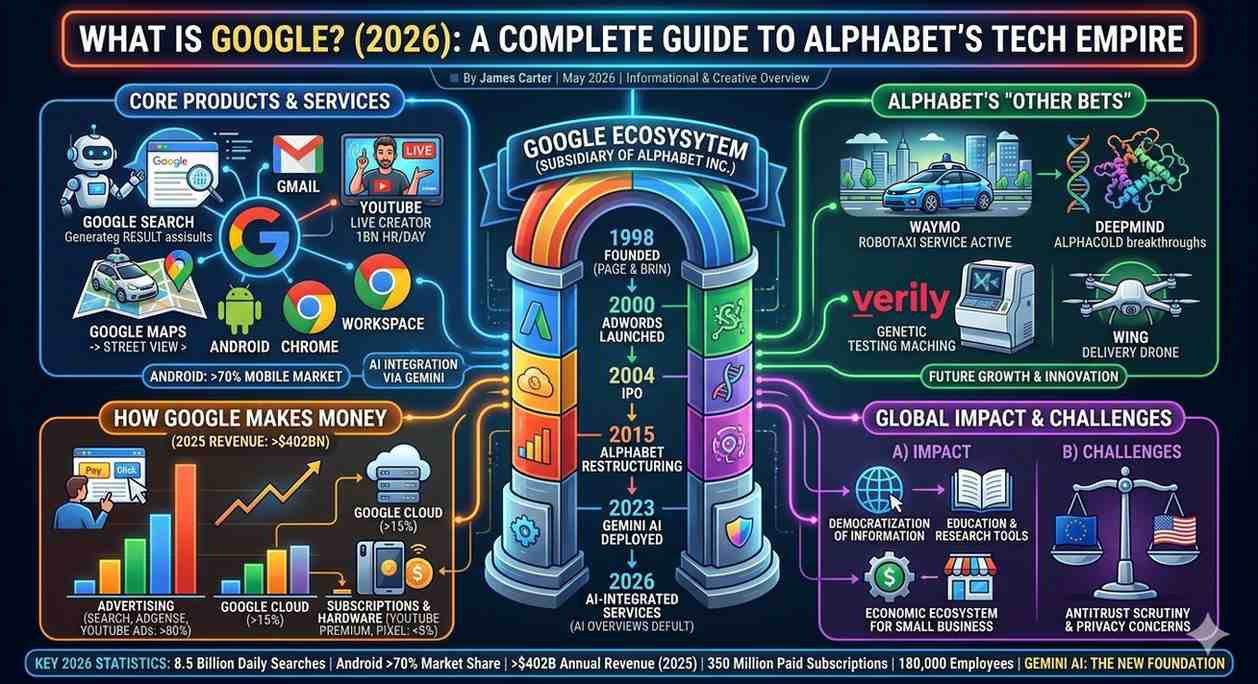
Google is an American technology company founded in 1998 by Larry Page and Sergey Brin. It started as a search engine designed to organize information on the internet, and has since grown into one of the largest, most influential technology companies in human history. Today, Google operates as a subsidiary of Alphabet Inc. and offers more than 50 products and services, including Search, Gmail, YouTube, Google Maps, Android, Chrome, Google Cloud, and Gemini AI. More than 70 percent of all online search requests worldwide go through Google, and the company generated over $402 billion in total revenue in 2025.
Why Google Matters ?
You used Google today. You almost certainly used it yesterday. You will probably use it again before this day ends.
This is not an exaggeration. Google processes approximately 8.5 billion search queries every single day. That is roughly 99,000 searches every second, around the clock, across every country on earth. No other tool, platform, or invention in modern history has become this deeply embedded in how human beings find information, communicate, navigate, learn, and do business.
But here is what most people do not realize: Google is not just a search engine. It has not been just a search engine for a very long time.
Google is an ecosystem. It is the operating system running on more than 70 percent of the world’s smartphones. It is the email service used by more than 1.8 billion people. It is the video platform that serves over one billion hours of video every single day. It is the cloud computing infrastructure powering thousands of the world’s biggest companies. And in 2026, it is one of the most advanced artificial intelligence research organizations on the planet.
This guide covers everything you need to know about Google: where it came from, what it does, how it makes money, how its search algorithm works, and where it is headed.
The History of Google : From a Garage to a Global Empire
The Stanford Beginning (1995 to 1998)
The story of Google begins not with a company, but with a research project at Stanford University.
In 1996, two PhD students named Larry Page and Sergey Brin began working on a project they initially called “BackRub.” The idea was straightforward but revolutionary: instead of ranking web pages based on how many times a keyword appeared on the page, rank them based on how many other pages linked to them. The more links a page received from credible sources, the more authoritative and relevant it was likely to be.
This concept became the PageRank algorithm, named after Larry Page. It was a fundamentally better way to evaluate the quality of web content, and it made search results dramatically more useful than anything that existed at the time.
According to Britannica, Google was officially incorporated as a company on September 4, 1998. At the time, the founders were working out of a garage in Menlo Park, California, rented from Susan Wojcicki, who would later become the CEO of YouTube.
Growth and the Dot-Com Era (1999 to 2004)
Google grew with extraordinary speed. Within a year of launching, it was handling more than 500,000 queries per day. By 2000, it was processing 100 million queries daily and had become the world’s largest search engine.
The company introduced Google AdWords in 2000, a system that allowed businesses to place targeted text ads next to search results. Advertisers paid only when users clicked their ads. This performance-based model turned out to be one of the most profitable business inventions in history, and it became the financial engine that powered everything Google built afterward.
In 2001, Google launched Image Search with 250 million images, transforming how people found visual content online. The same year, Larry Page stepped back from the CEO role and Eric Schmidt was brought in to provide executive leadership as the company scaled.
In 2004, Google launched Gmail on April 1st. The announcement was so surprising that many people thought it was an April Fools’ joke. Free email with a full gigabyte of storage at a time when most email services offered only a few megabytes. It was not a joke. Gmail went on to become one of the most widely used communication tools in history.
Also in 2004, Google went public on the NASDAQ stock exchange under the ticker symbol GOOG, raising $1.67 billion in one of the most anticipated IPOs of the decade.
The Platform Years (2005 to 2014)
This period defined Google as a technology platform company, not just a search company.
In 2005, Google acquired a small startup called Android Inc. for approximately $50 million. At the time, Android was intended for digital cameras. Google repurposed it as a mobile operating system, and the first Android phone, the HTC Dream, launched in 2008. By 2025, Android powered over 70 percent of the world’s smartphones.
In February 2005, Google Maps launched and permanently changed how people navigate and understand the physical world. Street View followed in 2007, capturing 360-degree imagery of streets across dozens of countries.
In 2006, Google acquired YouTube for $1.65 billion, a price that many analysts at the time called outrageously high. It turned out to be one of the greatest acquisitions in business history. YouTube is now the world’s second-largest search engine and the dominant platform for video content globally.
In 2008, Google launched Chrome, a web browser that prioritized speed, simplicity, and stability. Within a few years, Chrome became the most-used web browser in the world, a position it still holds in 2026.
Restructuring Under Alphabet (2015 to Present)
By 2015, Google had grown so large and so diverse that its founders decided a structural reorganization was necessary. On August 10, 2015, Google announced the creation of Alphabet Inc. as a new parent holding company.
Under this structure, Google became the largest subsidiary of Alphabet, focused on its core businesses: Search, Ads, Maps, YouTube, Android, Chrome, and Google Cloud. Other projects, including the self-driving car project Waymo, the life sciences company Verily, and the research lab DeepMind, became separate subsidiaries of Alphabet.
This restructuring was designed to give each major project the autonomy, leadership, and investment focus it needed to succeed independently, while maintaining the overall financial strength of the Alphabet umbrella.
Today, Sundar Pichai serves as CEO of both Google and Alphabet. He took over as Google’s CEO in 2015 and became Alphabet’s CEO in 2019 when Larry Page and Sergey Brin stepped back from executive roles.
What Does Google Actually Do? Core Products and Services
Google Search
Google Search is the product that started it all and remains the most important thing Google does. It is the most visited website on the internet, processing over 8.5 billion searches per day across every language, country, and device category.
When you type a query into Google, a complex system involving hundreds of algorithms and signals works in milliseconds to identify the most relevant, authoritative, and helpful content from across the entire indexed web. According to Google Search Central’s official documentation, Google uses multiple AI-powered ranking systems including PageRank, RankBrain, BERT, and the Multitask Unified Model (MUM) to understand what users are looking for and surface the best available answers.
In 2026, Google Search looks fundamentally different from even three years ago. AI Overviews, powered by Google’s Gemini AI model, now appear at the top of results for approximately 48 percent of all tracked search queries. Instead of just showing links, Google now generates synthesized answers directly on the search results page, pulling from multiple credible sources and presenting information in a conversational format.
Gmail
Gmail launched in 2004 and transformed email. Today it serves more than 1.8 billion active users worldwide, making it the most widely used email service on the planet. Gmail introduced threaded conversations, powerful search, excellent spam filtering, and large storage, setting a standard that every other email service has spent two decades trying to match.
Google Maps
Google Maps launched in 2005 and has since become indispensable for navigation, local search, and geographic discovery. With Street View imagery covering millions of miles of roads worldwide, real-time traffic data, public transit integration, and business listings, Google Maps is the default navigation tool for most of the world’s smartphone users.
According to about.google, Maps helps over one billion people navigate their world every month.
YouTube
Acquired by Google in 2006 for $1.65 billion, YouTube is now worth an estimated $450 billion and generates over $31 billion in advertising revenue annually. It is the world’s largest video platform, with over 500 hours of video uploaded to the platform every single minute.
YouTube is also the second-largest search engine in the world. When people want to learn how to do something, watch entertainment, follow news, or discover music, YouTube is where they go. The platform serves more than one billion hours of video content every single day.
Android
Android is the world’s most widely used operating system. Originally acquired by Google in 2005, Android now powers over 70 percent of all smartphones globally, representing billions of active devices across virtually every country. Its open-source model allowed device manufacturers worldwide to adopt it, making Android the dominant platform for mobile computing at a global scale.
Google Chrome
Google Chrome is the world’s most used web browser with a market share exceeding 65 percent globally. Chrome is available on Windows, Mac, Linux, iOS, and Android, and its performance, security features, and integration with Google services have made it the default browser for most internet users worldwide.
Google Cloud
Google Cloud is one of the fastest-growing segments of Google’s business. It provides cloud infrastructure, data analytics, machine learning tools, and enterprise software to businesses of all sizes. In Q1 2026, Google Cloud revenues grew 63 percent year-over-year to $20 billion, led by explosive demand for AI infrastructure and enterprise AI solutions. Google Cloud is now firmly established as the third-largest cloud platform globally, behind Amazon Web Services and Microsoft Azure.
Google Workspace
Google Workspace (formerly G Suite) is Google’s suite of productivity tools for businesses, educational institutions, and organizations. It includes Gmail, Google Docs, Google Sheets, Google Slides, Google Drive, Google Meet, and Google Calendar. Workspace allows real-time collaboration on documents and files from anywhere in the world, and it has become the standard productivity platform for many organizations, especially in education and remote-first businesses.
Gemini AI
Gemini is Google’s flagship artificial intelligence model and one of the most significant products in the company’s history since Search itself. Launched as Bard in 2023 and rebranded as Gemini in 2024, it represents Google’s answer to the challenge posed by AI models like ChatGPT.
Gemini is natively multimodal, meaning it can understand and generate text, code, images, audio, and video. It is integrated directly into Google Search, Gmail, Docs, YouTube, Android, and Chrome. Gemini 2.5, released in 2025, introduced a major leap in long-context understanding and reasoning capability.
As of Q1 2026, Google reported 350 million total paid subscriptions, with Gemini Enterprise showing 40 percent quarter-on-quarter growth in paid monthly active users. Gemini is now the engine powering AI Overviews in Google Search worldwide.
Google Pixel and Nest Hardware
Google designs and sells its own hardware devices, including the Pixel smartphone line (known for its AI-enhanced camera system), Nest smart home devices (including Nest Hub, Nest Thermostat, and Nest Doorbell), and Chromebook laptops. These hardware products serve as showcase devices for Google’s software and AI capabilities, and they contribute a meaningful portion of the company’s non-advertising revenue.
How Google Search Works: The Technology Behind the World’s Most Important Algorithm
Understanding how Google Search actually works is one of the most valuable pieces of knowledge for anyone who creates content, builds websites, or wants to understand the modern internet.
Crawling and Indexing
Before Google can show you search results, it must first discover and catalog web pages. This happens through a process called crawling, where automated programs called “Googlebot” follow links across the web, visiting billions of pages and collecting their content.
The information collected by Googlebot is then processed and stored in Google’s index, an enormous database representing a catalog of the entire web. Google’s index is one of the largest databases ever created by human beings.
Ranking Signals
When you submit a search query, Google’s systems evaluate hundreds of signals simultaneously to determine which pages best answer your question. These signals include content relevance, page quality, site authority, user experience signals (like page load speed and mobile-friendliness), freshness, and location.
According to Google’s official ranking systems guide, key AI systems within this process include:
PageRank, which evaluates the quality and quantity of links pointing to a page, treating each link as a vote of confidence from one source to another.
RankBrain, a machine learning system that helps Google understand how words relate to concepts, enabling relevant results even when a page does not contain the exact words from a search query.
BERT (Bidirectional Encoder Representations from Transformers), which helps Google understand how combinations of words express different meanings and intent, particularly for natural language and conversational queries.
MUM (Multitask Unified Model), an AI system capable of understanding information across text, images, and multiple languages simultaneously.
Gemini and AI Overviews in 2026
The biggest shift in how Google Search works in 2026 is the integration of Gemini AI throughout the search experience. As Google explains on their Search blog, Gemini brings multi-step reasoning, planning, and multimodal capabilities directly into Search.
AI Overviews now appear at the top of search results for almost half of all queries, generating synthesized answers from multiple trusted sources rather than simply showing a list of links. In January 2026, Google confirmed that Gemini 3 became the default model powering AI Overviews worldwide.
This represents the most significant change to how Google works since the introduction of PageRank itself.
How Google Makes Money: The Business Model
Most of Google’s services are completely free to use. So how does a company that gives away so much generate over $402 billion in annual revenue?
The answer lies in one of the most sophisticated business models ever built.
Advertising: The Core Revenue Engine
According to data from Alphabet’s official Q1 2026 SEC filing, advertising drives the vast majority of Google’s revenue. Google Search advertising alone generated $60.4 billion in Q1 2026, up 19 percent year over year.
Google’s advertising business works through two primary platforms:
Google Ads allows businesses to bid on keywords so their ads appear at the top of search results when users search for relevant terms. Advertisers pay only when users click on their ads. This pay-per-click model means every dollar spent on Google Ads is tied directly to user engagement.
Google AdSense allows website owners and content publishers to display Google-matched ads on their pages. Google shares a portion of the advertising revenue with the publisher, creating a mutually beneficial ecosystem that extends Google’s advertising reach far beyond its own properties.
YouTube advertising contributed over $31 billion to Google’s revenue in 2023, making it one of the most valuable advertising platforms in the world in its own right.
Google Cloud
Google Cloud has become a rapidly growing second pillar of Google’s business. In Q1 2026, Cloud revenues grew 63 percent to $20 billion, driven by surging demand for AI infrastructure and enterprise AI solutions. As businesses around the world accelerate their AI adoption, demand for Google Cloud’s computing power and AI tools continues to compound.
Subscriptions and Hardware
Google earns substantial subscription revenue from services including YouTube Premium, YouTube TV, YouTube Music, Google One (cloud storage), and Gemini Advanced. As of Q1 2026, Google reached 350 million paid subscribers across its subscription products.
Hardware revenue comes from Pixel phones, Nest smart home devices, and Chromebooks. While hardware represents a smaller share of total revenue, these products strengthen Google’s ecosystem and create direct relationships with consumers.
Google by the Numbers: Key Statistics for 2026
These figures put Google’s scale into context:
Google processes approximately 8.5 billion searches every single day. Android powers over 70 percent of the world’s smartphones. YouTube receives more than 500 hours of new video content every minute. Gmail serves over 1.8 billion active users. Google Chrome holds more than 65 percent of the global web browser market. Alphabet’s total revenue in 2025 exceeded $402 billion. Google Cloud grew 63 percent in Q1 2026 to $20 billion in quarterly revenue. Google Search advertising grew 19 percent year over year to $60.4 billion in a single quarter. Gemini has 350 million paid subscribers across its products. Google employs approximately 180,000 people worldwide.
Google and Alphabet: Understanding the Corporate Structure
Since 2015, Google has operated as a subsidiary of Alphabet Inc. Understanding this structure helps clarify how Google fits into the broader technology landscape.
Alphabet is a holding company. Google is its largest and most profitable subsidiary, generating the vast majority of Alphabet’s revenue. But Alphabet also owns several other businesses operating under separate leadership:
Waymo is Alphabet’s autonomous vehicle company, currently operating robotaxi services in several US cities. DeepMind is Alphabet’s world-leading AI research laboratory, responsible for breakthroughs including AlphaFold, which solved one of biology’s most complex problems. Verily focuses on life sciences and health technology. Wing is developing commercial drone delivery services.
As FourWeekMBA’s analysis of Google’s organizational structure notes, Google uses a hybrid matrix structure that combines functional leadership with product-based teams, enabling both large-scale coordination and rapid innovation. This organizational design supports Google’s ability to run massive global operations while simultaneously pursuing ambitious, long-term projects.
Google’s Impact on the World
Information Access
Google has fundamentally changed how humanity accesses information. Questions that once required a trip to a library or an encyclopedia, and before that, access to expensive experts, can now be answered within seconds by anyone with an internet connection. This democratization of information is one of the most significant developments in human history.
According to MIT’s research on information access, the ability to instantly access reliable information has had measurable positive impacts on education, public health, economic opportunity, and scientific progress.
Education and Research
Google Scholar, Google’s specialized search engine for academic content, has transformed how researchers and students find scholarly information. It indexes tens of millions of peer-reviewed papers, theses, books, and academic abstracts, making academic knowledge more accessible than ever before.
Google’s investment in tools like Google Classroom, Google for Education, and YouTube’s educational content has made high-quality learning resources available to students across the world, including in regions with limited access to traditional educational infrastructure.
Economic Impact
Google directly employs approximately 180,000 people worldwide. But its indirect economic impact is many times larger. The Google Ads ecosystem supports millions of businesses globally, many of which exist entirely because of the ability to reach customers through Google Search. The Android ecosystem supports hundreds of millions of jobs in app development, device manufacturing, and related industries.
Privacy Considerations
Google’s business model depends on collecting and analyzing user data to deliver relevant advertising. This creates a fundamental tension between service quality and user privacy that has generated significant regulatory scrutiny worldwide.
The European Union has imposed billions of dollars in antitrust fines on Google over the past decade. In the United States, the Department of Justice has pursued antitrust cases related to Google’s search market dominance and its agreements to be the default search engine on devices like Apple’s iPhone.
These regulatory challenges reflect genuine and important questions about the power of a single company to control how information is found, distributed, and monetized across the global internet.
The Future of Google: What Comes Next
AI as the New Foundation
The most important thing happening at Google in 2026 is the transformation of every product around artificial intelligence. Gemini is not just a chatbot. It is the new foundation layer on which Google is rebuilding Search, Maps, Gmail, Workspace, and Android.
This shift represents both Google’s greatest opportunity and its most significant challenge. The company that defined information access for the web era must now redefine it for the AI era, while competing with OpenAI, Microsoft, Meta, and others who are building their own AI-powered search and productivity experiences.
Quantum Computing
Google has been investing heavily in quantum computing research for over a decade. In 2019, Google claimed to achieve “quantum supremacy,” performing a calculation in 200 seconds that would take the world’s most powerful classical supercomputer approximately 10,000 years. While practical quantum computing applications remain years away, Google’s lead in this area could become strategically significant as the technology matures.
Autonomous Systems and Robotics
Through Waymo, Alphabet is building what could become the world’s leading autonomous transportation platform. Waymo vehicles have already driven tens of millions of miles autonomously and are providing commercial robotaxi services in multiple US cities. As regulations evolve and the technology matures, autonomous vehicles could become one of the largest businesses to emerge from the Google ecosystem.
Frequently Asked Questions About Google
What is Google used for?
Google is used for searching the internet, sending and receiving email through Gmail, watching videos on YouTube, navigating with Google Maps, storing and collaborating on documents through Google Drive and Workspace, managing mobile devices through Android, and increasingly, using AI assistance through Gemini. It is also the world’s largest digital advertising platform.
Who owns Google?
Google is a subsidiary of Alphabet Inc., a publicly traded holding company listed on the NASDAQ stock exchange. Alphabet is owned by its shareholders, with Larry Page and Sergey Brin maintaining significant ownership stakes and voting control through their Class B shares. Sundar Pichai serves as CEO of both Google and Alphabet.
When was Google founded?
Google was officially founded and incorporated on September 4, 1998, by Larry Page and Sergey Brin while they were PhD students at Stanford University.
Is Google the most used search engine in the world?
Yes. Google handles more than 70 percent of all global internet searches. It is the default search engine for the vast majority of web browsers, smartphones, and devices worldwide.
How does Google make money if its services are free?
Google primarily makes money through advertising. Businesses pay to appear in Google Search results when users search for terms relevant to their products or services. They pay only when users click on their ads. This pay-per-click model, combined with YouTube advertising, generated the majority of Google’s $402 billion in 2025 revenue. Google Cloud, hardware, and subscription services like YouTube Premium and Google One provide additional revenue streams.
What is Google Gemini?
Google Gemini is Google’s flagship artificial intelligence model. It is a multimodal AI system capable of understanding and generating text, code, images, audio, and video. Gemini powers AI Overviews in Google Search, integrates with Gmail, Docs, and Android, and is available as a standalone AI assistant. It is the most significant AI product Google has built and represents the company’s core strategy for the AI era.
What is Alphabet and how does it relate to Google?
Alphabet Inc. is the parent holding company created in 2015 when Google restructured its corporate organization. Google became Alphabet’s largest subsidiary, focused on its core internet businesses. Other Alphabet subsidiaries include Waymo (autonomous vehicles), DeepMind (AI research), and Verily (life sciences). Alphabet is publicly traded and Google represents the vast majority of its revenue and profits.
Final Thoughts
Google started as a better way to search the internet. It became the infrastructure of the modern digital world.
From the garage where Larry Page and Sergey Brin built the first version of PageRank, to the global technology empire generating over $400 billion in annual revenue and reshaping the nature of information access through AI, the trajectory of Google is one of the most remarkable stories in the history of human enterprise.
In 2026, Google is at another inflection point. The transition to AI-powered search, the explosive growth of Google Cloud, and the integration of Gemini across every product represent a fundamental reimagining of what Google is and what it does.
What remains constant is the original mission: to organize the world’s information and make it universally accessible and useful. After nearly three decades, Google continues to define what that mission means for each new technological era.
To learn more about how Google’s technology impacts the digital world, explore resources from Stanford University’s computer science department, where Google’s founders developed the research that started it all, and from MIT’s digital technology research for broader context on how technology companies shape information access globally.
