


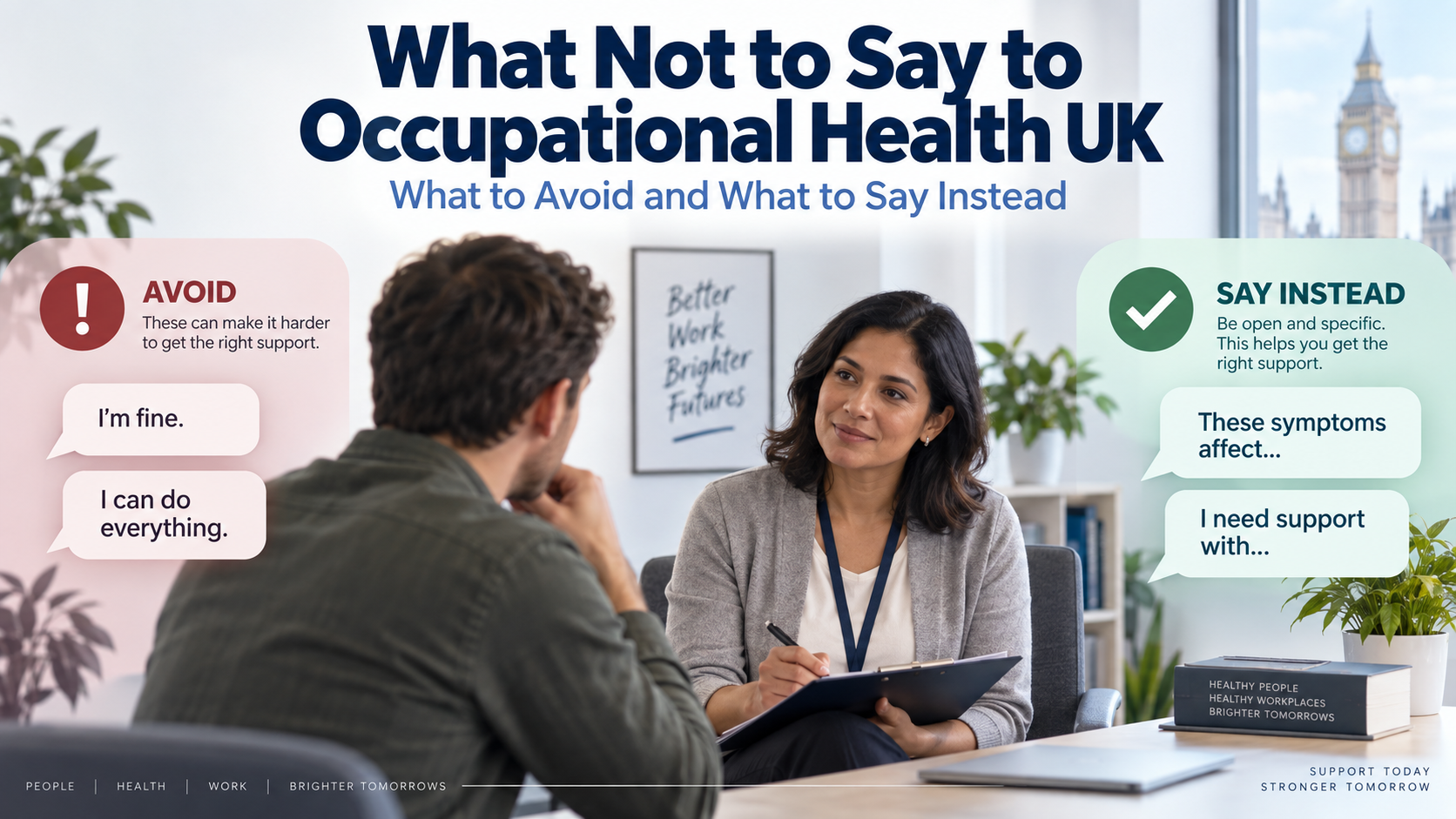
If your employer has referred you to Occupational Health, you may be worried about what to say during the assessment.
You might be asking:
- What should I not say to Occupational Health?
- Can Occupational Health get me sacked?
- Do employers have to follow Occupational Health recommendations?
- Can I refuse an Occupational Health assessment?
- Is Occupational Health confidential?
- Will my employer see everything I say?
- What happens after an Occupational Health assessment?
These are understandable questions, particularly if you are already dealing with illness, stress, anxiety, a long-term health condition or difficulties at work.
The most important thing to understand is that there is no official list of words that you are forbidden to say to Occupational Health. The better approach is to be honest, accurate and specific about your health and how it affects your ability to do your job.
You should not exaggerate your symptoms, invent a diagnosis or deliberately hide important information. At the same time, you do not have to provide unnecessary private details that have nothing to do with your work.
This guide explains what not to say to Occupational Health UK, what you can say instead, and answers the most common questions employees have about Occupational Health assessments.
Table of Contents
What Is Occupational Health?
Occupational Health is a type of medical service that focuses on the relationship between a person’s health and their ability to work.
An employer might use Occupational Health when an employee:
- Has a physical or mental health problem affecting work
- Has been absent from work for a long period
- Is returning after sickness absence
- May need reasonable adjustments
- Is struggling with workplace-related health issues
- Needs advice about how their role could be adapted
Acas explains that Occupational Health can help employers and workers consider health-related workplace support, reasonable adjustments and returning to work. Acas explains how Occupational Health is used at work.
Occupational Health is therefore not simply about deciding whether someone is “ill” or “not ill”.
It is often about understanding:
What can the employee do? What are they struggling with? What support might help?
What Not to Say to Occupational Health UK
There is no magic sentence that will automatically cause you to lose your job.
However, there are several types of statements you should avoid because they can create an inaccurate or incomplete picture of your circumstances.
1. Don’t Say “I’m Completely Fine” If You Are Not
Some employees feel pressure to appear strong during an Occupational Health assessment.
You might think saying “I’m completely fine” will reassure your employer.
But if you are actually struggling with fatigue, anxiety, pain, concentration, sleep problems or another health issue, this statement may not accurately explain your situation.
Instead, describe what is actually happening.
For example:
“I can manage most of my normal duties, but I have difficulty concentrating for long periods and my symptoms become worse later in the day.”
That gives Occupational Health useful information.
You do not need to make your situation sound worse than it is.
You simply need to describe it accurately.
2. Don’t Exaggerate Your Symptoms
Exaggerating your symptoms can make your situation harder to assess accurately.
For example, saying:
“I cannot use a computer at all.”
is very different from:
“I can use a computer, but prolonged screen time makes my symptoms worse.”
The second statement gives Occupational Health more useful information.
Try to explain:
- How often the problem happens
- How long it lasts
- What makes it worse
- What makes it better
- Which work activities are affected
- Whether you can still perform some duties
- Whether adjustments could help
Specific information is usually more useful than dramatic descriptions.
3. Don’t Invent a Medical Diagnosis
You should distinguish between a confirmed diagnosis and something you believe may be happening.
For example:
“I have been diagnosed with depression.”
is different from:
“I think I may have depression, but I have not received a diagnosis.”
If you have not been formally diagnosed, do not present your assumption as a confirmed medical condition.
Instead, explain your symptoms honestly.
You can say:
“I have been experiencing these symptoms, but I have not received a formal diagnosis yet.”
Or:
“My GP is currently investigating the problem.”
This gives Occupational Health accurate information without making assumptions about your medical condition.
4. Don’t Say You Need No Adjustments Just to Look Strong
Some employees worry that asking for adjustments will make them look weak or incapable.
That is not necessarily the case.
If a workplace adjustment could help you perform your job, it is reasonable to discuss it.
Depending on the circumstances, adjustments could include:
- Flexible working hours
- Additional breaks
- Changes to duties
- A phased return
- Changes to the workstation
- Different working arrangements
- Temporary changes to workload
- Changes to how tasks are organised
If you think something would help, explain why.
For example:
“I can perform my normal duties, but regular short breaks would help me manage my symptoms and maintain concentration.”
The aim is not to demand a particular adjustment.
The aim is to explain what may help you work effectively.
5. Don’t Turn the Assessment Into a Personal Attack on Your Manager
Workplace problems can be relevant to Occupational Health.
For example, you may be experiencing stress because of:
- Excessive workload
- Workplace conflict
- Bullying concerns
- Poor communication
- Long working hours
- Changes to your role
- Difficult relationships at work
However, try to describe the facts rather than turning the assessment into a personal attack.
Instead of:
“My manager is destroying my life.”
you could say:
“My workload increased significantly after a change in the team structure, and I began experiencing sleep problems and difficulty concentrating.”
The second statement provides information that Occupational Health can understand and consider.
If you have a formal complaint about bullying, harassment or another workplace issue, that may need to be dealt with through your employer’s grievance or other appropriate procedure.
6. Don’t Say “I Can’t Do Any Work” Unless That Is Actually True
There can be a significant difference between being unable to perform your normal role and being unable to perform any work at all.
For example, you might be unable to:
- Work night shifts
- Stand for long periods
- Lift heavy objects
- Travel long distances
- Work continuously without breaks
while still being able to perform other duties.
Instead of saying:
“I cannot work.”
you could explain:
“I am currently struggling with night shifts, but I can perform daytime duties.”
Or:
“I can perform administrative tasks, but prolonged standing causes significant problems.”
This helps Occupational Health understand your functional ability.
7. Don’t Hide Important Information
You should not deliberately hide information that is directly relevant to your ability to work.
For example, it may be important to discuss:
- Symptoms affecting concentration
- Medication side effects affecting work
- Mobility difficulties
- Fatigue
- Recurring symptoms
- Mental health difficulties affecting work
- Previous sickness absence
- Problems returning to work
- Tasks that make your condition worse
However, relevant does not mean everything in your personal life.
You can focus on information that helps explain your health and its impact on work.
8. Don’t Assume You Have to Tell Occupational Health Everything
The opposite mistake is believing that you must reveal every private detail about your life.
You can ask questions about what information is needed and how the assessment will be used.
For example:
“Could you explain what information will be included in the report?”
You can also ask:
“Who will receive the report?”
and:
“What information will my employer be given?”
These are reasonable questions.
You may want to understand the assessment process before discussing highly personal information.
Can Occupational Health Get You Sacked?
This is one of the biggest concerns employees have.
Occupational Health does not normally make the final employment decision.
Its role is generally to provide professional information and advice about health and work.
For example, an Occupational Health assessment may consider:
- Whether you are fit for work
- Whether you can work with adjustments
- Whether you are likely to return to work
- Whether your duties could be changed
- Whether further medical information is needed
- What support could help you remain in work
The employer then considers that information alongside the wider circumstances.
Therefore, being referred to Occupational Health does not automatically mean that you are going to be dismissed.
Can an Occupational Health Report Contribute to Dismissal?
Yes, an Occupational Health report can sometimes form part of an employer’s decision-making process.
For example, an employee may have a long-term health condition that substantially affects their ability to perform their job.
The employer may consider:
- Occupational Health advice
- Medical evidence
- The employee’s ability to perform their role
- Possible reasonable adjustments
- Absence history
- Whether the situation is likely to improve
- Whether alternative work is available
However, dismissal because of illness should not simply be treated as an automatic consequence of an Occupational Health report.
GOV.UK states that dismissal because of illness should be a last resort, and employers should consider ways of helping an employee return to work, including Occupational Health and reasonable adjustments where applicable. GOV.UK guidance on dismissals due to illness.
That distinction is important.
An Occupational Health assessment can sometimes identify ways of helping an employee stay in work rather than contributing to their dismissal.
Do Employers Have to Follow Occupational Health Recommendations?
Not automatically.
An Occupational Health professional provides advice and recommendations. The employer then considers those recommendations alongside the circumstances of the workplace and any legal duties that apply.
This means an employer may not implement every recommendation exactly as written.
However, that does not mean Occupational Health advice can simply be ignored without consideration.
If your employer has not followed a recommendation, you can ask:
“Could you explain why the Occupational Health recommendation has not been implemented?”
You could also ask:
“Has an alternative adjustment been considered?”
This keeps the conversation factual and constructive.
What If Occupational Health Recommends Reasonable Adjustments?
If you are disabled under the Equality Act 2010, reasonable adjustments may be particularly important.
Examples can include:
- Changes to working hours
- Changes to duties
- Additional breaks
- Changes to equipment
- Changes to working arrangements
- Phased return to work
- Changes to the physical workplace
The specific adjustment depends on the individual circumstances.
An Occupational Health recommendation does not automatically mean that every suggested change must be provided.
However, where disability-related legal duties apply, an employer needs to properly consider those duties.
Can I Refuse an Occupational Health Assessment?
Generally, you do not have to agree to an Occupational Health assessment.
Acas states that a worker does not have to agree to an Occupational Health assessment. However, an assessment can provide useful information about support and can help prevent an employer from making major decisions without important health information.
This means refusing an assessment can have practical consequences.
Before refusing, find out:
- Why the employer wants the assessment
- What questions have been sent to Occupational Health
- What information will be requested
- Who will receive the report
- Whether you can see the report
- What happens if you refuse
Understanding the process may help you decide how to respond.
Why Might an Employee Refuse Occupational Health?
Employees may feel uncomfortable about an assessment because they are worried about:
- Losing their job
- Their diagnosis being shared
- Being judged
- Being pressured to return to work
- The report being inaccurate
- Their employer receiving too much medical information
These concerns are understandable.
However, refusing without understanding the process may mean your employer has less medical information when considering your situation.
If you are concerned, ask questions first.
You can say:
“Before I agree to the assessment, could you explain what information will be requested and what will be shared with my employer?”
What Happens During an Occupational Health Assessment?
The exact process can vary.
The Occupational Health adviser may ask about:
- Your health
- Your symptoms
- Treatment
- Your job
- Your normal duties
- Difficulties performing particular tasks
- Your sickness absence
- Returning to work
- Possible workplace adjustments
- What you can currently do
You may also be asked whether your condition affects specific activities.
Try to give practical examples.
For example:
“I can work for several hours, but I struggle with prolonged concentration after lunch.”
This is more useful than simply saying:
“I can’t concentrate.”
Is Occupational Health Confidential?
Occupational Health involves sensitive health information, but you should not assume that everything you say will remain completely separate from your employer.
The assessment normally exists because your employer needs relevant information about your health and work.
Ask the provider about:
- What information will be included in the report
- Who will receive it
- What information will not be shared
- Whether you can see the report
- Whether you can raise factual errors
Understanding the process beforehand can make the assessment less stressful.
Can I See My Occupational Health Report?
The process can vary depending on how the assessment is arranged.
Acas states that after an Occupational Health assessment, the adviser must ask the worker’s permission before sharing the assessment with the employer. If a doctor carries out the assessment, the employer must inform the worker in writing about their rights.
You can therefore ask about the report process before agreeing to the assessment.
Useful questions include:
“Will I see the report before it is sent to my employer?”
“Can I point out factual errors?”
“When will the report be shared?”
“What happens if I disagree with the report?”
What Should I Say to Occupational Health Instead?
A simple way to prepare is to think about three things:
1. What is happening?
Explain your symptoms or health problem.
For example:
“I have been experiencing fatigue and difficulty concentrating.”
2. How does it affect your job?
Explain the practical impact.
“It becomes particularly difficult during long meetings and toward the end of the working day.”
3. What might help?
Explain any support that you believe could help.
“Short breaks and some flexibility around my working hours may help me manage the symptoms.”
This gives Occupational Health a much clearer picture.
Examples of What to Say
If asked: “Can you do your job?”
Instead of:
“No, I can’t do anything.”
Try:
“I can perform many parts of my role, but I currently struggle with prolonged standing and long shifts.”
If asked about your symptoms
Instead of:
“They’re terrible all the time.”
Try:
“The symptoms vary. They are usually worse after long periods of activity.”
If asked whether you need adjustments
Instead of:
“I don’t need anything.”
Try:
“I think regular breaks and some flexibility could help me manage the symptoms.”
If asked about your manager
Instead of:
“My manager is the problem.”
Try:
“There have been repeated workload and communication issues, and these have increased my stress.”
If you don’t know something
You do not need to guess.
Simply say:
“I’m not sure.”
Accurate uncertainty is better than giving an answer that is not true.
How to Prepare for an Occupational Health Assessment
Good preparation can make the assessment much easier.
Make a list of your symptoms
Think about:
- What symptoms you experience
- How frequently they occur
- How long they last
- What makes them worse
- What helps
- Whether they vary during the day
Review your job duties
Think about:
- What you can do normally
- What you find difficult
- What you currently cannot do
- Which tasks make symptoms worse
- Which tasks you could perform with adjustments
Consider possible adjustments
You do not need to know exactly what adjustment your employer should provide.
But it can help to think about whether:
- Flexible hours
- Additional breaks
- A phased return
- Different duties
- Equipment changes
- Reduced workload temporarily
- Working from another location
could help.
Prepare questions
You can ask:
- What is the purpose of the assessment?
- Who will receive the report?
- What information will be shared?
- Can I see the report?
- What happens if I disagree with it?
What If You Disagree With the Occupational Health Report?
An employee may sometimes believe that an Occupational Health report does not accurately describe their situation.
If this happens, identify the specific issue.
For example:
“The report says that I can work full-time without restrictions, but I do not believe this accurately reflects the limitations I described during the assessment.”
Then explain why you believe the statement is inaccurate.
Avoid simply saying:
“The whole report is wrong.”
Specific concerns are easier to investigate.
Keep copies of relevant correspondence and ask the Occupational Health provider or employer what process is available for raising concerns.
If the issue could affect your employment, you may also want independent employment-law advice.
What If My Employer Ignores Occupational Health Advice?
If your employer does not implement a recommendation, ask for an explanation.
For example:
“Occupational Health recommended a phased return. Could you explain why this recommendation has not been implemented and whether an alternative arrangement has been considered?”
This creates a clear record of your concern.
If the recommendation relates to disability and reasonable adjustments, consider whether the employer has properly considered its legal responsibilities.
Do not assume that an employer’s decision automatically means it has acted unlawfully. The legal position depends on the individual circumstances.
What Not to Say to Occupational Health: Quick Checklist
Before your appointment, remember:
Avoid saying:
❌ “I’m completely fine” when you are not.
❌ “I can’t do anything” when you can perform some duties.
❌ “I have a medical condition” when you have not received a diagnosis.
❌ “Nothing can help me” without considering possible support.
❌ “My manager is ruining my life” without explaining the actual workplace circumstances.
❌ Exaggerated descriptions of your symptoms.
❌ Statements that you know are inaccurate.
❌ Unnecessary private information that is unrelated to your work.
Instead:
✅ Be truthful.
✅ Give specific examples.
✅ Explain what you can and cannot do.
✅ Explain how symptoms affect particular duties.
✅ Discuss possible adjustments.
✅ Ask how your information will be used.
✅ Ask who will receive the report.
✅ Keep relevant records.
✅ Raise factual errors if you believe the report is inaccurate.
Occupational Health and Workplace Wellbeing
Health problems and workplace stress can sometimes overlap.
If your concerns involve stress, relationships, communication or personal wellbeing, it can help to separate the different issues.
For example, if a workplace problem is affecting your mental wellbeing, explain:
- What happened.
- How frequently it happens.
- How it affects you.
- How it affects your work.
- What support might help.
If you are also researching broader wellbeing and relationship topics, you can read our guide on what a sex-positive relationship means for information about healthy communication and boundaries in relationships.
For employees working in healthcare, our ESR Login NHS guide explains the Electronic Staff Record system and may be useful when dealing with employment-related NHS information.
Frequently Asked Questions
Can Occupational Health get me sacked?
Occupational Health normally provides advice rather than making the final dismissal decision. However, its report can form part of an employer’s decision-making process.
A referral itself does not automatically mean that you will be dismissed.
Do employers have to follow Occupational Health recommendations?
Not automatically. The employer considers the recommendations alongside the wider circumstances and any legal obligations that apply.
Can I refuse an Occupational Health assessment?
Generally, yes. However, refusing may mean that your employer makes decisions without additional Occupational Health information.
What should I tell Occupational Health?
Explain your health problems honestly, how they affect your work, what you can still do and what support or adjustments may help.
Should I tell Occupational Health about my mental health?
If your mental health affects your ability to work, it is appropriate to explain the relevant symptoms and their practical impact.
Can I lie to Occupational Health?
You should not deliberately provide false information. Accurate information gives Occupational Health the best opportunity to understand your situation.
Should I exaggerate my symptoms?
No. Exaggeration can create an inaccurate picture of your functional ability.
Is an Occupational Health assessment the same as a GP appointment?
No. Occupational Health focuses on the relationship between health and work. It is not simply the same as a normal GP consultation.
Can Occupational Health diagnose me?
The scope of an assessment depends on the provider and circumstances. Do not assume that an Occupational Health adviser will provide a new medical diagnosis simply because you attend an assessment.
Can I see my Occupational Health report?
The process varies, but Acas explains that the Occupational Health adviser must obtain the worker’s permission before sharing the assessment with the employer.
What happens if I disagree with the report?
Identify the specific factual error or misunderstanding and ask the provider or employer what process is available to raise it.
Can my employer dismiss me because of illness?
Dismissal due to illness can happen in some circumstances, but GOV.UK states that dismissal should be a last resort and employers should consider ways of supporting the employee first.
Final Thoughts
If you are searching for what not to say to Occupational Health UK, the most important lesson is simple:
Do not try to find the “perfect words”. Give accurate information.
You do not need to make your condition sound worse.
You do not need to pretend that everything is fine.
You do not need to invent a diagnosis.
And you do not need to turn the appointment into a personal argument with your employer.
Instead, explain:
- What you are experiencing
- How often it happens
- How it affects your work
- What you can still do
- What tasks are difficult
- What support may help
Also ask questions about the assessment itself, particularly what information will be included in the report and who will receive it.
An Occupational Health assessment can help an employer understand how a health condition affects someone’s work and what support may be appropriate. It can also provide useful information when considering a return to work or reasonable adjustments.
If you are concerned about dismissal, discrimination, reasonable adjustments or another employment-law issue, consider obtaining individual advice because employment rights depend on the specific facts of your situation.
