


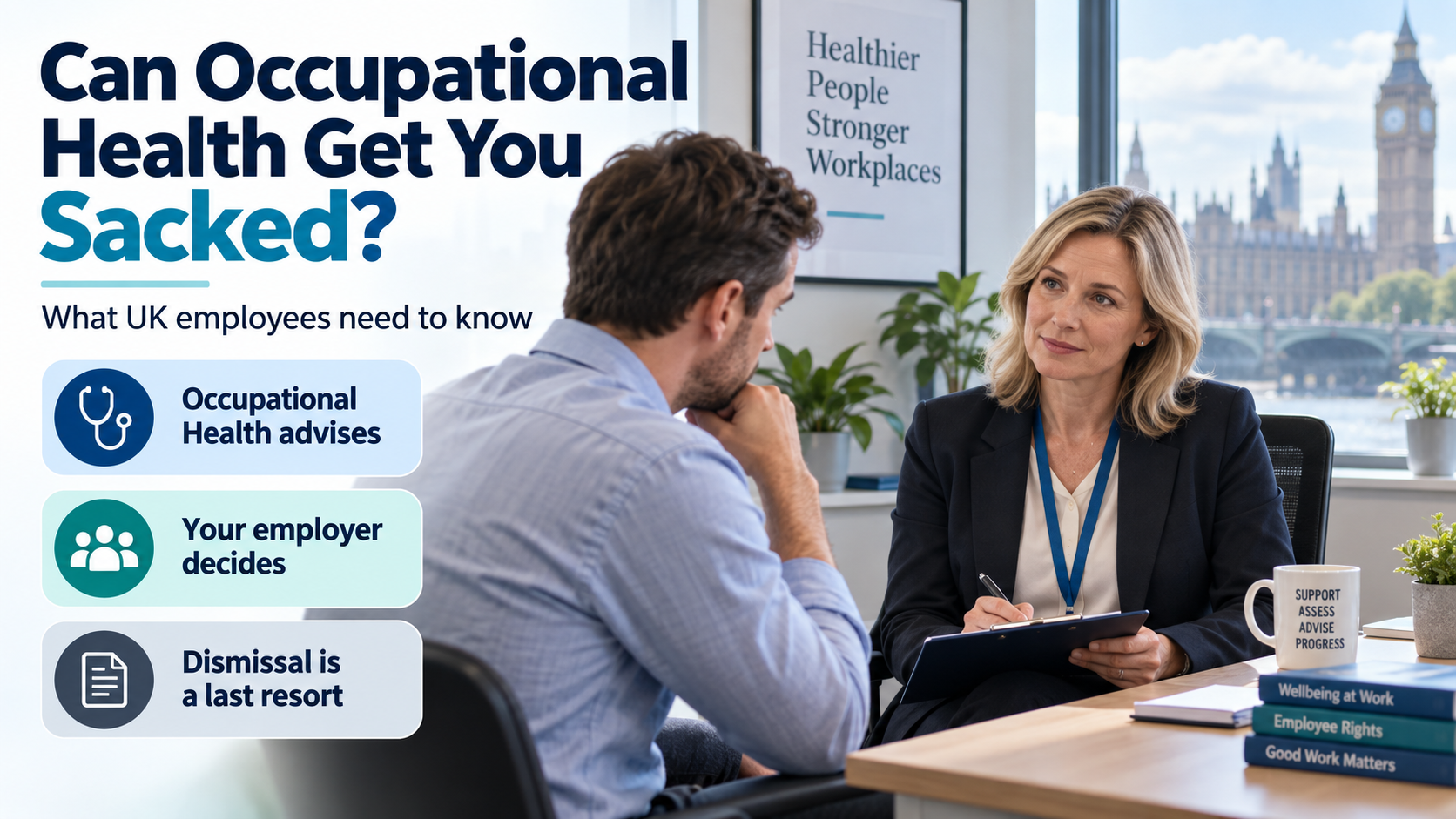
If your employer has referred you to Occupational Health, you may immediately wonder: can Occupational Health get you sacked?
The short answer is no, Occupational Health does not normally have the power to sack you. An Occupational Health professional assesses how your health affects your work and may recommend support, restrictions or workplace adjustments. Your employer makes the final employment decision.
However, an Occupational Health report can become part of the evidence your employer considers when dealing with long-term sickness absence, capability, returning to work or reasonable adjustments.
That distinction is important. Being sent to Occupational Health does not automatically mean your employer intends to dismiss you.
Under Acas guidance on Occupational Health at work, employers may use Occupational Health when a worker is struggling with physical or mental health, has been absent for a long period, is returning after sickness absence or may need reasonable adjustments.
Can Occupational Health Actually Sack You?
No. Occupational Health is normally an advisory medical service rather than the part of an organisation that makes dismissal decisions.
An Occupational Health adviser might be asked whether you are currently fit for work, whether your condition affects particular duties, whether a phased return could help, whether workplace adjustments should be considered or when your situation should be reviewed again.
The adviser may put their findings and recommendations into an Occupational Health report.
Your employer then considers that report alongside other relevant information before deciding what happens next.
Acas explains that the employer should consider Occupational Health recommendations, but it remains up to the employer to decide whether to implement them, taking account of the organisation’s needs and its legal obligations to the worker.
So the simplest way to understand the relationship is:
Occupational Health advises. Your employer decides.
Can an Occupational Health Report Lead to You Losing Your Job?
Potentially, but an Occupational Health report does not itself dismiss you.
Suppose you have been absent from work for several months because of a serious health problem. Your employer may ask Occupational Health whether you are likely to return, which duties you can perform and whether adjustments could help.
The assessment might conclude that you are currently unable to perform your normal duties but could return gradually on reduced hours.
In another case, the report might indicate that an employee is unlikely to be able to perform essential parts of their role for the foreseeable future.
Those conclusions can lead to very different conversations.
An employer might allow additional recovery time, arrange a phased return, modify duties, consider another role or review the situation again later. In more difficult cases, the report could become part of a formal capability process.
This is why the answer to “can Occupational Health get you sacked?” requires some nuance. Occupational Health cannot normally dismiss you, but its professional opinion can influence decisions your employer later makes.
Can You Be Sacked for Ill Health in the UK?
Yes, dismissal on capability grounds can sometimes be possible when persistent or long-term illness means an employee cannot do their job.
But dismissal should not automatically follow simply because somebody is ill.
Official GOV.UK guidance on dismissal due to illness states that dismissal should be a last resort. Employers should consider ways to help an employee return to work, including obtaining medical information, arranging an Occupational Health assessment and considering reasonable adjustments where appropriate.
GOV.UK also explains that persistent or long-term illness can potentially be a fair reason for dismissal where it makes it impossible for someone to do their job, but an employer should first look for ways to support the employee and allow reasonable time for recovery.
This means a capability decision is normally broader than simply asking, “What did Occupational Health say?”
The employer may need to consider your prognosis, the nature of your role, how long you have been absent, what duties you can still perform, whether adjustments are possible and whether your situation is likely to improve.
Is an Occupational Health Referral a Sign You Are Going to Be Sacked?
Not necessarily.
An Occupational Health referral can happen for many reasons, including returning after an operation, prolonged sickness absence, repeated absence, work-related stress, a request for adjustments or concerns about whether particular duties are safe for you.
In many cases, Occupational Health is used to help an employee stay in work, not remove them from it.
The referral itself therefore tells you much less than the questions your employer has actually asked Occupational Health to answer.
If you are concerned, ask your employer what the purpose of the referral is and what information they want Occupational Health to provide.
You may also find our related guide on what not to say to Occupational Health UK useful before attending your assessment, particularly if you are unsure how to explain your symptoms or work limitations clearly.
What If Occupational Health Says You Are Unfit for Work?
Being declared currently unfit for work does not automatically mean you will be dismissed.
The word “currently” can be crucial.
Someone may be unable to work today but expected to recover within several weeks. Another person might be able to return immediately if certain duties are temporarily changed.
Occupational Health could recommend more time away from work, shorter hours, lighter duties, additional breaks, workstation modifications or a phased return.
Acas says possible outcomes following an Occupational Health assessment include further time off, appropriate therapy, workplace adjustments and a phased return using reduced hours or lighter duties.
A report saying that you cannot presently perform your full duties is therefore very different from evidence suggesting that you are unlikely to be able to return to the essential duties of the job.
What If Occupational Health Says You Are Fit for Work?
Being assessed as fit for work does not necessarily mean Occupational Health believes you can immediately return to every duty without support.
A report could say that you are fit to return with adjustments.
For example, you might be able to return if you initially work shorter hours, avoid heavy lifting, take regular breaks or temporarily perform different duties.
Your employer should consider the recommendation alongside your actual role and circumstances.
If you disagree with something important in the report, raise the specific point rather than simply stating that the entire assessment is wrong.
For example:
“The report says that I can return to unrestricted duties, but during the assessment I explained that prolonged standing significantly worsens my symptoms.”
Specific concerns are much easier to address than a general disagreement.
Does Your Employer Have to Follow Occupational Health Recommendations?
Not every Occupational Health recommendation is automatically binding on an employer.
Occupational Health provides professional advice. The employer considers whether a suggested adjustment is practical and appropriate while also considering any legal obligations that apply.
This becomes particularly important when an employee is disabled.
Acas states that employers must make reasonable adjustments when they know, or could reasonably be expected to know, that someone is disabled, although an employer does not have to make an adjustment that is unreasonable.
Official GOV.UK guidance on reasonable adjustments for disabled workers gives examples such as changing working arrangements, adapting equipment, changing where someone works and allowing a phased return.
An employer may therefore decide that one recommendation cannot reasonably be implemented but consider another way of addressing the disadvantage.
Can You Be Sacked If Occupational Health Recommends Adjustments?
An adjustment recommendation does not make dismissal automatically impossible, but it can be highly relevant to the employer’s decision.
For example, imagine Occupational Health says an employee could perform their job effectively if they were allowed to work different hours.
The employer would need to consider that information when deciding how to proceed, particularly if the employee is disabled and the duty to make reasonable adjustments applies.
GOV.UK states that an employer cannot dismiss someone merely because they have become disabled. Dismissal may potentially arise where the disability means the person cannot do the job even with reasonable adjustments.
That is very different from saying that every disabled employee is protected from dismissal in all circumstances.
The individual facts matter.
Can You Refuse an Occupational Health Assessment?
Generally, an employee does not have to agree to an Occupational Health assessment.
But refusing one can have consequences.
Acas explains that an employee does not have to consent to an assessment, but participating can help them obtain support, return to work safely and prevent an employer from making major decisions without important health information.
If you refuse, your employer may still have to decide what to do using the information already available.
That could mean relying on your fit notes, absence history, previous medical information, workplace records and what you have personally told them.
Before refusing, it is sensible to understand why the assessment has been requested.
What Should You Say to Occupational Health?
Trying to give Occupational Health the answer you think will protect your job is usually less useful than giving an accurate account of your situation.
Do not minimise genuine symptoms simply because you are worried about looking incapable. Equally, do not exaggerate what you cannot do.
Occupational Health is often interested in your functional ability: what you can do, what you struggle with and what could make working easier or safer.
Instead of saying:
“I can’t work at all.”
when that is not completely accurate, you might say:
“I can manage desk-based duties, but prolonged standing significantly increases my symptoms.”
Likewise, rather than saying:
“I’m completely fine.”
when you are struggling, explain what is actually happening.
A useful approach is to describe:
- the symptoms or health difficulties you experience;
- how frequently they occur;
- which job duties are affected;
- what you can still do;
- what makes your symptoms worse;
- whether treatment or medication affects your work; and
- what workplace changes might help.
The goal is not to present yourself as more or less ill than you really are. It is to provide enough accurate information for Occupational Health to understand the relationship between your health and your job.
Can Occupational Health Share Everything With Your Employer?
Occupational Health assessments involve sensitive health information, but that does not mean you should assume that everything discussed will automatically be passed to your manager.
Acas states that after an Occupational Health assessment, the adviser must ask for the worker’s permission before sharing the assessment with the employer. It also says health information held by the employer should remain confidential and accessible only to people who genuinely need it.
Before your assessment, you can ask what will be included in the report, who will receive it, whether you will be able to see it and what happens if you believe something is factually incorrect.
Understanding this process can make the assessment much less intimidating.
What If Your Occupational Health Report Is Wrong?
If the report contains an important factual mistake, raise it promptly.
Identify the exact statement that concerns you and explain what you believe is inaccurate.
For example:
“The report states that I can work full-time without restrictions, but I explained during my assessment that I cannot currently manage prolonged standing.”
Keep copies of the report and relevant correspondence, particularly if your employer is considering capability or dismissal.
If the issue is serious, ask the Occupational Health provider what process exists for raising factual concerns.
What Happens After an Occupational Health Assessment?
There is no single outcome.
Your employer might decide that you can return normally, return with adjustments, remain absent for longer, begin a phased return or attend another assessment after a period of recovery.
In more serious long-term capability cases, the employer may eventually consider whether continued employment is realistically possible.
For employees working in the NHS, separate employment systems may also be relevant when checking absence, employment or workforce information. Our ESR login NHS guide explains how the Electronic Staff Record system is accessed and used.
Whatever your sector, an Occupational Health assessment should be viewed as one part of a wider employment process rather than a dismissal decision in itself.
Occupational Health vs Your Employer
| Occupational Health | Employer |
|---|---|
| Assesses how health affects work | Makes employment decisions |
| Gives an opinion about fitness for work | Decides how to respond |
| May recommend adjustments | Considers whether adjustments can be implemented |
| May recommend a phased return | Agrees the return-to-work arrangement |
| May advise that more recovery time is needed | Manages sickness absence |
| Provides professional health advice | May run a capability procedure |
| Does not normally dismiss employees | Can make the final dismissal decision |
This distinction is the key to understanding whether Occupational Health can get you sacked.
What Should You Do If You Think Your Job Is at Risk?
If you are concerned that your referral is connected to possible dismissal, focus on obtaining clear information rather than trying to guess what your employer is planning.
Ask why the referral has been made, what questions have been sent to Occupational Health and what decision the report is intended to inform.
Attend meetings prepared. Explain your condition accurately and keep copies of relevant fit notes, Occupational Health reports, emails and adjustment requests.
If your employer begins a formal capability or dismissal process, consider obtaining individual advice from Acas, your trade union or an employment-law professional.
Northern Ireland has separate employment and disability legislation from Great Britain. Employees there can check Northern Ireland guidance on dismissal because of illness, which likewise explains that employers should normally consider alternatives before dismissing somebody who is persistently or long-term sick.
Frequently Asked Questions
Can Occupational Health recommend that I am dismissed?
Occupational Health may provide an opinion about your ability to perform your job and your likely prognosis. That information could be relevant to a capability process, but the employer makes the dismissal decision.
Can Occupational Health say I am permanently unfit for work?
An Occupational Health professional may give an opinion about whether you are medically capable of returning to your role based on the information available. The wording, prognosis and possibility of adjustments or alternative duties are important.
Does being referred to Occupational Health mean my employer wants to sack me?
No. Occupational Health referrals are commonly used to obtain advice about sickness absence, returning to work, health difficulties and reasonable adjustments. A referral by itself does not establish that dismissal is planned.
Can my employer dismiss me while I am off sick?
Potentially, yes. Persistent or long-term illness can sometimes lead to a capability dismissal, but official UK guidance says employers should first look at ways to support the employee and give reasonable time to recover.
Should I be honest with Occupational Health?
Yes. Accurate information about your symptoms, abilities and limitations helps the adviser understand how your health affects your work. Avoid deliberately hiding relevant information or exaggerating your condition.
Can Occupational Health Get You Sacked? The Key Point
So, can Occupational Health get you sacked?
No, Occupational Health itself does not normally sack employees. Its role is to provide professional advice about your health, your ability to work and any support or adjustments that might be appropriate.
An Occupational Health report can influence an employer’s decision, particularly in long-term sickness or capability cases. But an assessment does not automatically mean you are about to lose your job.
Official UK guidance treats dismissal for long-term ill health as a last resort and expects employers to consider appropriate support and reasonable adjustments where relevant.
For many employees, an Occupational Health assessment serves a very different purpose: finding a safe and practical way for them to remain in work or return to work.
This article provides general information about UK Occupational Health and employment. It is not individual legal advice.
