


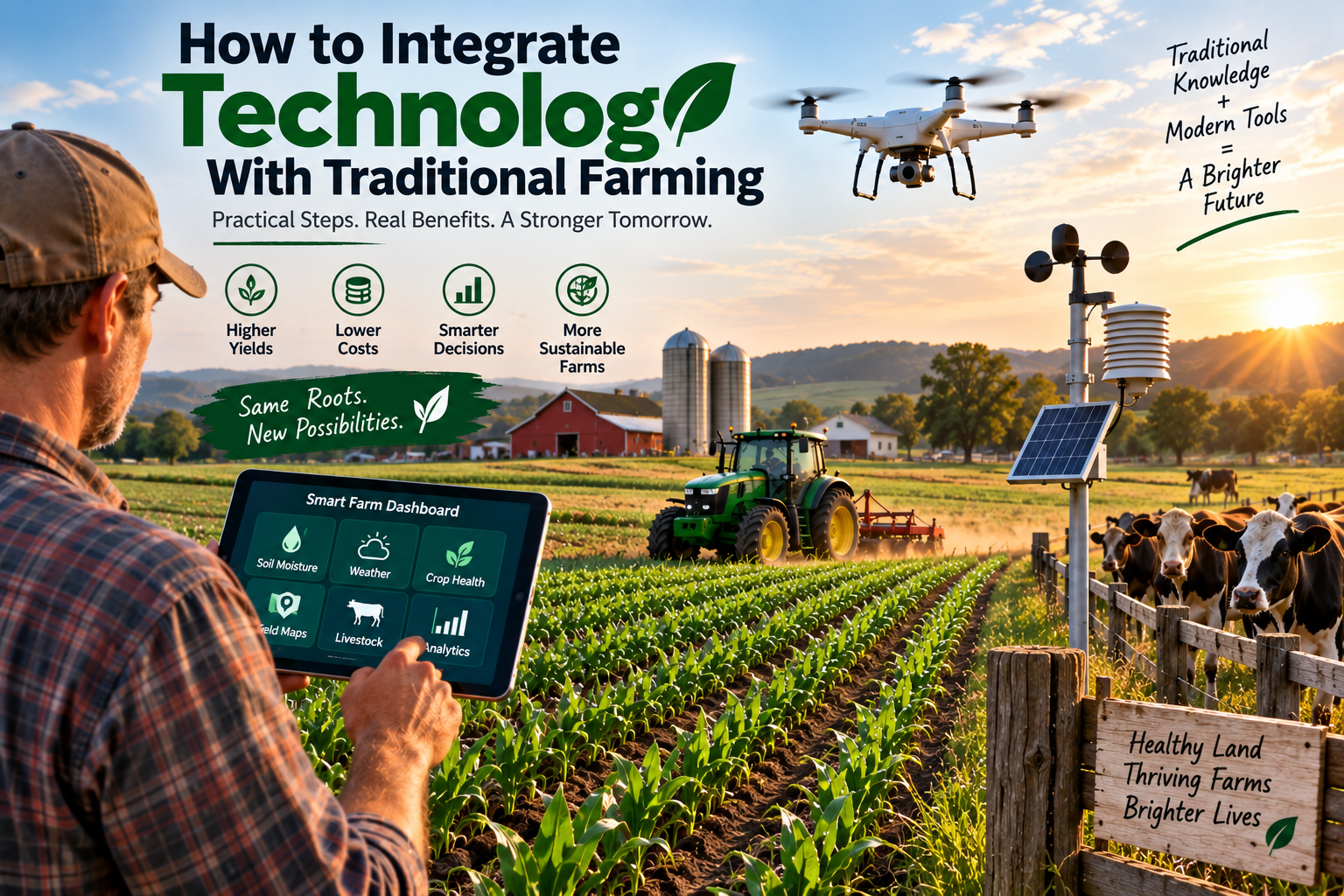
Learning how to integrate technology with traditional farming does not mean replacing proven agricultural knowledge with sensors, software, drones or automated machinery.
The better approach is to use technology where it solves a real farm problem.
A farmer may already know which area of a field dries first, where yields usually fall, how livestock behave before becoming visibly unwell, or which soil stays wet after heavy rain. Technology can add measurements, records and automation that make those observations easier to verify and act on.
For most U.S. farms, a practical strategy is simple: identify one problem, measure the current situation, test an appropriate technology on a small scale, compare the results and expand only when the value is clear.
That approach fits modern American agriculture. According to USDA’s 2025 farm technology data, 85% of U.S. farms reported internet access and 82% had smartphones. That means many farms already have the basic digital foundation needed to begin using connected agricultural tools.
The goal, however, is not to make a farm look more technologically advanced.
The goal is to make better farming decisions.
Table of Contents
What Does Integrating Technology With Traditional Farming Mean?
Integrating technology with traditional farming means combining established agricultural practices with tools that improve measurement, accuracy, timing, recordkeeping or automation.
A farmer may continue checking soil conditions by hand while also using moisture sensors. Crop scouting can still happen on foot while drone imagery helps locate areas that deserve closer inspection. A producer can rely on years of experience with a field while GPS maps show exactly where yield or soil conditions vary.
Technology therefore works best as an additional source of information.
A moisture sensor can tell a farmer what is happening at a particular depth in the soil, but it cannot automatically account for every factor affecting irrigation. Crop stage, soil type, weather forecasts, rooting depth and local experience still matter.
Likewise, a drone image may identify an unusual area in a field, but the image alone might not tell you whether the cause is water stress, insects, disease, nutrient deficiency, compaction or equipment damage.
The strongest model is usually not farmer versus technology.
It is farmer plus technology.
Start With the Farm Problem, Not the Technology
One of the easiest ways to waste money on agricultural technology is to buy a tool before deciding exactly what it should improve.
Do not begin with:
“Should I buy a drone?”
Start with:
“What problem am I trying to solve?”
Maybe irrigation costs are increasing. Perhaps fertilizer application is inconsistent. Equipment may be making unnecessary overlapping passes. Farm records might be scattered across notebooks. Livestock health problems may be difficult to detect early.
Once the problem is clear, technology becomes easier to evaluate.
A useful framework is:
Problem → Baseline → Technology → Trial → Measurement → Expansion
For example, suppose excessive irrigation is the problem. First record current water use, irrigation frequency and crop performance. Then test soil moisture sensors in representative parts of a field. Compare sensor-informed irrigation with the existing method. Expand the technology only when water use, labor, crop condition, yield or another meaningful measure shows that the investment is worthwhile.
How to Integrate Technology With Traditional Farming Step by Step
- Choose one important farm problem. Focus on something affecting yield, labor, fuel, water, inputs, equipment time or production risk.
- Establish a baseline. Record what happens under the current farming method so you have something meaningful to compare.
- Select the simplest useful technology. A basic sensor may solve the problem better than an expensive automated system.
- Test it on a limited scale. Start with one field, irrigation zone, herd group or piece of machinery.
- Compare technology with field observations. Check whether the data matches what experienced operators are seeing.
- Measure the outcome. Look at water, fuel, labor, input costs, downtime, crop quality, yield or another relevant indicator.
- Expand only when the results justify it. Technology should prove its value before becoming part of the entire operation.
This gradual approach allows a traditional farm to modernize without abandoning practical knowledge built over many seasons.
Begin With Digital Farm Records
Digital recordkeeping is one of the easiest technologies to introduce because it does not require changing how crops are grown or livestock are managed.
A smartphone, tablet or computer can record planting dates, crop varieties, fertilizer applications, pesticide use, irrigation, rainfall, machinery maintenance, livestock treatments, harvest results, labor and input costs.
The immediate advantage is organization.
The larger advantage appears over time.
Once several seasons of reliable information are available, a farmer can compare fields, seed varieties, fertilizer rates, machinery performance and management decisions.
Traditional knowledge often exists in memory. Digital records preserve that knowledge in a form that can be searched, compared and analyzed.
Accurate records also create a stronger foundation for later technologies such as yield mapping, precision application and farm-management software.
Use Soil Moisture Sensors to Improve Irrigation
Water management is a good example of technology supporting an existing agricultural skill.
Farmers have always used rainfall, crop appearance, soil inspection, temperature and experience to judge irrigation needs.
Soil moisture sensors add another source of evidence.
Instead of irrigating simply because a particular day has arrived on the schedule, a producer can compare field observations with moisture readings from the root zone.
Sensors should not be treated as a replacement for field knowledge.
Placement matters. Soil depth matters. Soil texture matters. A sensor installed in an unusually wet part of a field cannot automatically represent every acre.
The most useful monitoring system is often one designed around what the farmer already knows about differences in drainage, elevation and soil type.
Add GPS Guidance Where Overlap Costs Money
GPS guidance and auto-steering are among the most established precision technologies in U.S. crop agriculture.
These systems help tractors, sprayers and other machinery follow consistent paths across fields. That can reduce skips and unnecessary overlap.
USDA Economic Research Service precision agriculture data show that in 2023 guidance or auto-steering systems were used by 52% of midsize crop-producing farms and 70% of large-scale crop-producing farms. USDA also identified reasons for adopting precision technologies that include saving labor time, reducing input costs, increasing yield, reducing operator fatigue and improving soil or environmental outcomes.
Smaller farms do not necessarily need to purchase expensive new machinery to benefit.
Retrofitting existing equipment, renting compatible machinery, using a custom operator or paying for precision application services may make more financial sense.
The right question is not simply:
Does GPS technology work?
It is:
Will owning or accessing GPS technology create enough value on this particular farm to justify its total cost?
Combine Drones With Traditional Crop Scouting
Drones can provide a wider view of a field than a farmer can obtain from ground level.
They can help locate crop stress, storm damage, drainage problems, uneven growth or areas requiring closer inspection.
But drones are usually most useful for answering where should I investigate?, rather than automatically answering what is wrong?
Imagine aerial imagery reveals a discolored area in a cornfield.
Someone still needs to inspect that area.
The cause might be insects, disease, drainage, drought stress, nutrient deficiency, compaction, herbicide injury or machinery damage.
The drone can help locate the problem faster.
Traditional agronomic knowledge helps determine its cause.
U.S. farmers also need to consider aviation requirements. The FAA’s Part 107 rules for commercial drone operations apply to many non-recreational small-drone operations.
Using drones to spray or dispense agricultural products can involve additional requirements. The FAA separately explains Part 137 requirements for agricultural drone operations.
That means crop scouting and agricultural spraying should not automatically be treated as the same type of drone operation.
Map Field Variability Before Using Variable-Rate Technology
Traditional management sometimes treats a whole field as though every acre behaves in the same way.
In practice, fields can vary considerably.
Soil texture, drainage, organic matter, elevation, previous management and yield may change across relatively short distances.
Precision mapping can make those differences easier to document.
Once meaningful management zones are identified, variable-rate technology can alter seed, fertilizer or other input rates according to location.
The important point is sequence.
Do not invest heavily in variable-rate equipment simply because the machine supports it.
First establish whether meaningful variation exists and whether you have reliable information for deciding where rates should change.
A machine capable of changing fertilizer rates automatically is only useful when the farm has good evidence about where, how much and why those rates should change.
Add Local Weather Monitoring
Farmers have always watched weather because planting, irrigation, spraying and harvesting depend on it.
A farm weather station can make those observations more localized.
Depending on the system, farmers may monitor rainfall, temperature, humidity, wind or soil temperature.
These readings can supplement regional forecasts.
They should not replace local judgment.
A county forecast may predict rain while a particular farm receives very little. A weather station may show technically suitable conditions for fieldwork while experienced operators know that the soil is still too wet for heavy equipment.
Technology improves visibility.
It does not eliminate judgment.
Use Livestock Sensors as an Early-Warning System
Traditional livestock management depends heavily on observation.
Experienced producers often notice subtle changes in movement, appetite, feeding, rumination, reproductive behavior or general condition.
Wearable and automated monitoring technologies can add continuous information to those observations.
The most useful role for many livestock-monitoring systems is early warning.
If a system detects an unusual change in an animal’s activity, the producer can inspect that animal sooner.
The technology does not replace the producer or veterinarian.
It helps identify which animal may need closer attention.
Automate Only After Improving the Process
Automation can reduce repetitive labor, but automating an inefficient practice simply makes the inefficient process happen faster.
A better sequence is:
Observe → Measure → Improve → Automate
Consider irrigation.
If every irrigation zone currently operates for the same amount of time even though one area retains considerably more water, adding automated controls without changing the schedule may simply automate overwatering.
First understand the variation.
Then improve the irrigation method.
After that, automation can make the improved system easier to operate.
The same principle applies to fertilizer application, feeding, greenhouse controls, machinery routes and produce sorting.
Plan for Weak Internet Connectivity
Having internet access at the farmhouse does not guarantee dependable connectivity in every field, pasture or remote building.
Before purchasing cloud-dependent agricultural equipment, determine what happens when cellular or internet service disappears.
Can the system continue working offline?
Can it store information locally?
Will it synchronize later?
Is manual operation still possible?
Can critical records be accessed if the vendor’s online service becomes unavailable?
Connectivity should be considered before purchase, not after installation.
A simpler system with reliable offline operation may sometimes be more useful than an advanced platform that becomes unreliable in remote areas.
Protect Your Farm Data
Modern agricultural technology can collect valuable information about fields, yields, livestock, soil, machinery performance, production history and input rates.
Farmers should understand what happens to that information before connecting more equipment.
Important questions include who owns the data, whether it can be exported, whether access continues when a subscription ends, whether information can be shared with third parties and whether the platform works with equipment from other manufacturers.
Compatibility matters too.
A farm can quickly end up with separate platforms for machinery, weather, irrigation, accounting, livestock and field mapping.
If none of those systems communicate, technology can actually increase administrative work.
Train the People Who Will Use the Technology
Agricultural technology can fail even when the equipment itself works correctly.
Operators may struggle with calibration, software settings, sensor placement, maintenance, troubleshooting or data interpretation.
Training should therefore be included in the total cost of adoption.
If outside technical help is required, understanding the role of implementation professionals can be useful. HelpForSoul’s guide to technology solutions professionals explains how technology specialists can help organizations evaluate, implement and support technical systems.
For agricultural technology, also ask whether support is available during critical periods such as planting, spraying and harvest.
A system that stops working during an important production window can cost far more than its purchase or subscription price suggests.
Calculate the Real Return on Investment
Farm technology should be judged by what it changes, not by how advanced it looks.
A simple framework is:
Value created + costs avoided + labor saved − total ownership cost
Total ownership cost includes more than purchase price.
Installation, subscriptions, connectivity, maintenance, repairs, replacement sensors, training, consultant fees and staff time should all be considered.
Benefits may also extend beyond higher yield.
GPS guidance may reduce overlap and operator fatigue. Moisture monitoring may reduce unnecessary pumping. Digital records may save administrative time. Drone scouting may locate problem areas faster.
A technology does not need to produce a dramatic yield increase to be worthwhile.
It needs to create enough measurable value to justify what the farm spends on it.
What Technology Makes Sense for Small Farms?
Small farms can benefit from agricultural technology, but their investment strategy may need to differ from that of larger operations.
Expensive machinery is easier to justify when the benefit is spread across thousands of acres.
For smaller farms, lower-cost technologies may produce a stronger return.
Examples include digital recordkeeping, basic sensors, weather-monitoring tools, smartphone applications, equipment retrofits or contracted precision-agriculture services.
Owning technology is not the same as benefiting from technology.
A farm that needs drone mapping only a few times each year may receive better value from a service provider than from purchasing and maintaining its own equipment.
Technology should scale to the farm.
The farm should not have to scale simply to justify the technology.
A Simple Technology Adoption Model for Traditional Farms
| Stage | Main goal | Example |
|---|---|---|
| Digitize | Improve records and information access | Mobile farm records |
| Measure | Collect useful farm data | Soil moisture sensors |
| Analyze | Compare conditions and outcomes | Yield and field mapping |
| Improve | Change the process using reliable evidence | Better irrigation scheduling |
| Automate | Automate a process that already works | Automated irrigation controls |
| Connect | Link systems when integration saves time | Machinery and field-record integration |
This progression keeps investment tied to actual farm needs.
It also reduces the risk of buying several technologies at once and discovering that employees do not have enough time, training or support to use them properly.
Farmers who want to follow broader developments in digital technology can also explore HelpForSoul’s guide to AI and technology news platforms. For agricultural operations, however, new technology should always be evaluated according to what it can actually improve on the farm—not simply because it is attracting attention.
Traditional Farming and Technology Work Best Together
The best answer to how to integrate technology with traditional farming is not to choose between traditional knowledge and modern tools.
Traditional farming provides something technology cannot instantly recreate: years of observation about a particular farm.
A producer may already know that one field performs poorly after a wet spring.
Technology may help measure why.
A livestock farmer may recognize unusual behavior before it becomes obvious to anyone else.
Sensors may help identify the change sooner.
A grower may know that one section of a field consistently needs more water.
Moisture monitoring can help quantify that difference.
Technology is most valuable when it strengthens those decisions rather than replacing the person making them.
For U.S. farmers considering modernization, the strongest approach is usually gradual:
Preserve what works. Measure what matters. Test before expanding. Automate only proven processes.
That is how technology becomes part of traditional farming without allowing technology itself to become the purpose of the farm.
