

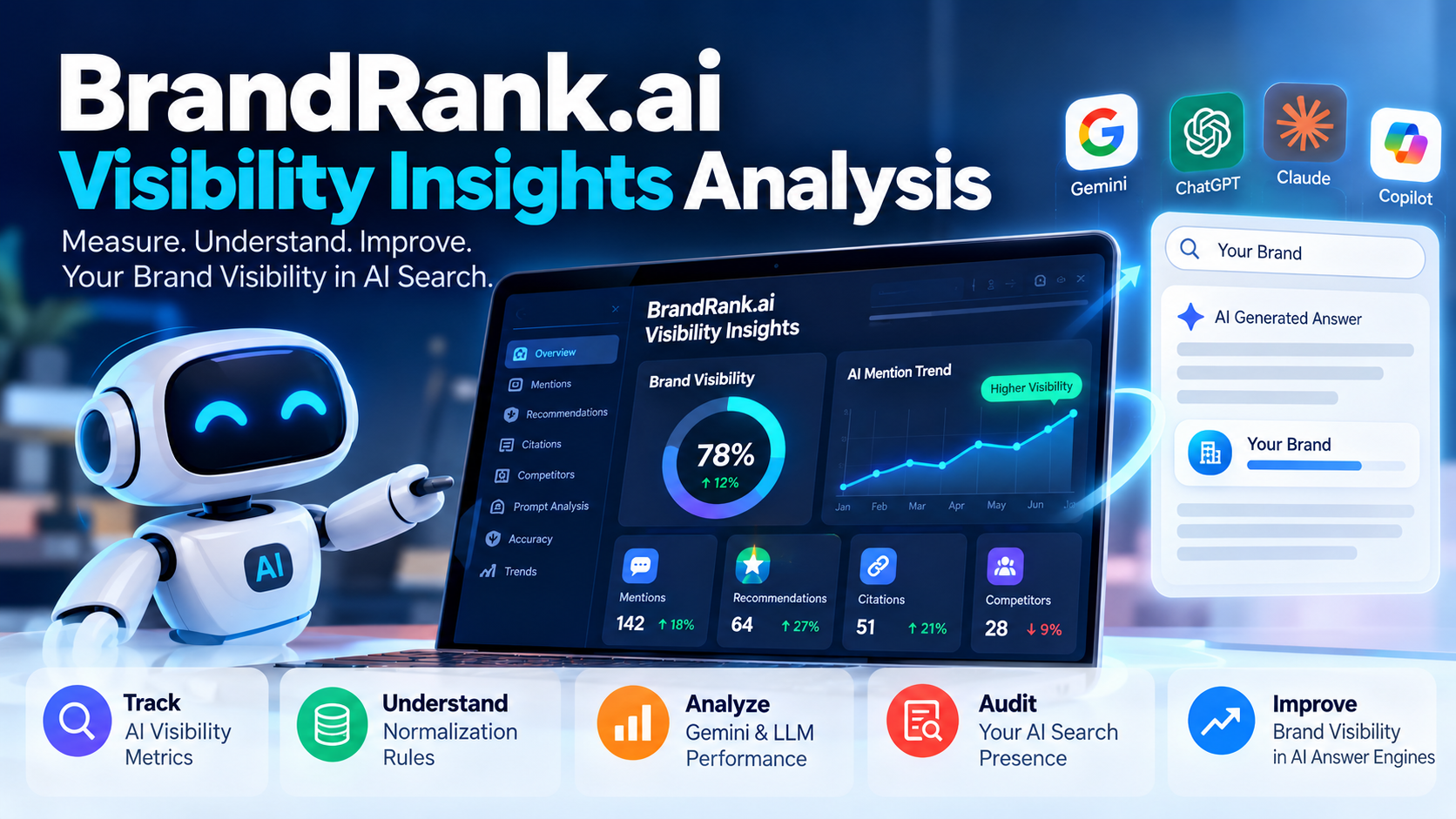
A BrandRank.ai visibility insights analysis should answer a practical question: How visible is your brand when people use AI systems to research, compare, and choose products or services?
The answer is more complicated than checking a traditional Google ranking.
In AI-generated answers, a brand can be mentioned, recommended, cited as a source, compared with a competitor, described inaccurately, or omitted entirely. That means AI visibility is best treated as a group of measurable signals rather than one universal position or score.
A useful analysis therefore looks beyond the headline number. It examines brand presence, recommendation strength, citations, competing brands, prompt intent, factual accuracy, and changes over time.
That is where BrandRank.ai visibility insights can become genuinely useful: not simply showing whether your brand appeared, but helping explain where it appears, why it may be missing, and what can realistically be improved.
Table of Contents
What Is AI Visibility?
AI visibility is the degree to which a brand, product, website, or organisation appears meaningfully in AI-generated answers.
Traditional SEO commonly asks:
Where does this page rank for a particular search query?
AI visibility asks different questions:
- Is the brand mentioned at all?
- Is it recommended?
- Is it included in a shortlist?
- Which competitors appear instead?
- Is the brand’s website cited?
- Are third-party sources cited when discussing the brand?
- Is the information accurate?
- Does visibility change when the prompt changes?
- Does the result differ between Gemini and other answer engines?
This is an important distinction because generative systems do not simply reproduce a ranked list of webpages.
Research from Princeton University on Generative Engine Optimization (GEO) describes generative engines as systems that synthesize information from multiple sources into generated responses and treats visibility within those responses as a distinct optimisation problem. Princeton University research on Generative Engine Optimization
For marketers, that means LLM brand visibility needs its own measurement framework.
Which AI Visibility Metrics Matter Most?
A good BrandRank.ai visibility insights analysis separates the underlying signals instead of treating every appearance as equal.
| Metric | What it tells you |
|---|---|
| Mention rate | How often your brand appears across relevant prompts |
| Recommendation rate | How often the AI actively presents your brand as an option |
| Citation visibility | Whether your pages or domains appear as supporting sources |
| Competitive visibility | Which competing brands appear alongside or instead of yours |
| Prominence | How noticeable your brand is within the generated answer |
| Accuracy | Whether the information presented about your brand is correct |
| Prompt coverage | Which customer questions trigger your brand |
| Intent visibility | Whether visibility occurs during informational, comparison, or buying queries |
| Consistency | Whether similar prompts produce reasonably stable patterns |
The distinction between these signals matters.
A brand might appear frequently without being recommended. Another could be cited as a useful source even when the company itself is not presented as a product recommendation.
Those are very different outcomes.
Mention, Recommendation, and Citation Are Not the Same
Imagine an AI answer contains the following sentence:
“Popular tools in this category include Brand A, Brand B, and Brand C.”
Brand A has received a mention.
Now consider:
“For smaller businesses that need simple setup, Brand A may be one option to consider.”
That is closer to a recommendation signal.
Now imagine the AI explains the category without recommending Brand A but uses information from Brand A’s website as a cited source.
That creates citation visibility.
A serious AI search audit should track these separately.
Otherwise, a high number of low-value mentions could make performance appear stronger than it really is.
BrandRank.ai Normalization Transformation Rules: What Does the Term Mean?
Searches for BrandRank.ai normalization transformation rules and BrandRank.ai normalization rules have created an unusual SEO topic.
The key point is that no publicly verifiable BrandRank.AI technical specification under the exact title “normalization transformation rules” was found during the research for this article.
That means it would be misleading to invent proprietary formulas, hidden scoring thresholds, regex rules, database schemas, or internal BrandRank.AI algorithms.
The underlying concepts of normalization and transformation, however, are legitimate and highly relevant to AI visibility measurement.
Normalization makes equivalent data consistent
Suppose the same company appears in AI answers as:
- BrandRank AI
- BrandRank.AI
- BRANDRANK.AI
- Brand Rank
- brandrank.ai
A measurement system needs a way to determine whether those references represent the same entity.
Normalization can map verified variations to one canonical entity.
The same problem can occur with:
- parent companies;
- subsidiaries;
- products;
- sub-brands;
- old company names;
- regional names;
- domains;
- capitalization;
- URLs with unnecessary parameters.
Without good normalization, one real brand could accidentally be counted several times.
Transformation makes raw answers measurable
Transformation performs a different job.
It converts an unstructured AI response into fields that can be analysed.
For example:
| Raw observation | Transformed field |
|---|---|
| “Brand A is a useful option” | Brand mentioned = Yes |
| Brand appears in recommendation list | Recommended = Yes |
| Gemini generated the response | Engine = Gemini |
| Competitor B also appeared | Competitor mention = Yes |
| A webpage was cited | Citation = Present |
| Prompt asked for alternatives | Intent = Comparison |
Normalization asks:
What entity is this?
Transformation asks:
What measurable information can we extract from this observation?
That distinction is important when interpreting AI visibility reports.
Why Normalization Matters for AI Visibility
Poor normalization can create misleading metrics.
Suppose an AI response mentions a product and its parent company.
One analytics tool may count them as one brand appearance.
Another may treat them as two separate entities.
A third might merge several product lines into the corporate brand.
All three dashboards could then display a “share of visibility” percentage while actually measuring different things.
Before relying heavily on any AI visibility score, ask:
- What counts as a brand mention?
- Are products and parent companies separated?
- How are aliases handled?
- How are duplicate citations handled?
- Are domains normalized?
- Are regional entities treated separately?
- Is the original AI response preserved for review?
A number becomes meaningful only when you understand what produced it.
How to Conduct a Better AI Search Audit
A strong AI search audit starts with real customer questions, not prompts designed to guarantee that your company appears.
Start with unbranded prompts
Instead of testing only:
“Is ExampleBrand good?”
include queries such as:
- What are the best tools for this problem?
- Which companies offer this service?
- What are the best alternatives to Competitor X?
- Which solution is suitable for a small business?
- What platform supports Feature Y?
- Compare the leading options for this use case.
These prompts reveal whether an AI system independently connects the brand with its intended market.
Keep branded prompts too
Branded questions serve a different purpose.
They can reveal:
- incorrect descriptions;
- outdated prices;
- wrong product features;
- old company information;
- reputation issues;
- misunderstood positioning.
The important point is to separate branded and unbranded visibility rather than blending everything into one unexplained percentage.
AI Visibility Metrics for Gemini
Businesses researching AI visibility metrics for Gemini should avoid judging performance from one prompt or one response.
Instead, create a stable group of prompts and track them repeatedly.
Useful Gemini visibility metrics include:
- Brand mention rate
- Recommendation rate
- Citation rate
- Competitor appearance
- Prompt coverage
- Accuracy rate
- Prominence within answers
- Visibility by customer intent
- Changes over time
Then compare the same conceptual prompt groups with other answer engines where appropriate.
The purpose is not to determine whether Gemini “likes” your brand. It is to identify patterns that are strong enough to guide decisions.
How to Improve Brand Visibility in AI Answer Engines
There is no legitimate technique that guarantees an AI system will mention or recommend a company.
The more sustainable approach is to improve the clarity, usefulness, consistency, authority, and verifiability of the information surrounding the brand.
1. Make your brand easy to understand
Keep important information consistent across your site.
Clearly identify:
- company name;
- products;
- services;
- target customers;
- important features;
- locations;
- product relationships;
- policies;
- pricing when appropriate.
Ambiguous information makes accurate interpretation harder.
2. Answer customer questions directly
Pages should provide useful answers before burying readers in promotional copy.
Harvard’s guidance on optimizing web content for search engines and artificial intelligence recommends clear page titles, descriptive headings, meaningful links, concise definitions, question-based content, structured comparisons, and fresh, accurate information. Harvard guidance on optimizing sites for search engines and artificial intelligence
This is useful beyond SEO.
If your website clearly explains who a product is for, what it does, how it differs from alternatives, and where its limitations are, both people and machines have better information to work with.
3. Cover meaningful topic gaps
Do not create dozens of nearly identical pages for every keyword variation.
Instead, identify questions that matter during actual discovery and decision-making.
For example:
- What problem does the product solve?
- How does implementation work?
- What does it integrate with?
- How does pricing work?
- What alternatives exist?
- Which use cases fit?
- What limitations should buyers know?
- What evidence supports major claims?
This creates topical depth without turning the website into a collection of keyword-stuffed pages.
4. Improve evidence around important claims
Statements such as:
- “best”;
- “most trusted”;
- “most accurate”;
- “industry leading”;
- “number one”
need credible support if they are going to carry meaningful weight.
This is where measurement discipline matters.
NIST’s AI Risk Management Framework emphasises structured Govern, Map, Measure, and Manage functions and treats measurement and evaluation as part of responsible AI management. NIST AI Risk Management Framework
Although NIST’s framework is not an SEO guide, the broader principle is valuable: a useful metric needs context, defined measurement, and responsible interpretation.
5. Keep information accurate
Old information can be as damaging as missing information.
Regularly review:
- pricing;
- product names;
- discontinued features;
- integrations;
- locations;
- leadership information;
- policies;
- statistics;
- documentation.
Accuracy matters because increased visibility is not useful when AI systems are repeating outdated information about the business.
AI Business Context: Strategic Visibility Is More Useful Than Raw Visibility
In an AI business context, strategic visibility means appearing for questions that actually matter to customer discovery or decision-making.
Consider this hypothetical example.
Brand A appears across 100 broad informational prompts.
Brand B appears across only 40 prompts, but those include:
- product comparisons;
- alternatives;
- purchase recommendations;
- category shortlists;
- high-intent use cases.
Brand A has greater raw visibility.
Brand B may have more commercially meaningful visibility.
This is why visibility data should be segmented according to intent, not merely counted.
AI strategy also requires governance around what is measured and how teams respond to the results. HelpForSoul’s related article on why AI transformation is a governance problem rather than only a technology problem explores the broader importance of accountability, measurement, monitoring, and decision ownership in AI programmes.
The same idea applies to visibility analytics: collecting numbers is not enough. Someone must understand what they mean and decide what to improve.
What Are AI Visibility Products?
People searching “what is AI visibility products” are generally looking for tools that monitor how brands appear across AI-generated answers.
An AI visibility product may track:
- brand mentions;
- recommendations;
- citations;
- prompt performance;
- competitors;
- share of voice;
- source domains;
- factual accuracy;
- sentiment or framing;
- historical changes.
The feature list matters less than the methodology behind it.
Before choosing or interpreting an AI visibility platform, ask:
Which AI systems are covered?
Which prompts are being tested?
How are prompts selected?
How are brand entities normalized?
How are recommendations distinguished from mentions?
Can the original responses be reviewed?
How are competitors selected?
Are countries and languages separated?
How frequently are observations collected?
Can the methodology remain consistent enough to measure change?
An attractive dashboard cannot compensate for unclear measurement.
A Practical BrandRank.ai Visibility Insights Analysis Framework
Use this workflow when reviewing BrandRank.ai visibility insights or another AI visibility dataset.
1. Find the missing prompts
Identify questions where the brand would reasonably be expected to appear but does not.
2. Look at who appears instead
Competitor substitution can reveal category, content, authority, or positioning gaps.
3. Separate mentions from recommendations
Do not give every appearance equal weight.
4. Review citations
Look at which sources repeatedly support answers in your category.
5. Check factual accuracy
A visible but incorrectly described brand still has a problem.
6. Segment by intent
Separate informational prompts from comparison and buying-oriented queries.
7. Connect every gap to a possible action
The response might involve:
- clearer content;
- better product information;
- stronger supporting evidence;
- factual corrections;
- broader topical coverage;
- improved entity consistency;
- credible third-party visibility.
8. Repeat the measurement consistently
Changing the prompt set, competitor definition, market, and scoring method every month makes trend data difficult to trust.
Frequently Asked Questions
What is BrandRank.ai visibility insights analysis?
It is an analysis of how a brand appears within AI-generated answers, including its mentions, recommendations, citations, competitors, prompt coverage, accuracy, and changes over time.
What are BrandRank.ai normalization rules?
Normalization generally means mapping verified variations of the same brand, product, domain, or other entity into a consistent form for analysis. A publicly verifiable proprietary BrandRank.AI rulebook under that exact name was not identified during research for this article.
What is the difference between normalization and transformation?
Normalization makes equivalent data consistent. Transformation converts raw data into a structure that can be analysed, such as brand mention, recommendation status, citation, competitor, prompt type, and AI engine.
What is LLM brand visibility?
LLM brand visibility describes whether and how a brand appears in answers generated by large language model-based systems.
What strategies improve brand visibility in AI search engines?
Useful strategies include producing clear and accurate content, strengthening entity consistency, answering important customer questions, supporting claims with evidence, improving topical coverage, and monitoring how AI systems describe the brand.
Is AI visibility the same as Google ranking?
No. A traditional ranking normally describes where a page appears in search results. AI visibility concerns whether and how a brand or source appears inside a generated answer.
Can AI visibility be guaranteed?
No. A company can improve the quality, clarity, accuracy, authority, and accessibility of its information, but it cannot responsibly guarantee inclusion or recommendation in a specific AI-generated answer.
Final Takeaway
The most useful BrandRank.ai visibility insights analysis does not stop at a visibility percentage.
It asks:
Where does the brand appear?
For which customer questions?
Is it mentioned, recommended, or cited?
Which competitors appear instead?
Is the information accurate?
Which sources influence the answer?
How are entities normalized before the metrics are calculated?
Are commercially important prompts improving over time?
Once those questions are answered, AI visibility becomes more than another marketing score.
It becomes a practical diagnostic for understanding how a brand is represented across AI-powered discovery and where content, evidence, positioning, accuracy, or authority may need improvement.

