


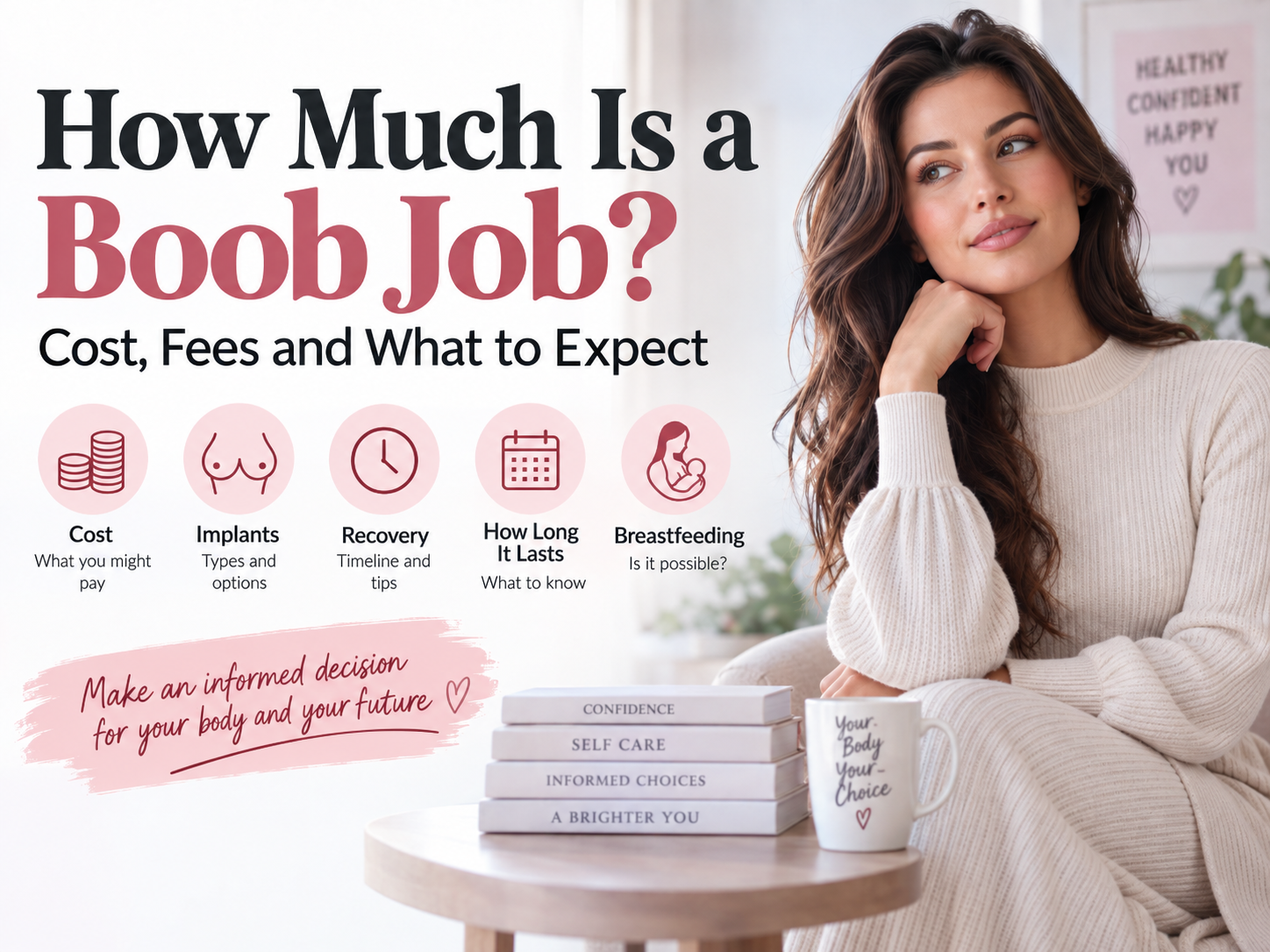
If you are searching how much is a boob job, expect breast augmentation to cost several thousand dollars, with the total potentially reaching five figures depending on the surgeon, implants, anaesthesia, surgical facility, location and complexity of the procedure.
There is no official fixed price for a boob job. The amount advertised by a clinic may also be only the surgeon’s fee rather than the complete amount you will pay.
A published cost analysis indexed by the National Library of Medicine estimated an initial silicone breast augmentation cost of around $6,335. However, that research is older, so it should be treated as a useful historical benchmark rather than a current guaranteed price. You can review the breast augmentation cost analysis on PubMed.
For a current personal estimate, the most useful approach is to request an itemised, all-inclusive quote from the surgeon or clinic you are considering.
Table of Contents
How Much Does a Boob Job Cost?
A boob job, medically known as breast augmentation, is surgery designed to increase or restore breast volume. It is most commonly performed using implants, although fat transfer may also be an option for some people.
When people ask how much does boob job cost, the answer depends on much more than the implant itself.
Your final bill may include:
- The surgeon’s fee
- Breast implants
- Anaesthesia
- Hospital or surgical-centre charges
- Pre-operative medical tests
- Prescription medication
- Post-operative garments
- Follow-up appointments
- Travel expenses
- Time away from work
- Possible future revision surgery
This is why two clinics can advertise very different prices for what appears to be the same procedure.
One clinic may quote only the surgeon’s professional fee, while another may include the implants, anaesthesia and surgical facility in one package.
Always compare total cost, not just the headline figure.
How Expensive Is a Boob Job in Reality?
If you are wondering how expensive is a boob job, think of it as a significant elective medical expense rather than a simple one-time purchase.
A straightforward procedure may cost several thousand dollars. More complicated surgery can cost considerably more.
The price may increase if breast augmentation is combined with:
- A breast lift
- Correction of significant asymmetry
- Removal of previous implants
- Implant replacement
- Scar revision
- Treatment for a previous complication
The number that matters is the amount you will actually pay from consultation through recovery.
Before booking surgery, ask:
“Is this the complete cost, or are there additional fees?”
That one question can prevent unpleasant surprises later.
What Is Included in a Boob Job Price?
A good written quote should make each major cost clear.
Surgeon Fee
This covers the surgeon’s professional work before, during and after the procedure.
Fees can vary according to experience, demand, procedure complexity and location.
Breast Implants
If implants are being used, ask whether their cost is already included.
The FDA recognises different types of breast implants, including saline-filled and silicone gel-filled implants. You can read the FDA guide to breast implant types before discussing the available options with your surgeon.
The type and characteristics of the implant may affect the overall price.
Anaesthesia
Breast augmentation normally requires anaesthesia.
Ask whether the anaesthesia professional’s fee is part of the quoted amount or an additional charge.
Surgical Facility
The operation also requires an appropriate surgical environment, staff and medical equipment.
Facility charges can form a meaningful part of the total cost.
Medical Tests and Medication
Some patients may require pre-operative testing.
You may also need pain medication or other prescriptions after surgery.
Follow-Up Care
Find out how many follow-up appointments are included.
Also ask whether you would have to pay more if an unexpected concern requires additional visits.
Why Does the Price Vary So Much?
There is no universal price because breast augmentation is not identical for every patient.
Surgeon Experience
Different surgeons set different professional fees.
An experienced surgeon may charge more, but price alone should never be used as a measure of quality.
The most expensive option is not automatically the best, and the cheapest option is not automatically unsafe.
Look at training, experience with breast surgery, communication, facility standards and aftercare.
Implant Choice
Implants differ in design and filling material.
The FDA provides detailed information about saline and silicone breast implants.
Your surgeon should explain why a particular implant is being recommended rather than simply presenting different prices.
Procedure Complexity
Correcting asymmetry or combining breast augmentation with another procedure can make the operation more complicated and expensive.
Revision surgery may also involve more work than first-time augmentation.
Location
Professional fees and facility expenses vary between cities and regions.
This means a price found online may not reflect what you will be quoted locally.
Implants vs Fat Transfer
Not every breast augmentation uses implants.
Fat-transfer breast augmentation uses fat removed from another area of the body and transfers selected fat cells into the breasts.
Because the process includes fat harvesting as well as augmentation, the pricing structure can differ from implant surgery.
The two options also achieve different results.
Implants can usually produce a larger and more predictable increase in volume. Fat transfer is often considered when someone wants a more modest increase and has suitable donor fat.
The better option should be based on your goals, anatomy and medical assessment rather than price alone.
How Long Does a Boob Job Last?
A major related question is how long does a boob job last?
Breast implants should not be considered permanent lifetime devices.
The FDA explains that breast implants are not lifetime devices and that the chance of complications increases the longer a person has them. Some people eventually require another operation. You can review the FDA breast implant risks and complications guidance.
This does not mean every person has to replace their implants after exactly 10 years.
There is no universal automatic replacement deadline.
Some people may keep implants for longer without problems, while others may need additional surgery earlier.
Reasons for future surgery can include:
- Implant rupture
- Capsular contracture
- Breast pain
- Implant movement
- Infection
- Changes in breast shape
- Asymmetry
- Cosmetic preference
- Changes following pregnancy or weight fluctuation
This matters when calculating how much a boob job really costs over time.
The initial operation may not be the only expense.
Do Breast Implants Have to Be Replaced Every 10 Years?
No.
This is one of the most common misconceptions about breast implants.
There is no rule saying that every implant must automatically be removed or replaced exactly ten years after surgery.
Instead, the implant should be monitored appropriately, and additional surgery may be considered if a problem develops or if the patient decides to change or remove the implants.
The FDA provides more information about what to consider before getting breast implants.
Long-term monitoring should therefore be part of your decision before having the first operation.
Can You Breastfeed With a Boob Job?
For many people, yes.
If you are asking can you breastfeed with a boob job, breast augmentation does not automatically prevent breastfeeding.
However, breast surgery can affect milk production.
The CDC explains that most people who have had breast or nipple surgery can produce at least some breast milk, although some may not be able to produce a full milk supply.
The effect can depend on factors such as:
- Where the incision was made
- Whether nerves were damaged
- Whether milk ducts were affected
- Where the implant was positioned
The CDC notes that implants placed below the chest muscle generally affect milk production less than implants positioned above the muscle.
You can read the CDC guidance on breastfeeding after breast surgery.
If breastfeeding matters to your future plans, discuss it with the surgeon before choosing the surgical technique.
What Are the Risks of a Boob Job?
Cost is only one part of the decision.
Breast augmentation is surgery and has potential complications.
The FDA lists possible breast-implant complications including:
- Capsular contracture
- Implant rupture
- Breast pain
- Infection
- Implant displacement
- Changes in sensation
- Asymmetry
- Scarring
- Additional surgery
- Implant removal
There are also uncommon but important conditions associated with certain breast implants.
The FDA breast implant safety information provides more detailed information about recognised complications.
Understanding these risks matters financially too.
A complication may require additional appointments, tests or surgery.
How Long Is Recovery After a Boob Job?
Recovery varies according to the procedure and individual.
The early period after surgery may involve:
- Swelling
- Soreness
- Tightness
- Bruising
- Activity restrictions
- Wearing a supportive surgical bra
People with desk-based work may be able to return sooner than those whose jobs involve heavy lifting or substantial physical activity.
The National Library of Medicine’s MedlinePlus resource provides an overview of breast augmentation surgery and recovery.
Follow the advice given by your own surgical team rather than assuming another patient’s recovery schedule will apply to you.
Do Not Forget the Hidden Costs of Recovery
The price charged by the clinic may not represent the complete financial effect of surgery.
You may also need money for:
- Time away from work
- Childcare
- Transportation
- Help at home
- Travel
- Accommodation
- Medication
- Post-operative clothing
For example, travelling a long distance to save money on surgery might become less economical once flights, hotels and follow-up travel are included.
When calculating how much does it cost for a boob job, include these indirect expenses too.
Is Travelling Somewhere Cheaper a Good Idea?
Lower prices elsewhere can be tempting.
But travelling for cosmetic surgery adds another layer of risk and planning.
Before choosing surgery far from home, ask:
- Who will provide follow-up care?
- What happens if a complication develops after you return home?
- Can you contact the original surgeon easily?
- Who will treat an infection or wound problem?
- Would you have to travel again for revision surgery?
The cheapest initial quote may not represent the cheapest overall experience.
Access to follow-up care should be part of the decision.
Can You Finance a Boob Job?
Many cosmetic surgery providers offer payment plans or third-party financing.
Financing can reduce the amount you pay upfront, but it can increase the total amount you eventually spend.
Before agreeing to monthly payments, look at:
- Interest rate
- Length of the agreement
- Total repayment
- Administration fees
- Late fees
- Early repayment terms
For example, an $8,000 procedure financed over several years can ultimately cost much more than $8,000.
Focus on the total repayment, not just the monthly figure.
What Should You Ask Before Paying a Deposit?
A consultation should answer far more than how much does a boob job cost.
Ask:
- What is the complete price?
- What is not included?
- Are the implants included?
- What type of implant will be used?
- Why is that implant recommended?
- Who will provide the anaesthesia?
- Where will the operation take place?
- How much time should I expect away from work?
- What complications should I understand?
- What happens financially if I need revision surgery?
- What long-term monitoring may be required?
- Could the procedure affect breastfeeding?
- How are after-hours problems handled?
- How many follow-up appointments are included?
Do not feel pressured to pay a deposit before you understand the answers.
Should Price Be the Main Reason to Choose a Surgeon?
No.
Price matters because you need to be able to afford the operation and any related expenses.
But breast augmentation involves your health and body.
Choosing purely according to the lowest advertised figure can cause you to overlook:
- Surgeon experience
- Surgical facility
- Implant choice
- Aftercare
- Follow-up access
- Revision policy
- Communication
- Safety procedures
A better approach is to compare value, care and total cost together.
Think About Why You Want Surgery
Breast augmentation is a personal decision.
Your reasons matter.
Wanting cosmetic surgery does not automatically mean anything is wrong with your confidence or body image. At the same time, surgery should not be something you feel forced into because of a partner, social pressure or comparisons with other people online.
Ask yourself:
- Am I doing this because I want it?
- Are my expectations realistic?
- Do I understand the risks?
- Can I afford possible future surgery?
- Am I comfortable with the surgeon?
- Would I still want this procedure if nobody else knew I had it?
If appearance is part of a wider conversation about intimacy, consent or relationship expectations, our guide to what a sex-positive relationship means discusses communication, boundaries and mutual respect.
How Much Is a Boob Job? The Practical Answer
So, how much is a boob job?
There is no single fixed price.
Expect breast augmentation to cost several thousand dollars, with complete costs potentially moving into five figures depending on the procedure.
The final amount can include:
- Surgeon fees
- Implants
- Anaesthesia
- Facility charges
- Medical tests
- Medication
- Aftercare
- Recovery expenses
Published research has placed initial breast augmentation costs in the mid-thousands, but older studies should not be mistaken for today’s guaranteed price. Current quotes vary significantly.
The best question is therefore not:
“Where can I find the cheapest boob job?”
It is:
“What is the complete cost of the procedure being offered to me, what is included, and what might I need to pay for later?”
That gives you a much more realistic understanding of the financial commitment.
Frequently Asked Questions
How much does boob job cost?
Breast augmentation generally costs several thousand dollars. The complete price depends on the surgeon, implant, anaesthesia, surgical facility, location and complexity of the procedure.
How expensive is a boob job?
A boob job is a significant elective expense. Straightforward procedures can cost several thousand dollars, while more complex surgery can move into five figures.
How much does it cost for a boob job with silicone implants?
There is no universal silicone implant price. The implant itself is only one part of the total cost. Surgeon fees, anaesthesia and facility charges can account for a substantial part of the final quote.
How long does a boob job last?
There is no guaranteed lifespan. Breast implants are not lifetime devices, and some people eventually require removal, replacement or another operation.
Do breast implants need replacing every 10 years?
Not automatically. There is no universal ten-year replacement rule. Some implants remain in place longer, while others need attention earlier because of complications or personal preference.
Can you breastfeed with a boob job?
Many people can breastfeed after breast augmentation, but some may produce less milk. The surgical technique, implant position and effect on nerves or milk ducts can influence breastfeeding.
Is the cheapest boob job the best option?
Not necessarily. Compare surgeon experience, implant choice, facility standards, follow-up care, revision policies and the full cost rather than choosing based only on the lowest advertised figure.
Final Thoughts
If you searched how much is a boob job, the most useful answer is that breast augmentation typically represents a several-thousand-dollar investment, but no single price applies to everyone.
The surgeon’s fee is only part of the calculation.
Implants, anaesthesia, the surgical facility, medication, recovery and potential future procedures can all affect the real cost.
Ask for an itemised written quote. Understand the implant being recommended. Discuss breastfeeding if it matters to you. Learn about potential complications and future monitoring.
And choose the procedure because it is right for you—not simply because you found the lowest price.
