


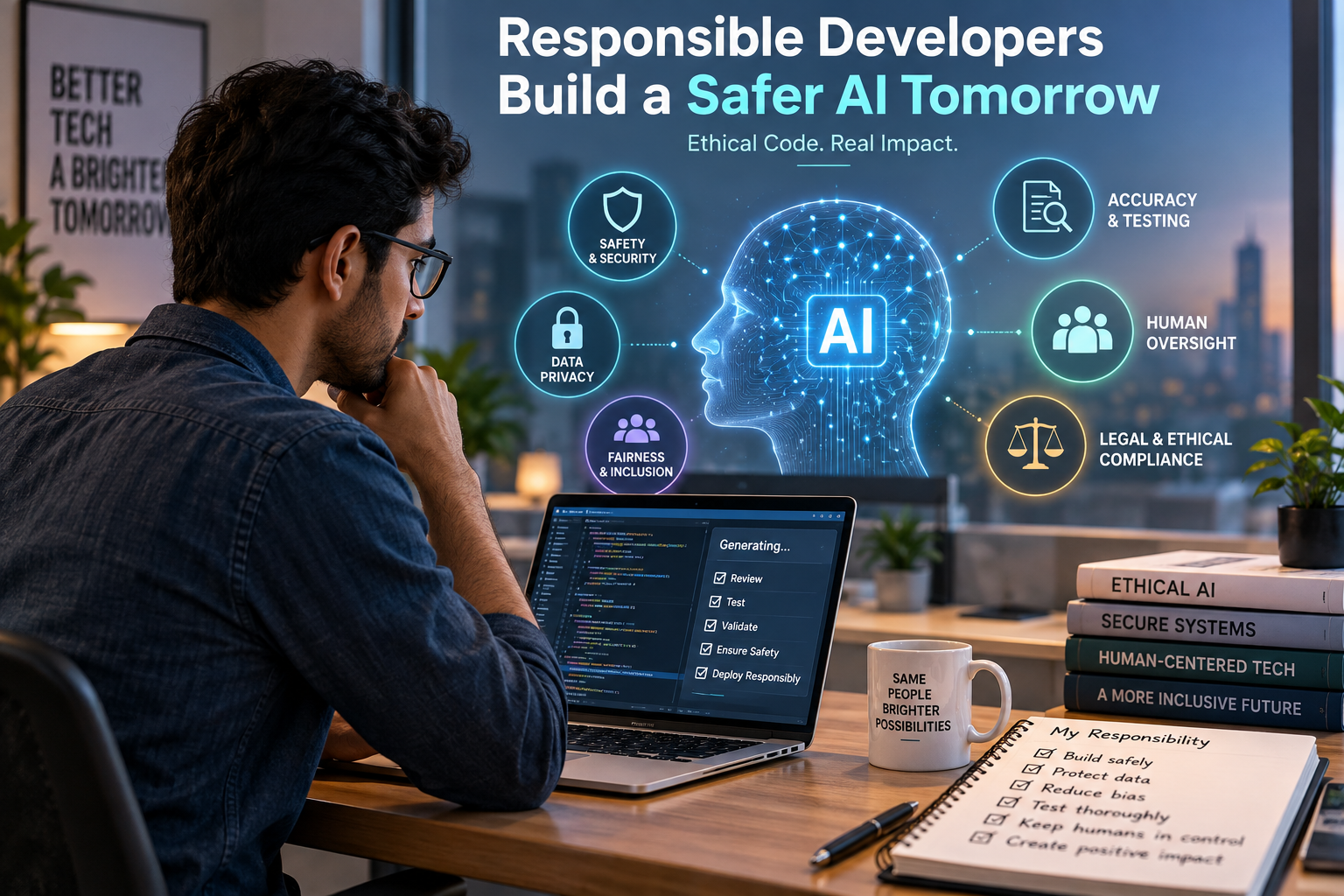
The responsibility of developers using generative AI is to make sure AI-assisted or AI-powered software is safe, reliable, secure, appropriately transparent, and suitable for the people and situations it affects.
That responsibility does not disappear because a model generated the code, recommendation, image, answer, or decision. Developers still have to validate outputs, protect sensitive data, test foreseeable failure modes, reduce harmful bias, respect intellectual-property rules, build appropriate human oversight, and monitor the system after deployment.
There is an important distinction, however: developers do not necessarily carry all responsibility alone. Accountability can also sit with the organisation deploying the system, the model provider, product owners, security teams, compliance teams, and other decision-makers. The developer’s responsibility is to control and document the parts of the system that fall within the developer’s role rather than treating the model as an independent party that can be blamed when something fails.
That turns responsible generative AI from an abstract ethics discussion into an engineering question:
Table of Contents
What evidence would you need before you were comfortable putting this AI system in front of real users?
Generative AI Changes What Developers Need to Test
Traditional software is usually designed around specified rules. The same input under the same conditions is expected to produce the same result.
Generative AI complicates that assumption.
A model may generate a convincing answer that is inaccurate. An AI coding assistant may create code that runs but introduces an unsafe dependency or flawed access-control logic. A customer-support system may answer ordinary questions correctly while failing badly on unusual cases. An AI agent may combine an innocent instruction with external data in a way its developers never anticipated.
The U.S. National Institute of Standards and Technology addresses this broader lifecycle problem through its Generative AI Profile for the AI Risk Management Framework, which is designed to help organisations identify and manage risks specific to generative AI across development, deployment, use, and evaluation.
That means testing a generative AI application cannot stop at:
Does it work?
Developers also need to ask:
Under what conditions does it stop working safely?
That second question is where much of the real responsibility begins.
1. Treat AI-Generated Output as Unverified Until Tested
Fluent output is not the same as correct output.
If generative AI produces code, developers should review it with essentially the same care they would apply to code submitted through an ordinary development workflow. Syntax is only the beginning.
Check whether the output handles edge cases, follows the intended architecture, uses appropriate libraries, respects access controls, produces correct results, and remains maintainable.
The same principle applies when the AI produces text or decisions rather than code.
For a retrieval-based assistant, for example, testing should include whether answers are actually grounded in the retrieved material. For an AI agent, developers should test what happens when the system receives ambiguous, conflicting, malicious, or incomplete instructions.
The practical rule is simple:
AI can generate the candidate output. It should not automatically become the accepted output.
2. Protect Sensitive Data Before It Reaches the Model
One of the easiest generative AI mistakes happens before the model generates anything: sensitive information is placed in the prompt or context.
Production systems may handle customer information, employee records, internal documents, API credentials, source code, financial information, or confidential business data. Developers therefore need to understand what information is being transmitted to an AI service, where it is stored, how long it is retained, and which systems or people can access it.
Data minimisation is often more effective than trying to secure information that never needed to reach the model in the first place.
The FTC’s privacy and security enforcement guidance reflects a broader principle that companies can face consequences when they fail to honour representations about protecting consumer information or maintain appropriate safeguards for sensitive data.
For developers, that translates into practical controls: remove unnecessary personal data, keep secrets out of prompts, control access to conversation logs, encrypt sensitive information appropriately, and understand the data practices of external AI providers before connecting them to production information.
3. Build for Adversarial Users, Not Only Cooperative Ones
A successful demonstration proves that the system works when people behave as expected.
Production software has to survive people who do not.
Generative AI introduces attack surfaces such as prompt injection, malicious external content, poisoned retrieval material, unsafe tool calls, unintended disclosure, excessive permissions, and attempts to bypass system instructions.
NIST’s work on AI security explicitly recognises threats including prompt injection, data poisoning, privacy attacks, and other adversarial techniques affecting generative AI systems.
A developer therefore needs to think beyond prompt wording.
If an AI agent can read email, update a database, execute code, make purchases, or call external tools, restrict its permissions to what it genuinely needs. Validate generated instructions before execution. Separate trusted system instructions from untrusted user or retrieved content. Add approval steps around high-impact actions.
The more autonomy an AI system receives, the more important those boundaries become.
4. Test for Uneven Failure, Not Just Average Accuracy
An AI system may appear accurate overall while performing poorly for a particular language, user group, writing style, geography, or uncommon scenario.
That makes aggregate accuracy an incomplete measure.
Developers should build evaluation datasets that represent the users and situations the product is expected to encounter. Testing can include different languages, dialects, input lengths, ambiguous questions, adversarial inputs, accessibility needs, and uncommon edge cases.
This does not mean a developer can guarantee that a generative model will never produce biased or undesirable output. It means foreseeable differences in performance should be investigated instead of hidden inside one average metric.
When prompting or evaluation is part of the problem, HelpForSoul’s guide to effective practices for training and steering AI models with prompts provides additional context on structured prompts, examples, evaluation sets, and iterative testing.
5. Keep Humans in Control Where the Consequences Are Serious
Not every AI-generated output needs manual approval.
An AI tool suggesting alternative variable names poses a very different level of risk from a system influencing medical care, employment, credit, education, financial decisions, security operations, or another person’s rights or opportunities.
Responsible development should therefore be risk-proportionate.
Low-impact uses can often operate with automated validation and monitoring. Higher-impact applications may require human review before an output becomes an action.
Human oversight must also be meaningful. A user who sees an AI recommendation but lacks the information, time, or authority to challenge it is not necessarily providing effective oversight.
Developers should make it technically possible to pause, override, correct, escalate, or reverse consequential AI actions.
6. Be Clear About What the AI Can and Cannot Do
Transparency is not the same as attaching an “AI-powered” badge to a product.
Useful transparency tells users what matters.
If an assistant can make mistakes, users should understand that. If information can become outdated, say so. If a human reviews important outputs, explain where that review occurs. If the system is generating rather than retrieving verified information, the interface should not imply a certainty the model does not possess.
Developers should also record information internally: model version, prompt version, evaluation results, system limitations, major configuration changes, and known failure cases.
That record becomes particularly valuable when a system’s behaviour changes after a model update.
This is also why broader AI governance needs operational ownership rather than policy alone. Technical controls become much more useful when teams know who owns monitoring, escalation, approval, and incident response.
7. Respect Copyright, Licensing, and Provenance
Generative AI can introduce intellectual-property questions at several points in the development process: training data, fine-tuning data, generated code, generated media, third-party datasets, and open-source components.
Developers should know where important assets originate and under what conditions they can be used.
That becomes especially important when generated material is intended for commercial publication or software distribution.
The U.S. Copyright Office’s Copyright and Artificial Intelligence initiative distinguishes between AI-assisted human creation and material generated without sufficient human authorship. Its January 2025 report concluded that AI assistance does not automatically prevent copyright protection, but copyrightability still depends on sufficient human-authored expressive elements.
For developers, the broader lesson is not to assume that “the AI made it” eliminates licensing, attribution, provenance, or ownership questions.
Review them before deployment, not after a dispute appears.
8. Monitor the System After Launch
A generative AI product has not finished being tested because it passed pre-release evaluation.
Real users will find inputs the test team never imagined. Providers may update models. Retrieval databases change. Attack techniques evolve. Product features change the context around the model.
Monitoring should therefore answer questions such as:
- Are failure rates increasing?
- Which inputs generate the most incorrect or rejected responses?
- Are safety controls being repeatedly triggered?
- Has a model or prompt update caused a regression?
- Are users finding unexpected ways to use tools or permissions?
- Can the team identify which configuration produced a problematic output?
- Is there a tested rollback or shutdown path?
Logs should provide enough information to investigate incidents without becoming an unnecessary store of sensitive user data.
The objective is observability with restraint.
A Practical Generative AI Release Gate
Before an AI feature goes live, a development team should be able to answer the following questions with evidence.
| Release question | Evidence to look for |
|---|---|
| Does the system work on realistic inputs? | Repeatable evaluation results |
| What happens on edge cases? | Edge-case and adversarial testing |
| Can users expose confidential information? | Data-flow and privacy review |
| Can untrusted content manipulate the AI? | Prompt-injection and security tests |
| Does performance vary significantly between user groups or scenarios? | Segmented evaluation results |
| Can the AI take consequential actions? | Permission boundaries and approval controls |
| Can a human intervene when necessary? | Override, escalation, and appeal mechanisms |
| Do we understand important data and content rights? | Provenance and licence records |
| Can an incident be investigated? | Appropriate logs and version records |
| Can the feature be disabled or rolled back safely? | Tested incident-response procedure |
If the team cannot answer an important question, that is useful information. It identifies work that still needs to happen before the feature receives greater authority.
Who Is Responsible When Generative AI Goes Wrong?
The answer is usually more nuanced than “the developer.”
Responsibility may be distributed among model providers, application developers, deploying organisations, product owners, management, security teams, compliance functions, and users.
A foundation-model provider may control the base model. The application developer controls how that model is integrated, what context it receives, what tools it can access, and what safeguards surround it. The organisation controls why the system is being deployed and what decisions it is allowed to influence.
Good governance defines those boundaries before an incident.
Poor governance discovers them afterwards.
Developers therefore do not need to pretend they control every element of a generative AI system. They do need to understand what they do control and engineer those parts responsibly.
What Responsible Generative AI Development Really Looks Like
Responsible generative AI development is not achieved by adding a safety statement at the end of a project.
It is visible in architecture.
It appears in permission boundaries, evaluation datasets, code review, data minimisation, security testing, documented model limitations, human escalation paths, monitoring, version control, and rollback procedures.
The most useful way to think about the responsibility of developers using generative AI is therefore not:
“How do I make the AI behave perfectly?”
No developer can guarantee that.
A better question is:
“How do I design the surrounding system so that predictable AI limitations do not become preventable harm?”
That is a responsibility engineers can actually act on.
Frequently Asked Questions
What is the responsibility of developers using generative AI?
Developers are responsible for the engineering decisions surrounding how generative AI is selected, connected, tested, secured, monitored, and presented to users. They should validate outputs, protect sensitive data, test safety and bias risks, provide appropriate oversight, respect applicable rights and licences, and prepare for failures after deployment.
Should developers trust AI-generated code?
AI-generated code should be reviewed and tested before production use. Developers need to understand what the code does, evaluate edge cases, examine dependencies and security implications, and confirm that it meets the same engineering standards expected from other production code.
Are developers solely responsible for generative AI failures?
Not necessarily. Responsibility is often shared between developers, organisations, model providers, product owners, and other stakeholders. Clear governance should establish who controls each part of the system and who is responsible for deployment decisions, monitoring, incidents, and corrective action.
Why is human oversight important in generative AI?
Human oversight provides a way to challenge, stop, correct, or reverse AI outputs when the consequences matter. The appropriate amount of oversight should depend on the risk of the use case rather than applying the same controls to every AI feature.
What should developers test before launching a generative AI application?
Testing should cover normal performance, edge cases, inaccurate outputs, sensitive-data handling, security attacks, prompt injection, permissions, uneven performance across relevant users or situations, human escalation, monitoring, and rollback.
