


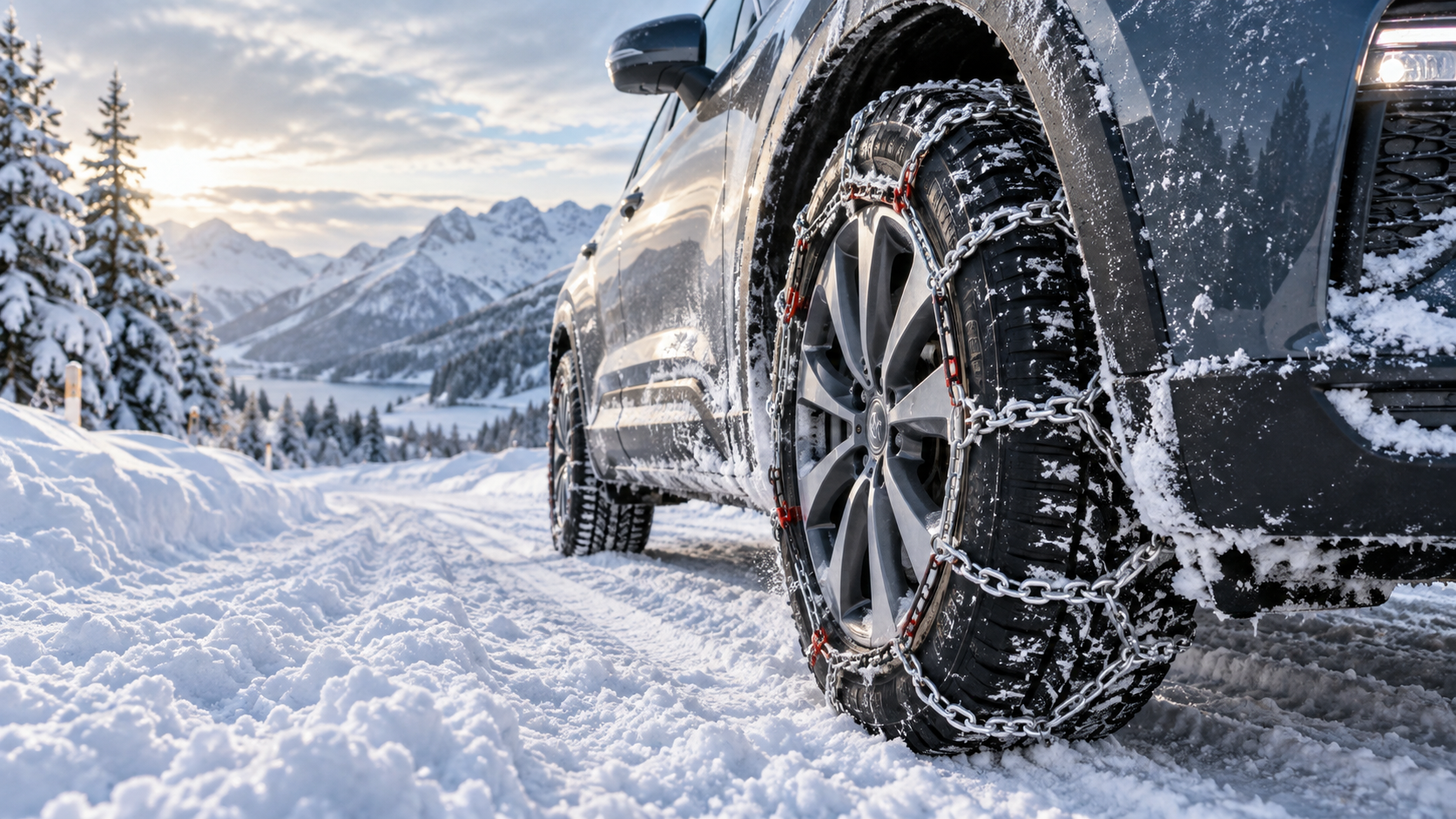
If you are asking why would you fit chains to your wheels, the correct theory-test answer is:
To help prevent skidding in deep snow.
Snow chains are fitted around a vehicle’s tyres to provide extra traction when deep or compacted snow makes normal tyres struggle to grip the road. They can reduce wheelspin, help the vehicle move through snow and give the driver better control in difficult winter conditions.
For theory-test revision, remember this simple relationship:
Deep snow → reduced grip → snow chains → extra traction.
Snow chains help with traction, but they do not make snow or ice completely safe to drive on. You still need to reduce your speed, leave more space from the vehicle ahead and use gentle acceleration, braking and steering.
Table of Contents
Why Would You Fit Chains to Your Wheels?
Your tyres depend on friction with the road to accelerate, steer and brake effectively.
When deep snow covers the road, the tread may struggle to obtain enough grip. You might press the accelerator and find that the driving wheels spin without moving the vehicle forwards properly.
Snow chains add strong links around the tyre. These links can bite into the snowy surface and provide additional traction.
They can help to:
- Reduce wheelspin when moving off
- Improve grip in deep snow
- Help a vehicle climb a snow-covered road
- Maintain forward movement on untreated roads
- Improve control in severe winter conditions
- Help prevent skidding caused by poor traction
The official Highway Code guidance for driving in adverse weather advises drivers to take particular care in snow and ice, drive slowly and leave considerably more stopping distance.
So even when chains are fitted, careful driving remains essential.
Why Would You Fit Chains to Your Wheels? Theory Test Answer
A theory-test question may appear like this:
Why would you fit chains to your wheels?
A. To prevent tyre wear
B. To prevent the brakes from locking
C. To help prevent skidding in deep snow
D. To protect the road surface
The correct answer is:
C. To help prevent skidding in deep snow
The easiest way to understand the answer is to focus on what chains actually do.
They increase traction.
They are not fitted primarily to prevent your brakes from locking. They do not reduce tyre wear, and they are not intended to protect the road surface.
In fact, driving with chains on a clear road can increase wear and potentially damage the chains, tyres or road.
If you are searching why would you fit chains to your wheels theory, remember one word:
Grip
That is what the chains are designed to improve.
How Do Snow Chains Work?
Ordinary tyres use their tread pattern and rubber surface to maintain contact with the road.
Deep or compacted snow interferes with that contact. Instead of gripping the surface firmly, the tyre may begin to slide or spin.
Snow chains wrap around the tyre and create additional contact edges. The links press into the snow, giving the wheel more opportunity to transfer engine power into forward movement.
Think of walking through snow in smooth shoes compared with boots that have a deep tread. The boots are usually better able to bite into the surface.
Snow chains work on a similar principle.
However, extra traction does not mean unlimited grip. A vehicle can still skid if the driver travels too quickly, brakes harshly or makes sudden steering movements.
Why Would You Fit Chains to Your Car Wheels?
The related search why would you fit chains to your car wheels is asking the same basic question.
Imagine trying to drive uphill following heavy snowfall. You press the accelerator gently, but the driving wheels start spinning.
Pressing harder may simply increase the wheelspin.
Snow chains can help the tyres bite into the snow so that more of the engine’s power produces forward movement.
They can be particularly useful on:
- Untreated roads
- Steep snow-covered hills
- Isolated rural routes
- Roads that have not yet been cleared
- Areas affected by heavy snowfall
- Roads where ordinary tyres cannot obtain enough traction
Chains are therefore temporary traction equipment for difficult snow conditions rather than something intended for everyday road use.
Are Snow Chains Allowed in UK?
Yes. If you are wondering are snow chains allowed in UK, they can be used when road conditions make them appropriate.
Official winter motoring guidance from Dudley Council explains that snow chains are generally only necessary in areas affected by heavy snow where roads have not been cleared.
The same guidance advises drivers to remove chains when travelling on a road without a reasonable covering of snow.
A useful rule is:
Snow-covered road → chains may be appropriate.
Clear road → remove the chains.
Are Snow Chains Legal in the UK?
If you are searching are snow chains legal in the UK, the practical answer is yes when they are used appropriately in snowy conditions.
Snow chains are not subject to a simple blanket ban.
What matters is where and when you use them.
Chains are designed to work with snow between the chain and the road. If you continue driving once you reach clear tarmac, the links repeatedly strike the road surface.
That can:
- Wear the chains rapidly
- Damage tyres
- Affect vehicle handling
- Cause excessive vibration
- Damage nearby vehicle components
- Potentially damage the road surface
This also answers the search variations are snow chains legal in UK and are tyre chains legal in the UK.
They can be used in suitable snowy conditions, but they should not remain fitted unnecessarily once the road becomes clear.
Are Snow Chains Illegal in the UK?
No. Saying snow chains are illegal in the UK would be misleading.
They can be used when severe snow makes additional traction necessary.
The important distinction is between:
Using snow chains appropriately on a snow-covered road
and
Continuing to use them unnecessarily on clear tarmac.
Official local-government guidance recognises their use during severe snow and explains when they should be removed.
When Should You Fit Snow Chains?
You would normally consider fitting chains when substantial snow has reduced tyre traction enough to make normal progress difficult.
Examples include:
- Deep snow covering the road
- Repeated wheelspin when moving off
- A steep snow-covered incline
- An untreated rural road
- A route that has not yet been cleared
- Severe snow where normal tyres cannot find enough grip
Snow chains are not normally required simply because the weather is cold.
They are intended for situations where snow itself has become a significant traction problem.
The Highway Code’s snow and ice guidance also recommends checking conditions before travelling and taking extra precautions during severe winter weather.
Which Wheels Should Snow Chains Go On?
Chains need to provide traction to the vehicle’s driven wheels.
However, the correct arrangement depends on the vehicle.
Requirements can differ between:
- Front-wheel-drive vehicles
- Rear-wheel-drive vehicles
- Four-wheel-drive vehicles
- All-wheel-drive vehicles
Do not guess.
Check your vehicle handbook and the instructions supplied with your snow chains.
You should also confirm:
- Correct tyre size
- Chain compatibility
- Wheel-arch clearance
- Suspension clearance
- Any manufacturer restrictions
Some vehicles have very little space around the tyre and may require a specific type of chain or another approved traction device.
It is also worth practising how to fit the chains before you need them. Learning in a dry, safe place is much easier than trying to understand the fitting process beside a snowy road.
Can Modern Car Technology Replace Snow Chains?
Modern vehicles may include traction control, stability systems, anti-lock braking and other driver-assistance technologies.
These systems can help the driver manage available grip, but they cannot create unlimited tyre traction where the road surface provides very little grip.
That distinction matters.
Technology can control wheelspin or adjust braking, but the tyre still needs physical contact with the surface. In severe snow, chains can provide additional mechanical traction.
If you are interested in how vehicle technology is developing more broadly, HelpForSoul’s guide to 2026 F-150 smart tech features looks at modern driver-assistance, connectivity and vehicle technology.
When Should You Remove Snow Chains?
Remove the chains when the road no longer has enough snow to justify using them.
If you move from a heavily snow-covered road onto clear tarmac, find somewhere safe to stop and take them off.
Leaving snow chains fitted unnecessarily may:
- Wear the chains quickly
- Damage the tyres
- Affect steering and handling
- Cause excessive vibration
- Damage surrounding components
- Damage the road surface
If you later encounter deep snow again, the chains can be refitted where appropriate.
Can You Drive Normally With Snow Chains Fitted?
No.
Additional traction does not mean you should return to normal driving speeds.
You should still:
- Drive slowly
- Accelerate gently
- Brake progressively
- Avoid sharp steering movements
- Leave significantly more space ahead
- Watch for ice beneath the snow
- Follow the chain manufacturer’s speed instructions
Snow chains improve traction. They do not eliminate the risks associated with snow and ice.
Do Snow Chains Completely Prevent Skidding?
No.
The wording of the theory-test answer matters:
Snow chains help prevent skidding in deep snow.
They do not guarantee that a vehicle cannot skid.
Loss of control can still happen because of:
- Excessive speed
- Harsh braking
- Sudden steering
- Ice
- Steep downhill roads
- Rapidly changing conditions
The chains improve the tyre’s ability to grip the surface, but safe winter driving still depends heavily on the driver.
Snow Chains vs Winter Tyres
Snow chains and winter tyres both help with winter driving, but they serve different purposes.
Winter tyres are designed for broader cold-weather conditions and can remain fitted during normal seasonal driving.
Snow chains are temporary traction devices designed for more severe snow-covered roads.
A vehicle might therefore use winter tyres throughout the colder season but only fit snow chains when encountering significant snow.
The distinction is simple:
Winter tyres = seasonal equipment
Snow chains = temporary extra traction in deep snow
Common Theory-Test Mistakes
Understanding why the alternative answers are wrong makes the correct answer much easier to remember.
To prevent the brakes from locking
Incorrect.
Snow chains improve tyre traction. They are not primarily a system for preventing brake lock.
To prevent tyre wear
Incorrect.
Chains do not protect tyres from normal wear. Using them incorrectly may actually increase wear.
To prevent damage to the road
Incorrect.
Snow chains are not road-protection equipment. Using them on clear tarmac can potentially damage the surface.
To help prevent skidding in deep snow
Correct.
Chains provide additional grip where deep snow makes ordinary tyre traction difficult.
What If the Question Is Worded Differently?
Several related keywords are simply variations of the same theory-test question.
Why would u fit chains to your wheels?
To help prevent skidding in deep snow.
Why would you fit chain to your wheels?
To provide additional grip when deep snow reduces tyre traction.
Why would you fit chains to your wheel?
For extra traction in severe snowy conditions.
Why would you fit chains to your car wheels?
To improve grip, reduce wheelspin and help prevent skidding in deep snow.
Why should you fit chains to your wheels?
Because deep snow can reduce normal tyre grip and chains provide additional traction.
The wording changes, but the principle remains:
Snow reduces grip → chains increase traction.
Frequently Asked Questions
Why would you fit chains to your wheels?
You would fit chains to your wheels to help prevent skidding in deep snow. They provide extra traction when ordinary tyres struggle for grip.
Why would u fit chains to your wheels?
For the same reason: chains increase tyre traction and can reduce wheelspin and skidding in deep snow.
Why would you fit chains to your wheels theory?
The correct theory-test answer is to help prevent skidding in deep snow.
Are snow chains allowed in UK?
Yes. Snow chains can be used where severe snowy conditions make them appropriate. They should be removed when there is no longer sufficient snow covering the road.
Are snow chains legal in the UK?
Yes. They can be used appropriately on snow-covered roads.
Are snow chains legal in UK?
Yes. The important point is to use them only where road conditions make them appropriate.
Are tyre chains legal in the UK?
Yes. Tyre chains can be used in suitable snowy conditions. Make sure they are compatible with your vehicle and tyres.
Are snow chains illegal in the UK?
No. They are not subject to a simple blanket ban. Their use should match the road conditions.
Can you use snow chains on clear roads?
They should be removed once there is no longer sufficient snow covering the road.
Do snow chains guarantee that you will not skid?
No. They improve traction but cannot eliminate the risk of skidding. Speed, braking, steering and road conditions still matter.
Final Answer
If your theory-test question asks:
Why would you fit chains to your wheels?
Choose:
To help prevent skidding in deep snow.
Snow chains increase traction when deep snow makes it difficult for ordinary tyres to grip the road. They can reduce wheelspin and help the vehicle maintain control and forward movement.
Remember:
Deep snow → reduced grip → chains → extra traction.
Use chains only when the conditions justify them, remove them once you return to clear roads and continue driving carefully even while they are fitted.
