

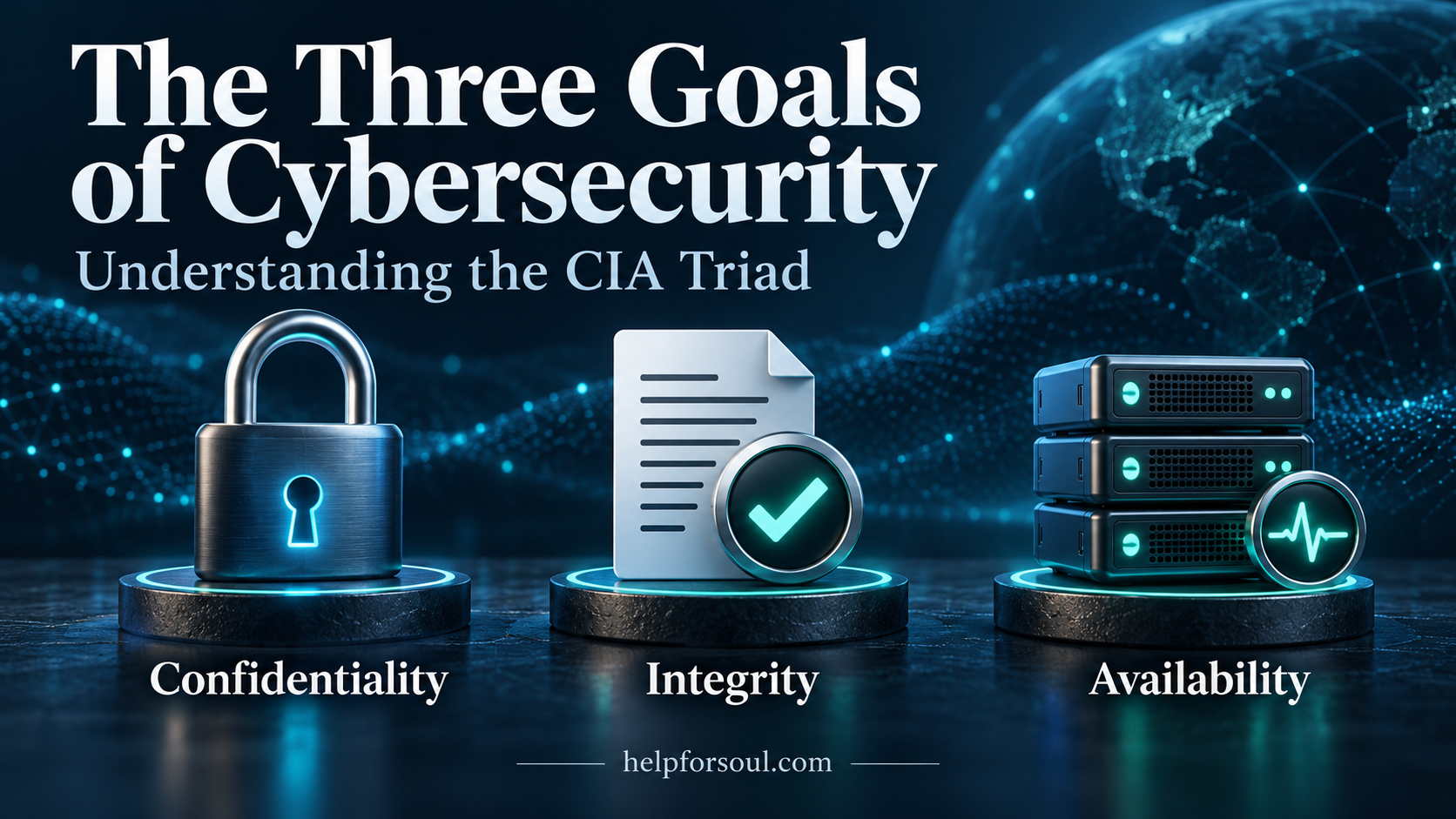
The three goals of cybersecurity are confidentiality, integrity, and availability. Known together as the CIA triad, they describe what security measures should protect: information should reach only authorised people, remain protected against improper changes, and be accessible when needed.
These goals help explain why cybersecurity involves more than preventing data theft. An attacker changing payment details or taking a website offline can cause serious harm without publishing anyone’s private information.
The NIST definition of information security identifies confidentiality, integrity, and availability as its core protection objectives. csrc.nist.gov
Table of Contents
What Does Each Cybersecurity Goal Mean?
| Goal | Meaning | Question to ask | Example of failure |
|---|---|---|---|
| Confidentiality | Protect information from unauthorised access or disclosure | Who can see it? | A private customer list becomes publicly accessible |
| Integrity | Guard against improper changes or destruction | Can we trust that it has not been improperly altered? | Someone changes an invoice’s bank details without approval |
| Availability | Maintain timely, reliable access for authorised users | Can we use it when needed? | Employees cannot access an essential business system |
These distinctions follow NIST’s explanation of the CIA triad. www.nccoe.nist.gov
An easy way to remember the model is: private, trustworthy, and accessible. Each word points to a different protection need.
Confidentiality: Keep Information Within Its Intended Audience
Confidentiality means information is available only to people or systems authorised to receive it.
For example, payroll employees may need access to salary records, while other departments do not. A business proposal may be shared with a client but should not be accessible through a public link.
Confidentiality applies throughout the information’s journey: while stored, during processing, and when transferred between systems. www.nccoe.nist.gov
What a Confidentiality Failure Looks Like
Imagine an employee shares a folder containing customer documents. Instead of granting access to one named colleague, they select “anyone with the link.”
The documents have not been changed or deleted. However, the sharing setting could expose them to unauthorised readers.
This illustrates why protecting information requires attention to permissions as well as passwords.
Practical Ways to Protect Confidentiality
Useful measures include:
- Restricting access to people who need it for their work.
- Reviewing access when responsibilities change.
- Removing access when someone leaves.
- Limiting administrator privileges.
- Enabling multifactor authentication.
NIST’s multifactor authentication guidance explains that MFA creates an additional barrier when a password is compromised. It also recommends limiting access and reviewing account privileges. www.nist.gov
For a practical check, inspect who can open an important folder today. Compare that list with who actually needs access.
Integrity: Protect Information Against Improper Changes
Integrity means guarding information against unauthorised or otherwise improper modification and destruction.
A record can remain private while losing its integrity. Someone might alter a payment amount, delete part of a report, or change an account setting without permission.
NIST’s data integrity guidance addresses unauthorised additions, deletions, and modifications. It also recognises that honest mistakes, alongside malicious activity, can damage information. www.nccoe.nist.gov
What an Integrity Failure Looks Like
Suppose a supplier invoice contains the correct bank account number. Before payment, someone replaces it with a different account number without approval.
The file may still be stored securely, and the finance team may still be able to open it. The problem is that its contents have been improperly changed.
Practical Ways to Protect Integrity
For a payment workflow, a business could separate permission to request a change from permission to approve it. It could also record changes and investigate unexpected edits.
Integrity monitoring and logging help teams identify changes and respond to suspicious activity. These capabilities feature in NIST’s guidance on detecting and responding to data integrity incidents. www.nccoe.nist.gov
A useful distinction is that an unchanged record is not necessarily an accurate record. If someone enters the wrong amount initially, protecting it from later alteration does not correct that mistake. Input checks and review still matter.
Availability: Make Information and Services Accessible When Needed
Availability means authorised users can reliably access and use information when required. It does not mean granting unrestricted public access. www.nccoe.nist.gov
What an Availability Failure Looks Like
Imagine an online shop whose customer data remains private and whose prices are correct. However, its checkout stops working.
The other protections do not remove the immediate problem: customers cannot complete purchases.
Availability therefore concerns the usable service, not simply whether its data still exists somewhere.
Practical Ways to Protect Availability
A practical recovery plan should identify:
- Which systems need to return first.
- Who is responsible for restoration.
- Where the necessary backups and instructions are kept.
- How the team will check that the restored service works.
NIST’s guidance on protection against destructive events includes backups, secure storage, and vulnerability management among its protective capabilities. www.nccoe.nist.gov
When reviewing your own arrangements, ask for evidence of a successful restoration. A backup file and a working recovery process are different things.
A Worked Example: Checking a Small Business’s Invoice System
Consider a hypothetical company that stores invoices in a shared cloud folder. Employees upload documents, finance staff review them, and an authorised manager approves payments.
Here is how the business could apply all three goals:
| Goal | What to check | Evidence to inspect | Possible improvement |
|---|---|---|---|
| Confidentiality | Can only the appropriate staff view invoices? | Folder permissions, external sharing settings, and active accounts | Remove unnecessary access and restrict public sharing |
| Integrity | Can payment details change without review? | Editing permissions, change history, and approval records | Require independent approval for sensitive changes |
| Availability | Could finance continue after losing access to the folder? | Recovery instructions and a completed restoration exercise | Assign a recovery owner and practise restoration |
This is an illustrative review, not a complete security audit. Its value is that it asks for observable evidence.
“We protect our files” is difficult to assess. “Only these named staff can access the folder, changes require approval, and we successfully restored a test invoice” is much more specific.
The example also shows why one safeguard rarely answers every question. Restricted access does not establish whether recovery works. A successful restoration does not establish whether the original sharing permissions were appropriate.
Can One Incident Affect All Three Goals?
Yes. The goals describe different consequences, and those consequences can overlap.
Imagine an attacker enters a business system, copies confidential documents, alters records, and disrupts access.
In this hypothetical incident:
- Copying confidential documents compromises confidentiality.
- Improperly changing records compromises integrity.
- Preventing legitimate use compromises availability.
The business would need to investigate each consequence. Restoring access would not, by itself, undo a disclosure or confirm that every record remained trustworthy.
This makes the CIA triad useful during planning and incident review: it encourages teams to examine the full impact rather than asking only whether information was stolen.
How to Turn the Three Goals Into Practical Action
Start with one important asset rather than trying to assess every system at once.
First, identify its purpose. A public website, payroll database, and shared project folder serve different needs.
Next, describe the consequences of failure. What would happen if information were exposed, improperly changed, or unavailable?
Then, inspect the safeguards. Look at permissions, approval processes, monitoring, and recovery evidence.
Finally, assign improvements. Give each identified gap an owner and a realistic completion date.
This is a suggested starting exercise. Organisations developing a wider programme can use the NIST Cybersecurity Framework to help organise cybersecurity risk management. The CIA triad describes key protection objectives; the framework supports a broader management approach. www.nist.gov
For teams building AI-powered applications, our guide to developers’ responsibilities when using generative AI covers related work, including protecting sensitive data, validating outputs, and testing foreseeable failures.
Frequently Asked Questions
What does CIA stand for in cybersecurity?
CIA stands for confidentiality, integrity, and availability. It names the three objectives in the CIA triad. www.nccoe.nist.gov
Which of the three goals is most important?
The priority depends on the system and the consequences of failure. For a hypothetical public emergency information service, timely access and protection against false updates could be particularly important. For confidential personnel records, preventing unauthorised disclosure would be a major concern.
Prioritising one goal does not mean ignoring the others.
Are passwords, firewalls, and antivirus software the three goals?
No. Those are security mechanisms. The goals describe the outcomes security measures should support: confidentiality, integrity, and availability. csrc.nist.gov
Does meeting the CIA triad mean a system is completely secure?
The triad is a useful model, not proof that every risk has been addressed. Security also requires understanding the system’s context, reviewing evidence, and managing risks over time. NIST’s Cybersecurity Framework provides resources for that wider work. www.nist.gov
Choose one account, folder, or application you rely on today. Check who can access it, who can change it, and how you would restore it. That is a practical first step towards applying the three goals of cybersecurity.


