


Three years ago, a mid-market SaaS company I worked with had a clean Salesforce instance, a decent domain authority, and a consistent content calendar. They showed up on page one for seven head terms. Then ChatGPT crossed 100 million users in two months, Gemini rolled into Google Search, and their organic lead volume dropped 31% in a single quarter – not because their content got worse, but because their brand entity was structurally invisible to the engines now doing the answering.
The culprit was not a Google algorithm update. It was inconsistency. Their brand appeared as “TechFlow Inc.” in press releases, “Techflow” in social bios, “TECHFLOW” in product documentation, and “tech-flow” in URL slugs. To a human reading those pages, it’s the same company. To an AI ingestion pipeline, it is four separate, weakly correlated entities – none strong enough to earn a confident recommendation.
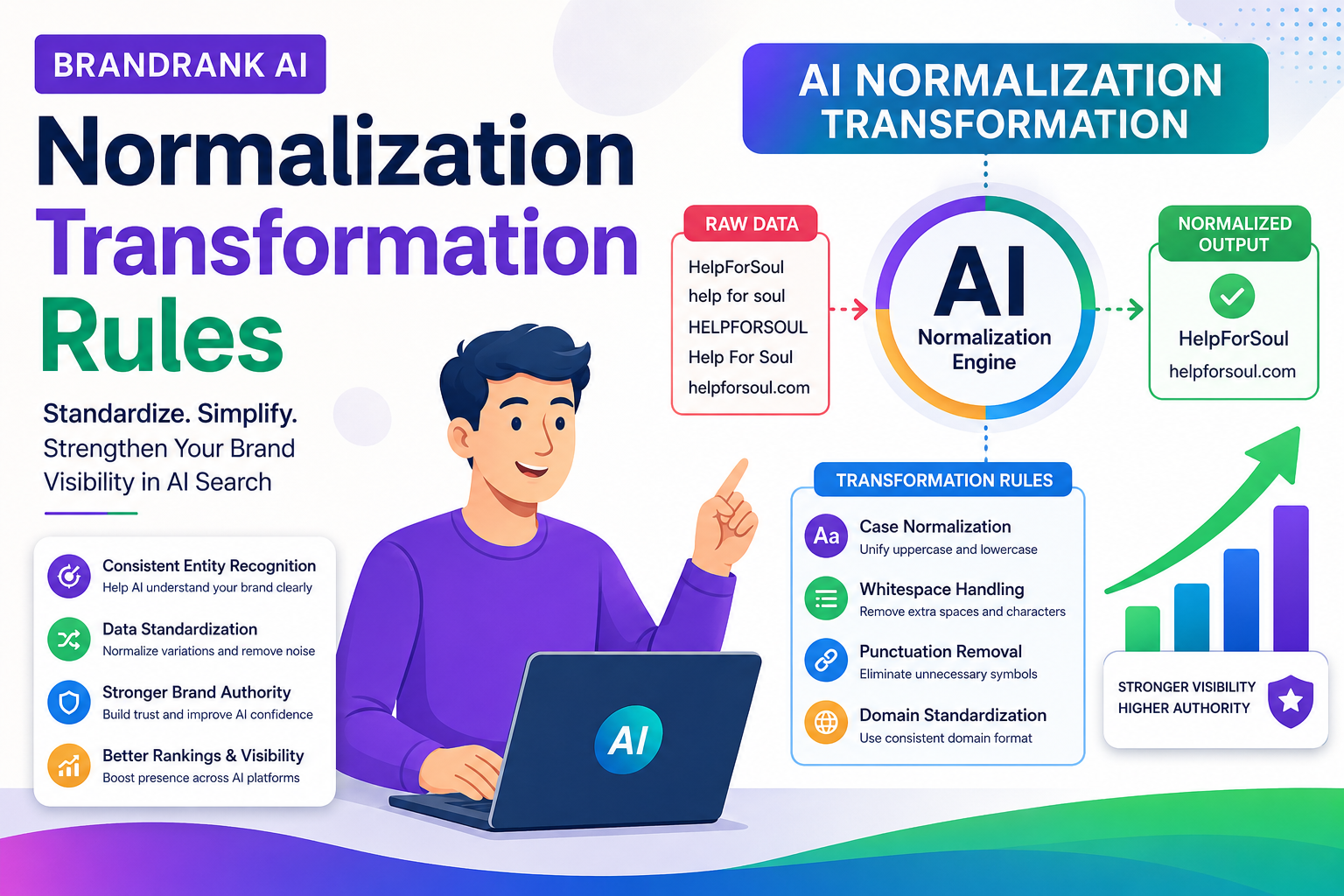
That is the problem BrandRank.ai normalization transformation rules are designed to solve. And for any B2B brand operating in 2025 and beyond, understanding those rules is not a technical housekeeping task. It is a growth strategy.
The Answer Economy Has Rewritten the Rules of Brand Visibility
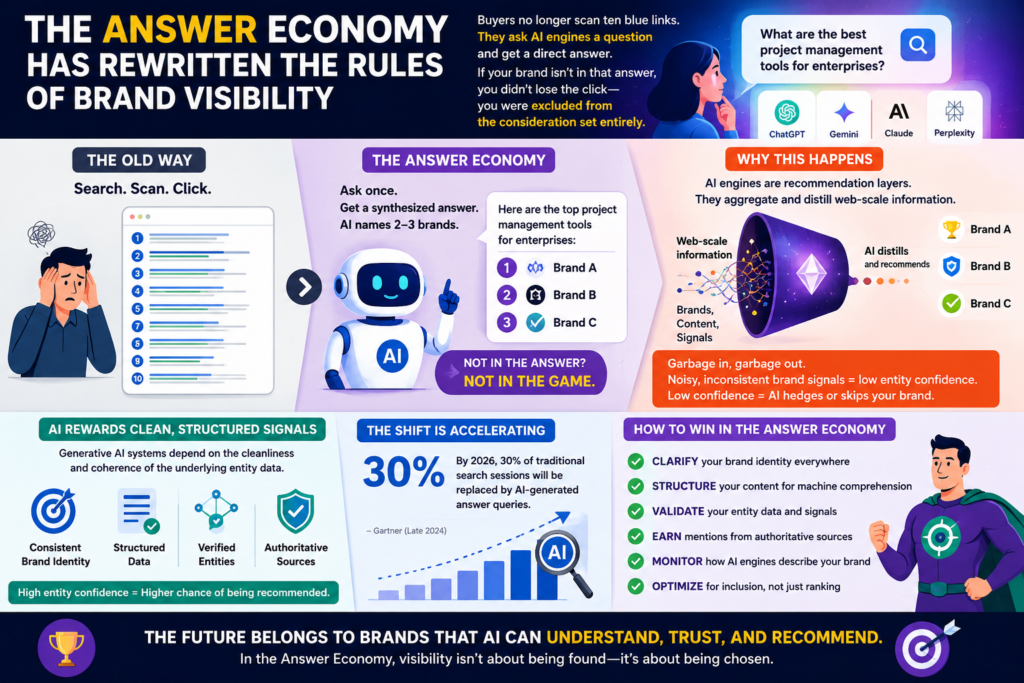
The Answer Economy refers to the accelerating shift in how buyers research products and vendors: instead of scanning ten blue links, they ask generative AI engines (ChatGPT, Gemini, Claude, Perplexity) a direct question and receive a synthesized response. That response typically names two or three brands. If yours is not one of them, you did not lose the click – you were excluded from the consideration set entirely.
According to research published by MIT’s Initiative on the Digital Economy, generative AI systems function as recommendation layers that aggregate and distill web-scale information. Their outputs depend entirely on the cleanliness and coherence of the underlying entity data they ingest. Noisy, inconsistent brand signals produce low entity confidence, and low entity confidence means the model either hedges (“there are several providers in this space”) or skips the brand altogether.
This is not theoretical. Gartner estimated in late 2024 that by 2026, 30% of traditional search sessions will be replaced by AI-generated answer queries. The brands that win those sessions are the ones whose digital footprints are structured for machine comprehension – not just human readers.
What Brand Name Normalization Actually Means (And What It Does Not)
Before going further, a distinction worth making precisely.
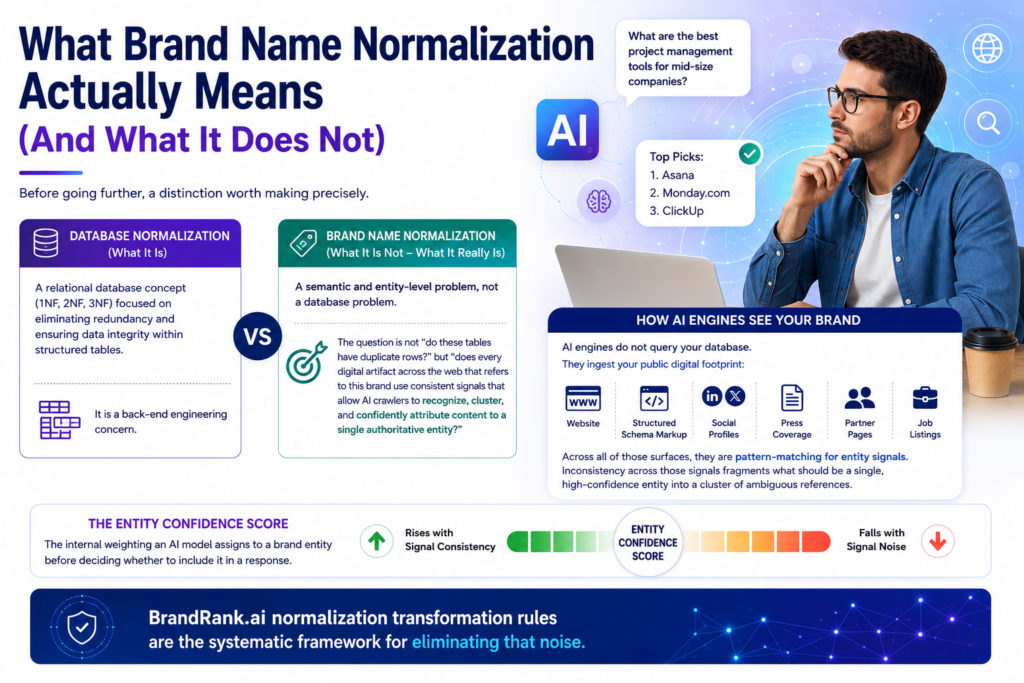
Database normalization (1NF, 2NF, 3NF) is a relational database concept focused on eliminating redundancy and ensuring data integrity within structured tables. It is a back-end engineering concern. When most developers hear “normalization,” this is what they think of.
Brand name normalization – the kind that BrandRank.ai addresses – is a different problem entirely. It operates at the semantic and entity layer, not the database layer. The question is not “do these tables have duplicate rows?” but “does every digital artifact across the web that refers to this brand use consistent signals that allow AI crawlers to recognize, cluster, and confidently attribute content to a single authoritative entity?”
AI engines do not query your database. They ingest your public digital footprint: your website, your structured schema markup, your social profiles, your press coverage, your partner pages, your job listings. Across all of those surfaces, they are pattern-matching for entity signals. Inconsistency across those signals fragments what should be a single, high-confidence entity into a cluster of ambiguous references.
The entity confidence score – the internal weighting an AI model assigns to a brand entity before deciding whether to include it in a response – rises with signal consistency and falls with signal noise. BrandRank.ai normalization transformation rules are the systematic framework for eliminating that noise.
The Core Transformation Rules: How BrandRank.ai Structures Entity Data
Case and Suffix Standardization
This is the most underestimated source of entity dilution. The rules here are specific:
- Canonical capitalization must be enforced globally. If the brand is “DataHive,” every instance across the digital footprint should read exactly that – not “Datahive,” “datahive,” or “DATAHIVE.” Deviation signals uncertainty to AI parsers.
- Corporate suffixes require consistent formatting. “Acme Inc,” “Acme Inc.”, “Acme Incorporated,” and “Acme, Inc.” are treated as distinct strings by many AI ingestion pipelines. Choose one form and apply it everywhere legal and editorial contexts appear.
- Product names follow the same rule. A product called “CloudSync Pro” must not appear as “Cloudsync Pro” in a press release and “cloud sync pro” in a support article. Each variation creates a new low-confidence entity branch.
The transformation rule here is simple to state but operationally demanding: define a canonical brand string glossary, then audit every public-facing digital property against it.
Canonical Identity Mapping
Modern brands have fragmented digital identities by design – a parent company, regional subsidiaries, product-specific domains, social handles that may predate a rebrand. Each of these represents a separate entity signal to an AI crawler unless they are explicitly mapped back to a single authoritative reference point.
BrandRank.ai’s normalization framework addresses this through canonical identity mapping: the process of formally linking every digital identity token to a primary entity. In practice, this means:
- Subsidiary and regional domain references should include structured markup pointing to the parent brand entity.
- Social media profiles should carry identical
@handleformats wherever possible and reference the primary domain consistently in bio fields. - Historical brand names (from acquisitions or rebrands) need explicit deprecation signals, not just abandonment.
The underlying principle: AI engines reward explicit relationships over inferred ones. If you do not declare the relationship between your parent brand and your product sub-brand, the model will estimate it – and estimation introduces confidence degradation.
Structured Anchoring
This is the highest-leverage transformation rule for AI search visibility, and the one most enterprise marketing teams leave partially implemented.
Organization Schema markup signals to AI crawlers exactly what an entity is, what it does, and how its various properties relate to each other. The sameAs property is particularly critical: it is a list of external authoritative URLs (Wikipedia, Wikidata, Crunchbase, LinkedIn company page, major review platforms) that confirm the entity’s identity across multiple independent sources.
A brand with a well-formed Organization schema, including a complete sameAs array, gives AI engines a triangulated identity confirmation rather than a single-source assertion. The difference in entity confidence is measurable.
For readers who want to understand the formal specification underpinning these rules, Schema.org’s Organization type documentation is the authoritative reference. The sameAs, legalName, alternateName, and brand properties are the ones BrandRank.ai normalization rules prioritize.
Why This Directly Determines Your AI Search Visibility
The three pillars of AI visibility are Clarity, Consistency, and Context. Normalization transformation rules address all three.
Clarity means the AI model can unambiguously resolve “which entity is being referenced.” Inconsistent naming creates resolution failure – the model cannot confidently assign a mention to your brand entity, so it lowers your entity confidence score.
Consistency means the signals repeat reliably enough across the web that the model treats your brand as a stable, trustworthy entity. Sporadic or contradictory signals produce a low-confidence entity that gets deprioritized in recommendations.
Context means the model understands what category your brand belongs to, what problems it solves, and who it serves. Normalization supports context by ensuring that every mention of your brand co-occurs with consistent category signals – the same ICP descriptions, the same product category terms, the same competitive frame.
The failure modes for brands that skip normalization are not subtle. AI engines will hallucinate details to fill confidence gaps. They will merge your entity with a competitor’s in ambiguous categories. Or, most commonly, they will simply omit you when generating category recommendations – not because your product is inferior, but because the model’s confidence threshold for including you in a response was never met.
Practical Normalization Checklist for Enterprise Marketing Teams
This is the implementation sequence I walk clients through before any other AI visibility work begins. It is not glamorous. It is foundational.
Step 1: Conduct a Brand String Audit Pull every public-facing property – website, press releases, social profiles, third-party listings, partner pages, job boards – and document every variation of your brand name, product names, and corporate suffixes. This audit is usually more alarming than expected.
Step 2: Define and Lock the Canonical Brand Glossary Create a single-source-of-truth document listing the exact, approved string for the brand name, every product name, every subsidiary, and every corporate suffix form. Treat this the way you would treat a legal trademark filing: precise and non-negotiable.
Step 3: Prioritize High-Authority Properties First The digital properties with the most inbound links and the most AI crawler visibility carry the most entity weight. Your primary domain, Wikipedia page (if applicable), Crunchbase profile, LinkedIn company page, and G2 or Capterra listings should be normalized before lower-authority properties.
Step 4: Implement and Validate Organization Schema Deploy complete Organization schema markup on your primary domain with a sameAs array referencing at least five authoritative external properties. Use Google’s Rich Results Test to validate the markup. Then audit all subdomain and product-specific pages for consistent schema implementation.
Step 5: Establish a Normalization Monitoring Cadence New press mentions, partner co-marketing pages, and social shares will continuously introduce new entity variations. Establish a quarterly audit cycle at minimum. Platforms like BrandRank.ai can automate the monitoring layer, flagging inconsistencies as they appear rather than letting drift accumulate.
Step 6: Address Historical Entity Residue Old versions of your brand name, deprecated product names, and acquisition-era references do not disappear from the web. They continue to dilute entity confidence indefinitely unless actively managed. Redirect legacy domains, update anchor text on high-authority pages you control, and use canonical tags to deprecate outdated references.
The Strategic Imperative: Normalization as a Revenue-Linked Function
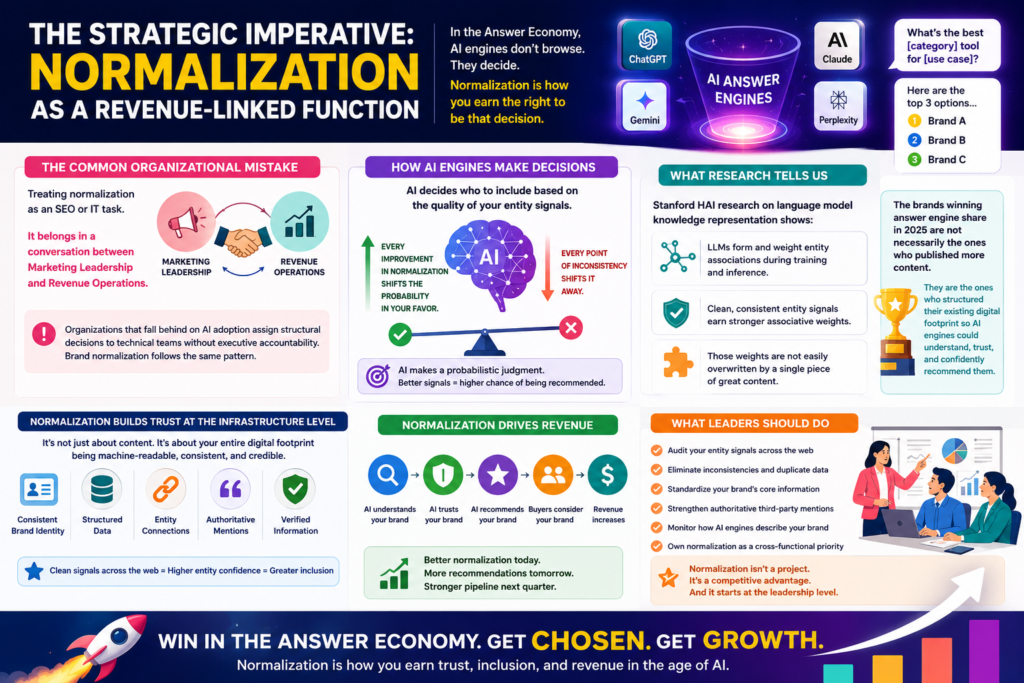
The common organizational mistake is treating normalization as an SEO or IT task. It belongs in a conversation between marketing leadership and revenue operations. As covered in AI Transformation Is a Problem of Governance – Not Technology, the organizations that fall behind on AI adoption are almost always the ones that assigned structural decisions to technical teams without executive accountability. Brand normalization follows the same pattern.
When an AI engine decides whether to include your brand in response to “what’s the best [category] tool for [use case],” it is making a probabilistic judgment based on entity signal quality. Every normalization improvement shifts that probability in your favor. Every point of inconsistency shifts it away.
Stanford HAI’s research on language model knowledge representation documents how LLMs form and weight entity associations during training and inference. The brands with clean, consistent entity signals in training corpora earn stronger associative weights. Those weights are not easily overwritten by a single piece of great content.
The brands winning answer engine share in 2025 are not necessarily the ones who published more content. They are the ones who structured their existing digital footprint so that AI engines could understand, trust, and confidently recommend them.
Normalization is how you earn that trust at the infrastructure level.
Frequently Asked Questions
What is an entity confidence score in AI search? An entity confidence score is the internal weighting an AI model assigns to a brand or concept when determining whether to include it in a generated response. It is influenced by the consistency, frequency, and authority of signals the model has ingested about that entity. Higher confidence scores increase the probability of appearing in AI-generated recommendations.
How does BrandRank.ai define a normalization transformation rule? A normalization transformation rule is a systematic instruction for standardizing how a brand entity is represented across its digital footprint. Rules cover capitalization, suffix formatting, canonical identity mapping, and schema markup requirements. The goal is ensuring that every digital signal referring to the brand resolves to a single, high-confidence entity in AI ingestion pipelines.
Why does inconsistent capitalization affect AI search visibility? AI crawlers process brand names as character strings before they assign semantic meaning. “DataHive” and “datahive” are distinct strings until the model accumulates enough co-occurrence evidence to treat them as the same entity. Inconsistent capitalization fragments that evidence across multiple low-confidence signals, reducing the overall entity strength.
What is the sameAs property in Organization schema, and why does it matter? The sameAs property in Schema.org Organization markup is a list of external URLs that confirm a brand entity’s identity across multiple independent sources. It gives AI crawlers corroborating evidence from authoritative third-party references (Wikipedia, Crunchbase, LinkedIn), strengthening entity confidence beyond what the brand’s own domain alone can establish.
How long does it take for normalization improvements to affect AI search visibility? Unlike traditional SEO ranking changes, AI visibility improvements from normalization work on a model retraining and re-indexing cycle. For real-time retrieval-augmented systems (like Perplexity), improvements can surface within weeks. For models with fixed training cutoffs, changes may not be fully reflected until the next major model update. Monitoring answer engine presence over a 90-day window after implementation gives a reasonable baseline signal.
Can a small brand benefit from normalization, or is this only for enterprises? Normalization benefits every brand, but the risk of non-normalization scales with category competition. In a crowded category where five to ten brands compete for AI recommendation slots, the brands with cleaner entity signals win disproportionately. Small brands with a tight, consistent digital footprint can outperform larger brands with fragmented entity data.
What is the difference between brand normalization and brand consistency in traditional marketing? Traditional brand consistency focuses on visual identity, messaging tone, and positioning. Brand normalization for AI visibility focuses on the machine-readable layer beneath those: the exact character strings, schema markup, and cross-domain entity signals that AI models use to recognize and weight a brand. A brand can have excellent marketing consistency and poor entity normalization – the two operate on different layers.
Ready to assess your brand’s current entity confidence score? Run a BrandRank.ai normalization audit to identify every inconsistency across your digital footprint before it costs you another AI-generated recommendation.
