


By a wildlife photography enthusiast who has done both trips and made the expensive mistakes so you don’t have to.
You have five days in November, ₹50,000, and two of India’s most legendary national parks calling your name. Jim Corbett or Ranthambore?
Most guides hand you a tidy verdict: “Ranthambore for tigers, Corbett for diversity.” Then they move on. That’s not enough.
What actually separates these two parks, for a photographer specifically, in November specifically, on a tight budget, is far more nuanced. Let’s break it down properly.
Comparing Corbett and Ranthambore for a 5-day wildlife photography trip in November on a ₹50,000 budget isn’t just about tiger sighting probability. It’s about light quality, zone strategy, gear trade-offs, and what kind of images you want to come home with.
Why November Is the Best Month for Wildlife Photography in Both Parks
Here’s what most articles mention but never actually explain: November isn’t just “a good month.” It’s arguably the single best month for wildlife photography in both parks. The reasons, though, are completely different for each.
Ranthambore in November
At Ranthambore, the post-monsoon lakes are still full. That means prey animals like sambar, nilgai, and chital cluster around the water. And where prey clusters, tigers follow.
According to the Wildlife Institute of India, Ranthambore’s core zones, especially Zone 3 and Zone 4, see tiger sighting rates climb significantly in October and November compared to the dry summer months.
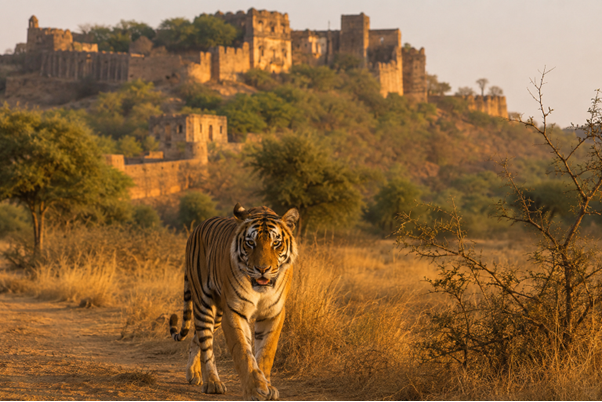
The light is extraordinary too. Golden-hour windows stretch from roughly 6:15 to 7:30 AM. The low winter sun creates warm side-lighting that makes tiger coats look like they’re glowing. Dust haze from Rajasthan’s scrublands adds a cinematic softness to backgrounds that you simply cannot replicate in post-processing.
Corbett in November
Corbett offers something entirely different: mist.
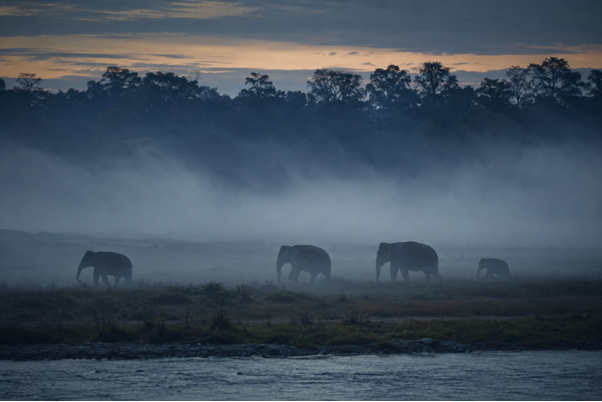
The Dhikala zone, the one photographers obsess over, sits inside a vast chaur (open grassland) flanked by sal forests. In November, morning mist rolls off the Ramganga River until around 8 AM. That window is absolutely otherworldly for atmospheric, layered shots. You are not just photographing animals. You are photographing a mood.
Temperatures sit between 10°C and 24°C, which means elephants stay active all day rather than retreating into shade.
One more thing worth noting: Corbett’s November crowds are noticeably lighter than Ranthambore’s. The peak-season rush hasn’t fully hit yet, so there is less jeep traffic competing for space at a sighting.
Photography Style First. Then Choose Your Park.
Most guides ask “which park is better?” That’s the wrong question entirely.
The right question is: what kind of photographer are you?
Choose Ranthambore for the Trophy Shot
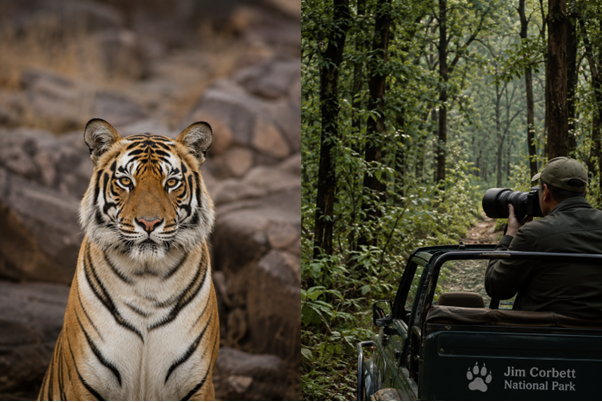
If you are chasing a tiger in the open, ideally mid-stride or at a water body with clean backgrounds, Ranthambore is your park. Full stop.
The open scrub terrain, rocky outcrops, and the iconic Ranthambore Fort backdrop give you compositions that look like they belong in National Geographic. Tigers like T-84 (Arrowhead) built their legend here because they are visible. The park’s well-known tigers, including Krishna (T-19) and Riddhi (T-124), are relatively habituated to safari vehicles. You can spend 20 minutes with a tiger instead of 20 seconds.
Choose Corbett for a Full Portfolio
If you want a portfolio rather than a single hero image, Corbett wins.
In five days at Corbett, a patient photographer can realistically capture wild elephants, gharial on the Ramganga riverbank, great hornbills, kingfishers, otters, and yes, tigers too. It is harder, messier, and more unpredictable. For photographers who want storytelling variety, that’s a feature, not a flaw.
The Corbett National Park official site lists over 650 bird species within park boundaries. A bird photographer could spend all five days in Dhikala alone and never run out of subjects.
A simple framework: Think of Ranthambore as a portrait studio and Corbett as an open newsroom. One gives you controlled, dramatic set-pieces. The other throws breaking stories at you from every direction.
The ₹50,000 Budget: What It Actually Gets You
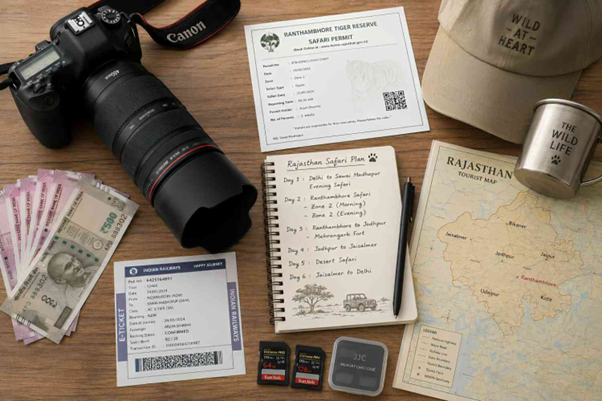
This is where most comparison guides go vague. Here’s a specific, realistic breakdown for each park.
Ranthambore: 5-Day Budget Estimate
| Item | Estimated Cost |
| Train (3AC, round trip from Delhi) | ₹2,800 to ₹3,500 |
| Budget guesthouse near Sawai Madhopur (4 nights) | ₹6,000 to ₹8,000 |
| 6 safaris (shared Canter, Zones 2 to 5) | ₹9,000 to ₹11,000 |
| Meals (local dhabas and hotel breakfast) | ₹3,500 to ₹4,500 |
| Park entry, camera fees, and tips | ₹2,500 to ₹3,000 |
| Total | ₹23,800 to ₹30,000 |
That leaves ₹20,000 or more as a buffer. The smart move is to upgrade two or three safaris to a private jeep, which costs around ₹4,000 to ₹5,000 per safari. For photographers, this is genuinely worth it. You control the position, the timing, and the silence.
Rajasthan Tourism reports that Ranthambore receives over 400,000 visitors annually. On a shared Canter during peak periods, you could have 20 people jostling for the same shot. A private jeep is a game-changer.
Corbett: 5-Day Budget Estimate
| Item | Estimated Cost |
| Train (3AC, round trip from Delhi) | ₹1,800 to ₹2,400 |
| Budget accommodation in Ramnagar (4 nights) | ₹5,000 to ₹7,000 |
| 6 jeep safaris (Bijrani or Jhirna zones) | ₹12,000 to ₹16,000 |
| Meals | ₹3,500 to ₹4,500 |
| Park entry, camera fees, and tips | ₹3,000 to ₹4,000 |
| Total | ₹25,300 to ₹33,900 |
Corbett’s safari system runs almost exclusively on private jeeps with a maximum of four to six people. So you are already in better shooting conditions by default.
The catch? Dhikala, the crown jewel zone, requires a minimum two-night stay at the forest rest house, booked through the Forest Department’s online portal. Those rooms disappear months in advance. Budget ₹2,500 to ₹3,500 per night for the rest house. Miss Dhikala, and you have missed what makes Corbett worth it.
Both parks fit comfortably within ₹50,000 if you book trains and safari permits at least 45 to 60 days ahead. November is peak season. Do not leave this to chance.
Zone Strategy: The Part Nobody Tells You
Picking the right park is step one. Picking the right zones within that park is where photographers actually win or lose.
Ranthambore Zone Guide
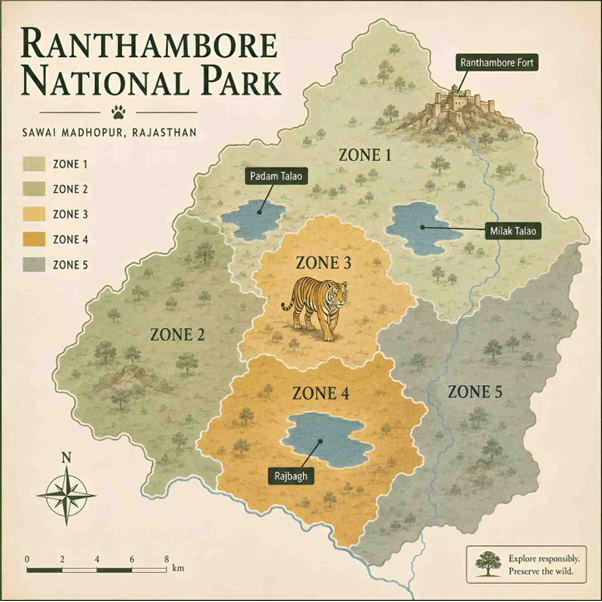
Zone 3 (Rajbagh-Milak area) and Zone 4 (Kachida Valley) are the November sweet spots.
Zone 3 features three interconnected lakes, Padam Talao, Milak Talao, and Rajbagh, that attract tigers reliably throughout the season. Zone 4 is less crowded and occasionally rewards visitors with leopard sightings as a bonus.
Avoid Zones 1 and 2 for tiger photography. They’re dominated by large tour groups, and the sighting density doesn’t justify the cost.
Corbett Zone Guide
Start with Dhikala if you can get the booking. It’s worth every rupee and every booking-refresh headache.
Bijrani is easier to book and excellent for both tigers and elephants. Jhirna is the only zone open year-round and has a slightly higher success rate for sloth bear sightings.
For a 5-day trip, the ideal split is two nights at Dhikala and two nights with Bijrani access, covering six to seven safaris across both zones. That variety gives your portfolio real depth.
Gear and Light: Going Deeper Than “Bring a 400mm”
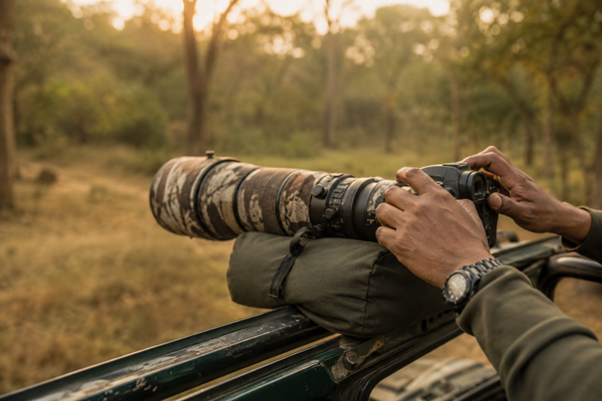
Alt text: Wildlife photographer using a telephoto lens with bean bag support on a safari jeep in an Indian national park
Most guides stop at lens recommendations. Here’s what the light actually demands from your kit.
Shooting at Ranthambore
Ranthambore light turns harsh by 10 AM. Your real golden window is 6:15 to 8:00 AM. After that, the Rajasthan sun creates heavy shadows and blows out highlights on lighter-coated prey animals.
You need a lens with fast, reliable autofocus. The AF system matters far more than megapixels here. A Sony A9 or Canon R5/R7 will track a moving tiger through scrub far better than older bodies. A 100 to 400mm zoom covers both tight portraits and environmental context shots well.
Always use a bean bag on the jeep’s side rail. It is your tripod.
Shooting at Corbett
Corbett light is softer and more forgiving overall. But the dense sal canopy means you will regularly shoot at ISO 3200 to 6400 in the forest interior. Test your camera’s high-ISO performance before you travel.
The upside: that soft, diffused forest light makes bird plumage look exceptional. A 500mm prime or a 200 to 600mm zoom will reward your patience if you have the reach.
Universal tips for both parks:
● Carry at least twice as many memory cards as you think you need.
● Always use your camera’s electronic or silent shutter mode. Tigers in Ranthambore tolerate vehicles, but in Corbett’s denser terrain, shutter noise can spook an animal mid-composition.
Frequently Asked Questions
Which park gives better tiger sighting chances in November?
Ranthambore has a higher sighting probability, largely because its open terrain makes tigers visible even when they are simply resting near water. Corbett’s tigers exist in similar numbers but hide more effectively in dense forest cover. For photographers, a Ranthambore sighting also tends to last longer and offer cleaner, less obstructed frames.
Is ₹50,000 enough for 5 days at either park?
Yes, comfortably, as long as you book trains and safaris in advance. Both parks can be managed between ₹25,000 and ₹35,000 for a solo traveler including accommodation, safaris, food, and travel from Delhi. Upgrading to private jeeps and mid-range stays brings the total to ₹40,000 to ₹45,000.
Can I visit both parks in one trip?
Technically yes, but it doesn’t work well in practice. Ranthambore is in Rajasthan and Corbett is in Uttarakhand. Travelling between them eats a full day in each direction and cuts your actual safari time in half. Five days at one park is significantly better than three days at one and two at the other.
Which park is better for bird photography?
Corbett, without question. With over 650 bird species including the pied kingfisher, great hornbill, and various Himalayan species, it offers serious ornithological range. Ranthambore has strong waterbird populations around its lakes, including painted storks and cormorants, but the overall variety is not comparable.
What if I am a first-time safari photographer?
Start with Ranthambore. The open terrain, longer sightings, and predictable tiger behaviour around the lakes are far more forgiving for someone still learning to track fast-moving subjects through a telephoto lens. Corbett rewards experience and patience.
Do I need to book in advance, or can I get permits at the gate?
Book in advance. Do not try to walk in during November. Online booking through the Rajasthan Forest Department portal for Ranthambore and the Uttarakhand Forest Department portal for Corbett is mandatory. Popular zones fill up 30 to 60 days ahead. Turning up without a permit in peak season means a wasted trip.
The Honest Verdict
Here is the bottom line, stated plainly.
Choose Ranthambore if you want the highest probability of tiger shots that will genuinely stop people mid-scroll. The open terrain, iconic fort backdrop, and habituated tigers give you frame-worthy images even on an average day. For a budget photographer who needs compelling wildlife images from their first major trip, Ranthambore delivers more consistently.
Choose Corbett if you are building a long-term portfolio and want variety that tells a fuller story of Indian wildlife. The mist, the elephants, the birds, the riverside gharials. It is messier and less predictable, but the ceiling on creative image-making is higher for a skilled photographer willing to put in the patience.
And if you want my honest personal take? In November, on a ₹50K budget, with just five days, Ranthambore is the smarter strategic choice.
But Corbett is the one I keep going back to.
Share your Corbett or Ranthambore shots in the comments. Would love to see what November light looks like through your lens.
